

Valaška: the shepherd's axe that became Jánošík's emblem
A long shaft, a small blade: the valaška went with Carpathian shepherds from the time of the Wallachian colonisation. Only the legend turned it into Jánošík's magic axe.
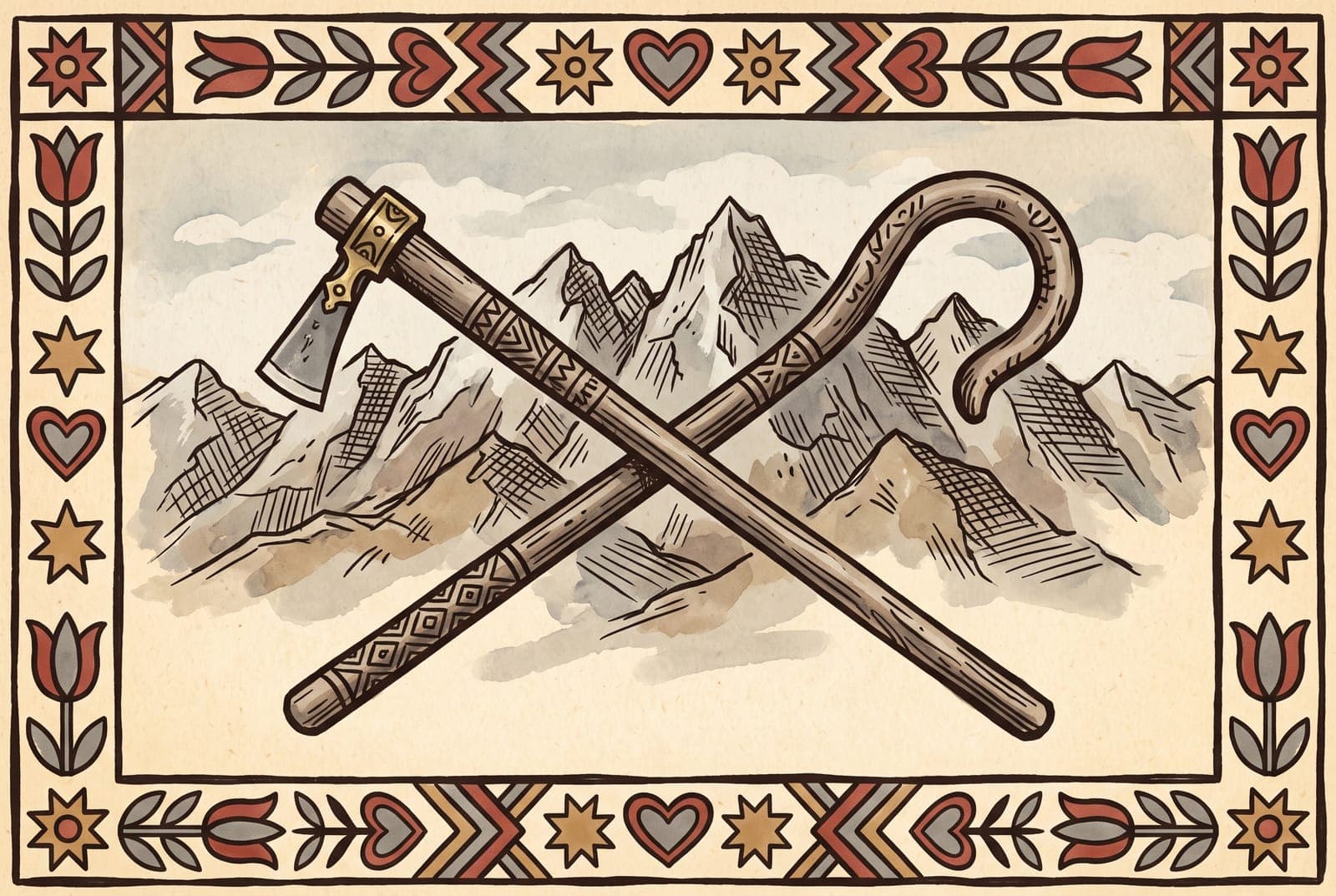
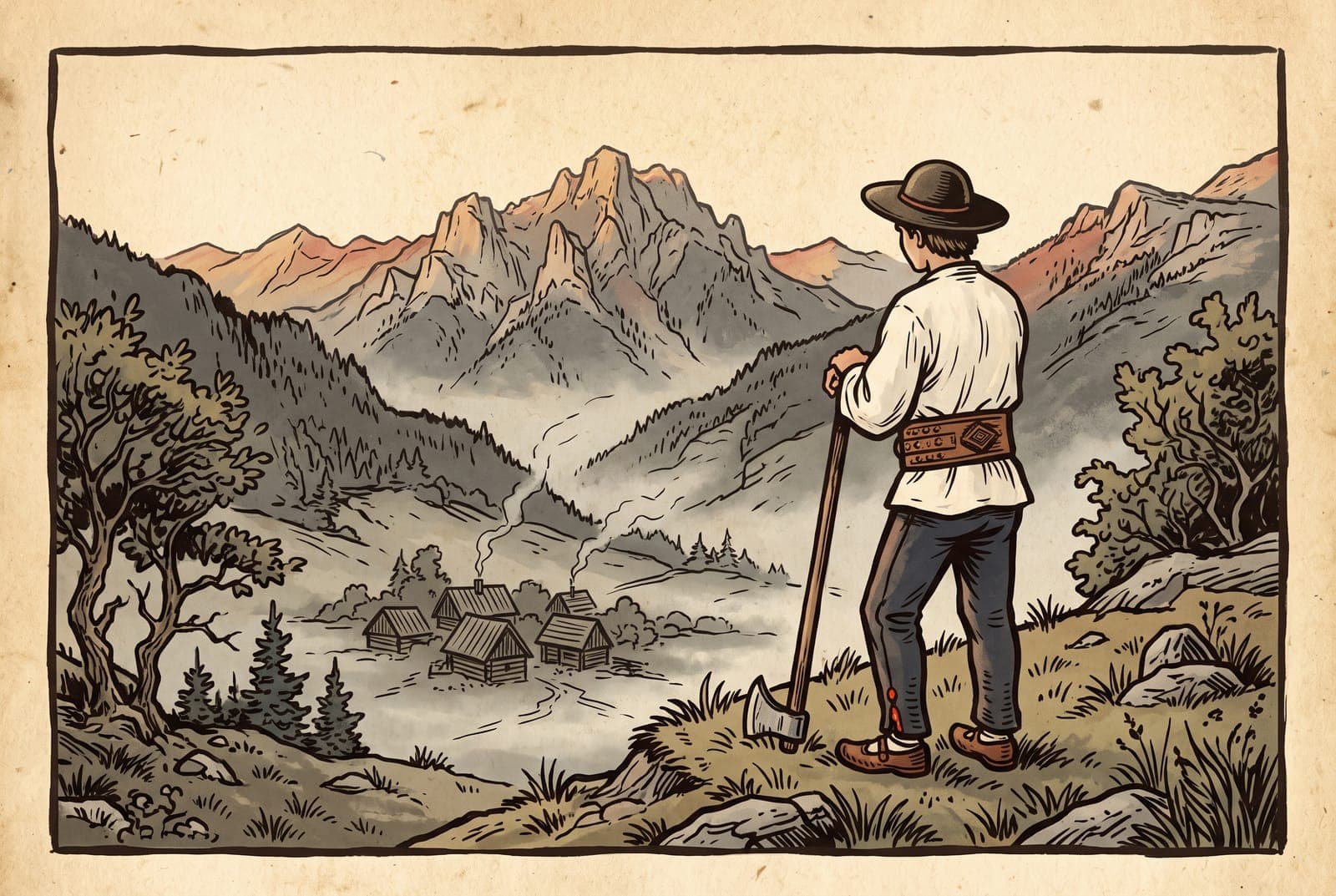
The valaška is a light, slender axe with a small blade on a long shaft, usually a little over a metre long. Carpathian shepherds used it as a walking staff, a working tool and a weapon all at once; its name goes back to the Valasi, the Wallachian pastoral settlers12. Juraj Jánošík carried one, as did practically every outlaw of his day – it was only in legend that it became a magic axe that strikes by itself712.
Anyone who opens janosik.de sees it straight away in the logo: an axe with a long shaft. Few objects are so firmly tied to Jánošík. Behind the symbol, though, lies a thoroughly everyday tool from the world of sheep farmers, mountain huts and highland forests. This article keeps the two apart: what ethnography and court records know about the valaška – and what storytellers later made of it.
What is a valaška?
The Slovak encyclopaedia of folk culture published by the Centre for Traditional Folk Culture defines the valaška briefly as “a hatchet with a longer handle – a support, defensive and work tool”1. That threefold role is what defines it. On steep ground the shepherd leaned on the long shaft as on a walking stick. With the blade he lopped branches, chopped wood and cleared pasture. And when it came to it, it served for defence – as a weapon12.
Its shape is distinctive: a long, light shaft, usually a little more than a metre, topped by a small, narrow blade2. There is a widely repeated explanation for the long shaft: carrying axes was at times restricted, and an axe with a tiny head could be concealed – the shaft passed for a walking stick2. Whether that was the only reason, the sources do not say; for people who spent whole days in the mountains, the shape was practical in any case.
Documented The earliest known written mention of the valaška dates from 1692: a price list for craft products from Zvolen county. Jánošík had been baptised four years earlier, in 1688.17
The valaška was more than a tool. It showed that its owner belonged to the shepherds' community; young shepherds were initiated into that community with it, and families engraved their own marks on the blade3. An axe was therefore also a kind of identity card – you could tell whose it was.
Origins: the Wallachian colonisation
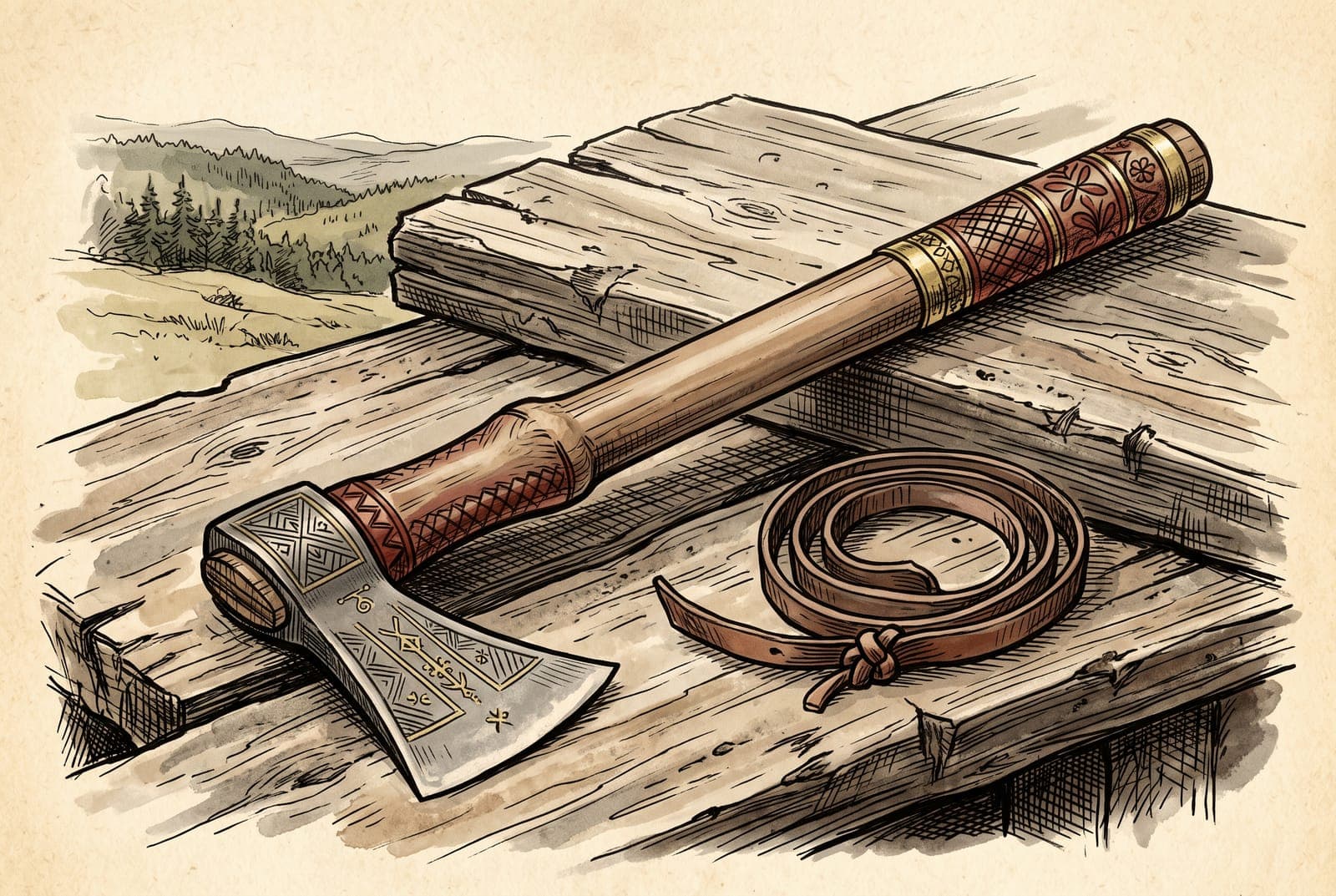
The name gives away its origin. Valaška derives from the Valasi – the “Vlachs” or Wallachians, pastoral settlers who spread along the Carpathian arc23. Between the 14th and 17th centuries they settled the mountain regions of northern and central Slovakia under what was known as Wallachian law (valašské právo). The first groups were of Romanian and Ruthenian origin; later settlers were mostly local Slovaks, Poles and Ruthenians. The movement reached Gemer, the upper Hron valley, Liptov, Orava and the Trenčín region4.
The settlers were at first exempt from taxes. After that they owed the landlord a twentieth of their sheep, plus dues on cattle, cheese, bryndza, game, leather and homespun cloth. They did guard duty and later forest work; their villages were headed by hereditary judges called šoltýs or vajda. By the 17th century the Wallachian settlers had largely merged with the rest of the village population4.
Jánošík's home is part of this story too: Terchová, beneath the peaks of the Malá Fatra, was founded as a Wallachian settlement5. The boy baptised in the parish of Varín in 1688 thus grew up in a village whose roots lay in the very shepherd culture that produced the valaška57.
Life on the salaš: bryndza and žinčica
The heart of this culture was the salaš, in the words of Slovak ethnography “the basic productive and economic unit of Wallachian sheep-herding in the Carpathians”. It comprised shelters for the shepherds, rooms for making cheese and pens for milking and for the night. The word itself has travelled far: from Turkish salaš or Tatar šalaš by way of Hungarian szállás6.
The salaš produced foods still regarded as typically Slovak. Bryndza, a mixed, salted sheep's cheese, arrived with the Wallachian colonisation; in early times it was packed into sheepskins and smoked. The first bryndza factory did not open until 1787, in Detva – long after Jánošík's death10. The whey left over from cheese-making became žinčica, a sourish drink11. Then there was oštiepok, a cheese the court records name explicitly among outlaws' loot7.
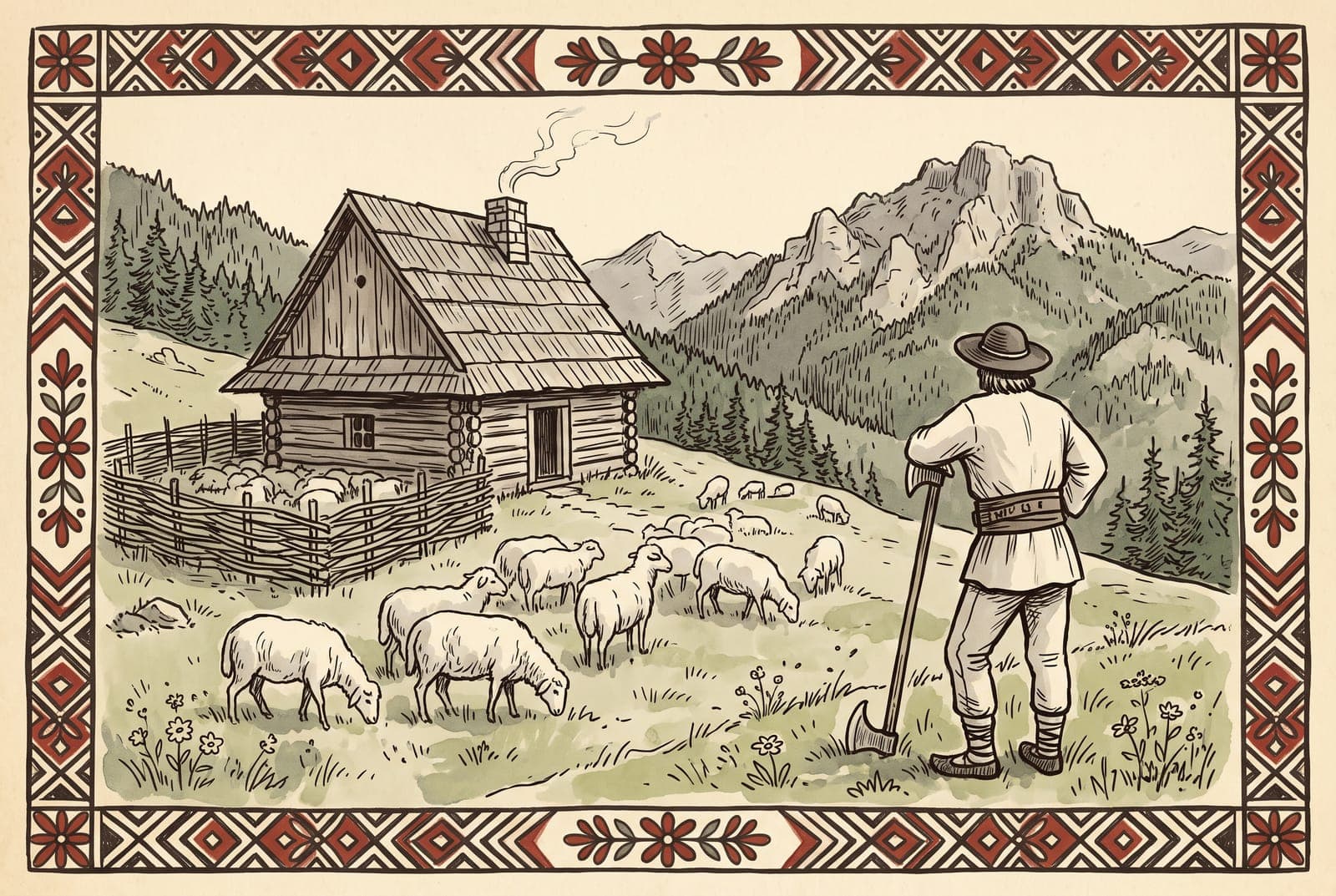
For the outlaws the salaš was both larder and target. Liptov court records of the 18th century name salaše as the most frequent target: bands took sheep, cheese, bryndza and oštiepky, and from one salaš near Hybe about twelve lumps of cheese. Such visits were usually not very violent7. For Jánošík himself, a route through the salaše of Revúca, Likavka, Bobrovec, Porúbka, Hybe and Važec is documented, with a sheep slaughtered at each7. An Orava band of 1735 spent the summer in the forest and went to the salaše, “where the shepherds gave them food and sometimes lodging”; in winter the men dispersed7.
Small wonder, then, that outlaws and shepherds looked so alike: most outlaws whose background the records give were shepherds – valasi and bačovia – followed by farmhands and a few former soldiers, mostly aged between 20 and 407.
Outlaw dress and weapons – what the court records say
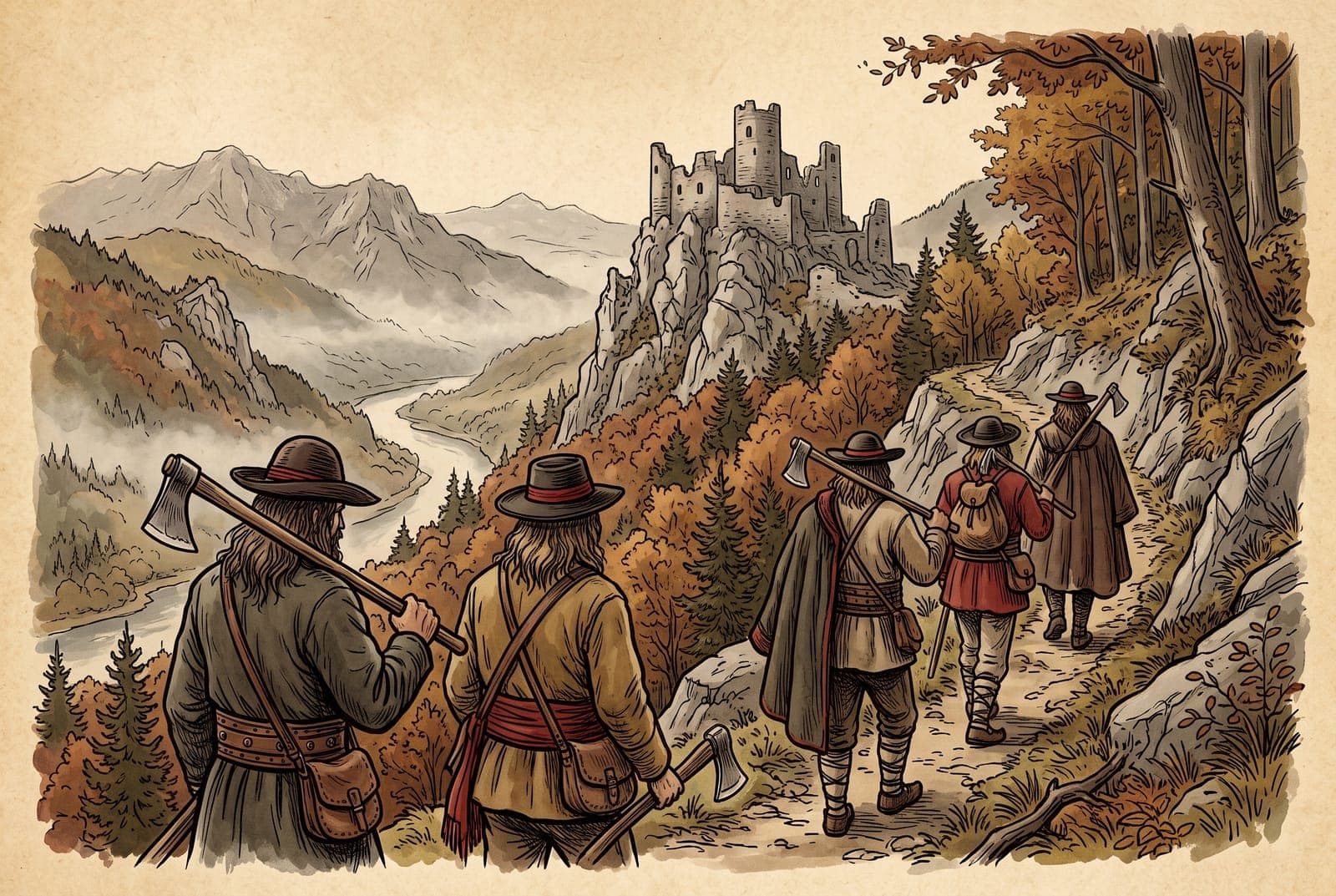
What did an outlaw look like? For Jánošík himself, the sources we have worked with give no description of his clothing. Records of other Liptov trials from somewhat later are telling, however7. In 1743 Matej Garaj is described wearing trousers, a hat, krpce and a coat called a širica, with a shoulder bag (tanistra) and a powder flask of deer horn slung over his shoulder. In 1782 the band of Michal Mlynarčík wore black “Wallachian” shirts and white decorated trousers made to order, and hats bound with red cloth, trimmed in white and red; the leader wore a silver ring and a belt7.
Ethnography knows the two key items independently of the outlaws. The opasok was a wide belt of folded smooth leather with metal clasps, embossing, studs and a pocket. It protected the body during heavy work, and shepherds wore it longest8. Krpce were low shoes of pig or cow leather, tied with straps and worn with linen footcloths or woollen stockings – in the mountains they remained working footwear into the early 20th century9.
And the weapons? Here the records are matter-of-fact. Every outlaw had a valaška or axe and a knife; some had long knives or sabres. Then came firearms: “flinty” (flintlocks), “karabíny” (carbines), the larger “mordárka” and pistols. In large bands every member might own at least one gun or pistol, while small bands sometimes had no firearm at all7. Weapons were stolen or bought; in one raid on a salaš a band seized carbines and a pistol7.
| Item | Purpose | Source |
|---|---|---|
| Valaška or axe | support, tool, weapon | 17 |
| Knife, long knife, sabre | weapon | 7 |
| Flintlocks, carbines, “mordárka”, pistols | firearms, common in large bands | 7 |
| Opasok (wide leather belt) | protecting the body during heavy work; pocket | 8 |
| Krpce (leather shoes) | working footwear in the mountains | 9 |
| Hat bound with red cloth | headwear, decoration (Mlynarčík band, 1782) | 7 |
| Black “Wallachian” shirt, white decorated trousers | clothing (Mlynarčík band, 1782) | 7 |
| Širica, tanistra, deer-horn powder flask | coat, shoulder bag, gunpowder (Matej Garaj, 1743) | 7 |
So the valaška was not the outlaws' only weapon, but according to the records it was the only one that truly everyone carried. A case from Liptov shows how much it meant to a band: the members knelt in the forest on a Sunday, laid two fingers on an axe and swore never to betray the band, not even under torture7.
The valaška in legend
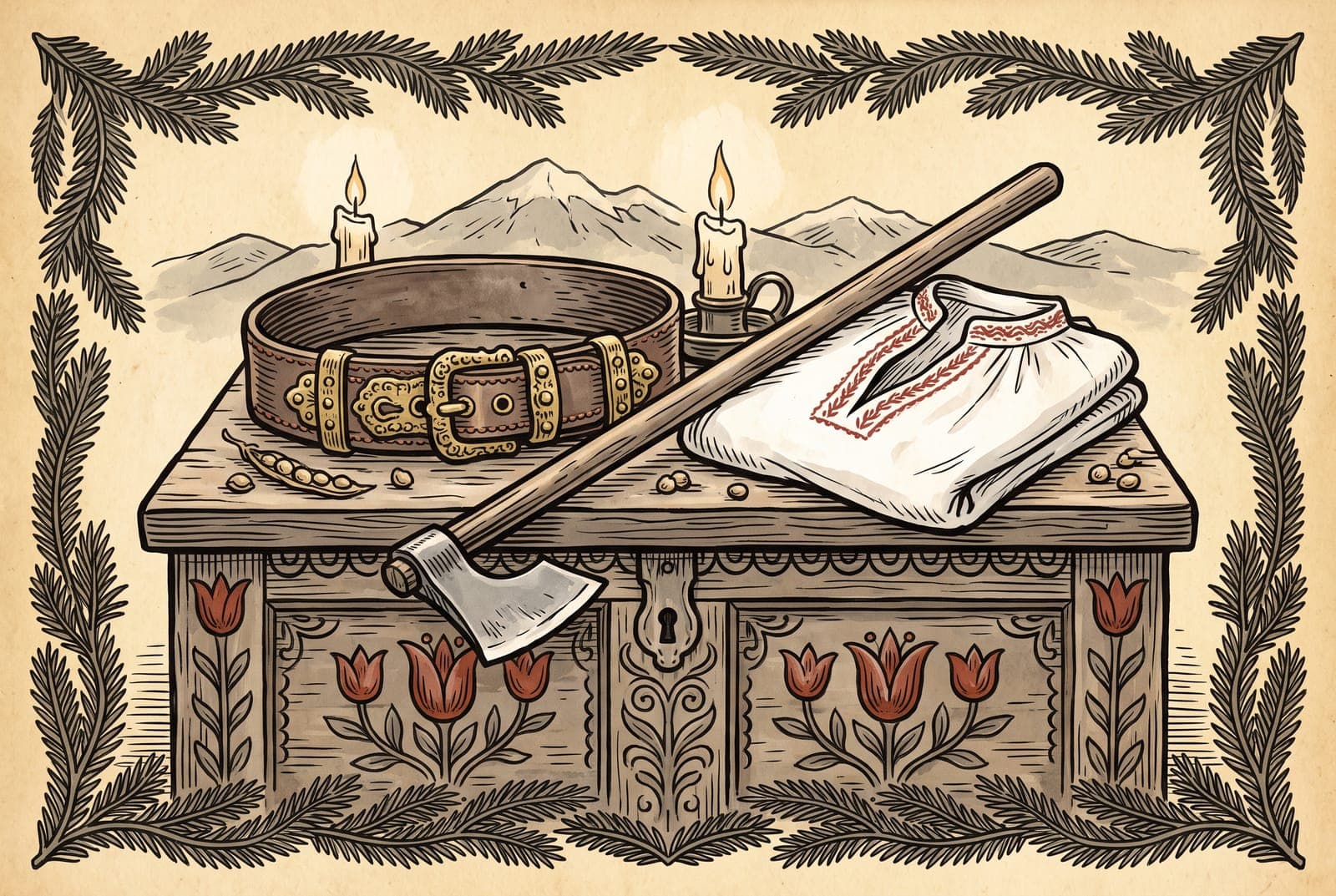
What the court records list soberly as a tool, folk tradition turned into magic. In many variants supernatural beings – rusalky, fairies (víly), witches, old women, a talking snake, sometimes the devil – test the young Jánošík's courage or kindness. Then they give him three objects: a shirt that grants superhuman strength or invisibility, a belt that makes him invulnerable, and a valaška that strikes by itself on command712.
Legend The magic axe belongs to a fixed pattern of folk storytelling: three donors, three gifts, plus seven years' service to a witch and a band of twelve. Such number magic is typical of fairy tales.712
In the legend the valaška is also the key to his downfall. In many versions Jánošík can be overpowered only after a lover or a traitor has cut his magic belt or hidden his valaška – only then does an old woman in the tavern scatter peas under his feet12. The folk formula runs: “Rúbte mu do pása, tam je jeho spása” – “Strike at his belt, that is where his salvation lies”712. This also explains why the legends gave the opasok magic powers8. Another motif tells that Jánošík won the leadership of the band in a valaška-throwing contest12.
None of this is history. What is documented is the trial: the court of Liptov county tried Jánošík in March 1713 in Liptovský Mikuláš; his interrogation survives only in a copy made in 18447. The diagram shows how the main motifs stand up against the sources.
Dance, film and image
The valaška is most alive in dance. It is central to the outlaw and shepherd dances; the outlaws themselves are said to have used it when dancing2. In Moravian Wallachia (Valašsko), across today's border, it is an integral part of the odzemek dance3.
In literature, film and the visual arts a canonical image of Jánošík took hold: belt, valaška and hat. It was shaped above all by Martin Frič's 1935 film starring Paľo Bielik, which shows exactly this outfit12. Ever since, Jánošík has been recognisable in illustrations, on stage and on screen by these three things – there is no authentic portrait of him.
The valaška as a symbol today
Today the valaška stands for several things at once: the shepherd culture of the Carpathians, the folk-dance tradition and Jánošík himself. So the axe in this website's logo is not an instrument of murder but a piece of everyday culture that the legend turned into an emblem of freedom. Respecting the legend, however, also means not confusing it with history: the historical Jánošík lived in a world in which the valaška was part of every outlaw's basic kit – alongside the knife and, in larger bands, firearms7.
Disputed You will often read online that the valaška is “UNESCO heritage”. Slovak Wikipedia and a Czech online magazine say so, but neither names a list or a year23. We could find no corresponding entry. Until it is documented, the claim stands as unconfirmed.
Frequently asked questions
What is a valaška?
A valaška is a light axe with a small, narrow blade on a long shaft, usually a little over a metre long. Carpathian shepherds used it as a walking stick, a tool and a weapon. Its earliest written mention dates from 1692.12
Where does the name valaška come from?
The name derives from the Valasi (Vlachs), pastoral settlers who spread along the Carpathian arc. Between the 14th and 17th centuries they colonised the mountains of present-day Slovakia under Wallachian law.24
Did Jánošík really have a magic axe?
No. The valaška that strikes by itself on command is a folk-tale motif, like the magic shirt and the magic belt. Historically, Jánošík carried an ordinary valaška like other outlaws; for large bands the records also mention firearms.712
What weapons did 18th-century outlaws carry?
According to court records from Liptov, every outlaw carried a valaška or axe and a knife, and some a sabre. Larger bands had flintlocks, carbines, the heavy “mordárka” and pistols.7
Sources
- valaška – Peter Slavkovský, Centrum pre tradičnú ľudovú kultúru (Encyklopédia ľudovej kultúry) [sk]
- Valaška – Wikipédia (sk) [sk]
- Řež a rubej do krve: kde se vzal fenomén valaška – info.cz [cs]
- valaská kolonizácia – Stanislav Horváth, Centrum pre tradičnú ľudovú kultúru (Encyklopédia ľudovej kultúry) [sk]
- Terchová – Wikipedia (en)
- salaš – Ján Podolák, Centrum pre tradičnú ľudovú kultúru (Encyklopédia ľudovej kultúry) [sk]
- Zbojníctvo na Slovensku. Zborník z vedeckej konferencie (Uličný, Mrva, Nemec, Floreková, Račko, Vítek u. a.) – Miroslav Nemec, Peter Vítek (eds.), Spolok Slovákov v Poľsku, Kraków (2014) [sk]
- opasok – Mojmír Benža, Centrum pre tradičnú ľudovú kultúru (Encyklopédia ľudovej kultúry) [sk]
- krpce – Mojmír Benža, Centrum pre tradičnú ľudovú kultúru (Encyklopédia ľudovej kultúry) [sk]
- bryndza – Rastislava Stoličná, Centrum pre tradičnú ľudovú kultúru (Encyklopédia ľudovej kultúry) [sk]
- žinčica – Rastislava Stoličná, Centrum pre tradičnú ľudovú kultúru (Encyklopédia ľudovej kultúry) [sk]
- Jánošíkovská legenda na Slovensku (bakalářská práce) – Jana Hrajnohová, Univerzita Karlova, Praha (2010) [cs]
Transparency notice (Art. 50 EU AI Act): research and text were produced with the help of an AI language model and editorially checked against the sources listed. Illustrations are AI-generated and are not historical depictions.
This article is also available in Deutsch, Slovenčina
More on Janosik.de
Jánošík – Legend and Truth: How a Robber Became a National Hero
The historical Juraj Jánošík was the captain of a small outlaw band, sentenced in Liptovský Mikuláš in 1713. The folk hero who robbed the rich to give to the poor was made by songs, poets and ideologies – traced here motif by motif.
Juraj Jánošík: Life, Trial and Legend of Slovakia's National Hero
A serf's son from Terchová, a soldier in two armies, an outlaw captain for little more than a year – and, after his execution in 1713, Slovakia's most famous hero. What the records really say about Juraj Jánošík.
Jánošík’s Outlaw Years 1711–1713: Raids, Band and Loot
Juraj Jánošík was an outlaw for barely eighteen months. What the court records reveal about his oath, raids, loot and helpers – told step by step.