

Juraj Jánošík: Life, Trial and Legend of Slovakia's National Hero
A serf's son from Terchová, a soldier in two armies, an outlaw captain for little more than a year – and, after his execution in 1713, Slovakia's most famous hero. What the records really say about Juraj Jánošík.
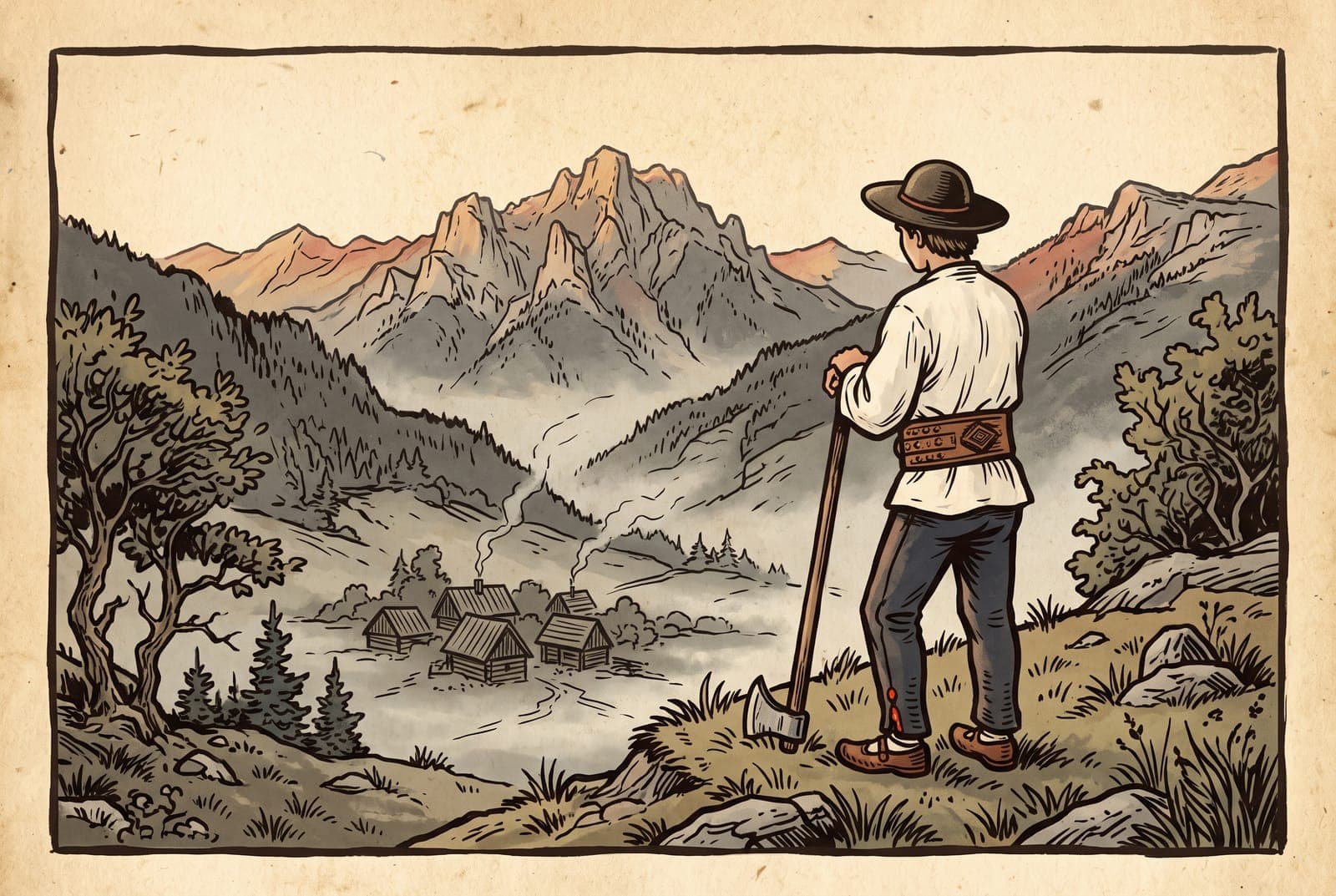
Juraj Jánošík was a Slovak outlaw captain from Terchová in what was then the Kingdom of Hungary. Baptised on 25 January 1688 in the parish of Varín, he served with the kuruc insurgents and then as an imperial guard at Bytča, led a robber band from autumn 1711, and on 16–17 March 1713 was sentenced at Liptovský Mikuláš to death on the hook25. Folk song, poetry and film later turned him into Slovakia's national hero11.
No contemporary picture of Juraj Jánošík exists. What we know about him comes from a baptismal register, a muster roll and court books – and from what he himself said under interrogation, in the end under torture. These traces are thin but surprisingly concrete. This overview follows them from the font to the gallows and keeps apart what is documented, what is disputed and what is legend.
Who was Juraj Jánošík?
His name appears in the sources in many forms: Latin Georgius Janossik, Hungarian Jánosik György, and in the Slovak passages of the records Juro Janošak or Janošiak25. It is always the same man: the son of a family of subject peasants from Terchová in Trenčín County, in the north of the Habsburg-ruled Kingdom of Hungary. The country was divided into counties that ran their own courts and could pass death sentences2.
Jánošík's life fell in troubled times. Between 1703 and 1711 the kuruc, the insurgents of Francis II Rákóczi, fought the imperial forces. The historian Ivan Mrva writes that the eight-year war made banditry grow to unprecedented dimensions2. Jánošík was no exception. What sets him apart is his afterlife in song, literature and film11.
Origins: baptised at Varín, at home in Terchová
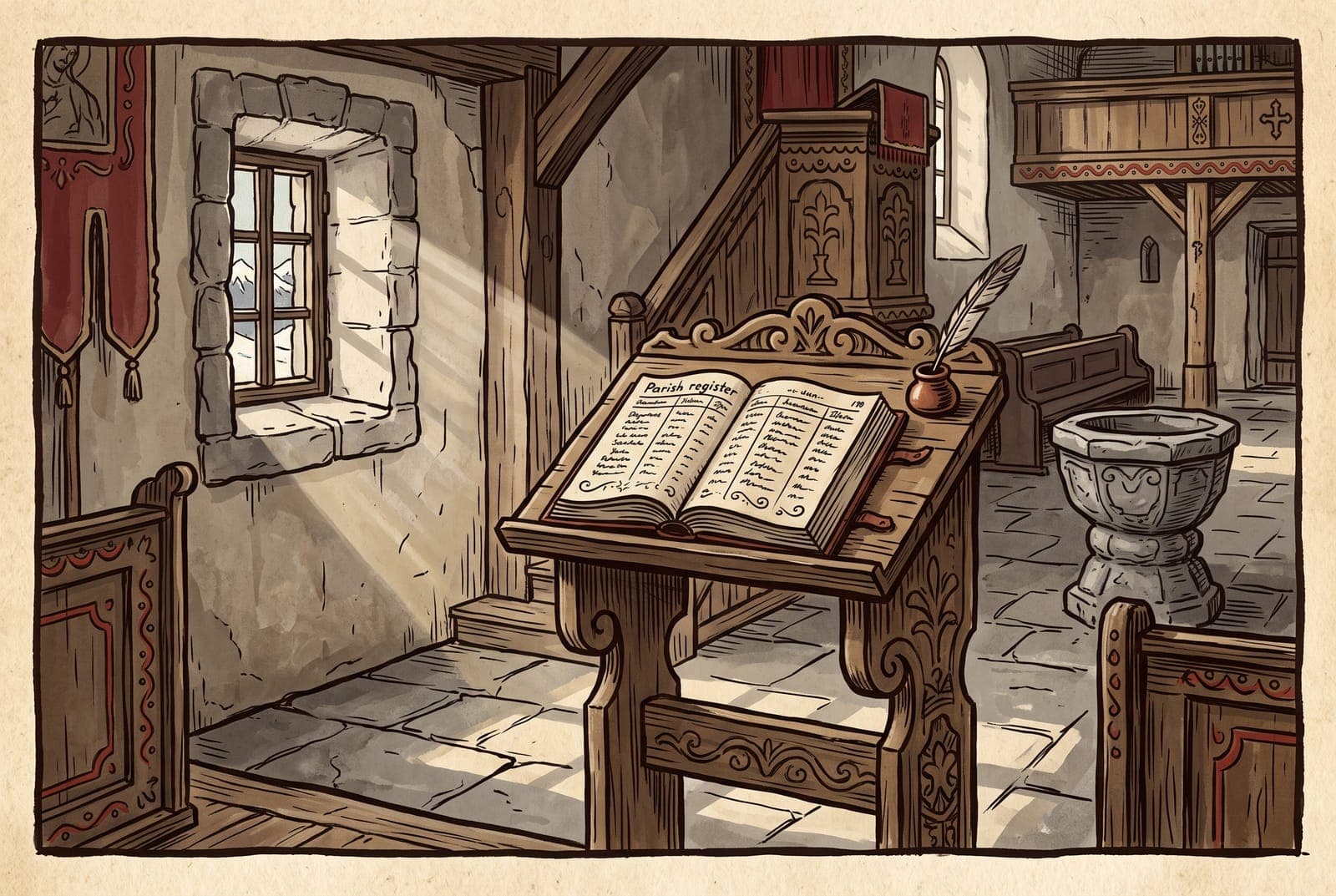
Terchová, a village below the peaks of the Malá Fatra, had no parish church of its own at the time; it belonged to the parish of Varín in the Váh valley2. There, in the Roman Catholic baptismal register for 1686–1718, page 34 holds the entry with which the story of Juraj Jánošík begins. The book is now kept in the State Archive in Žilina, Bytča branch2.
Documented “Eadem die baptizavi infantem natum de Martin Janosik et Anna Czisznik cui datum est nomen Georgii. Patrini erant Jacobus Mergad et Barbara Kristofik de Terchova.” – “On the same day [25 January 1688] I baptised a child born of Martin Jánošík and Anna Czisznik, who was given the name Juraj. The godparents were Jakub Mergad and Barbara Krištofík of Terchová.” Entry by the parish priest Michal Smutko, Varín register, p. 34.25
The register gives no date of birth, only the day of baptism. Since infants were then usually baptised very soon after birth, Juraj was probably born in January 16882. His parents were Martin Jánošík and Anna, whose surname appears in the sources as Cesneková, Čišníková or Czisznik25. The archivist Peter Vítek found his siblings in the same register: Barbora (baptised 14 January 1687), Ján (19 November 1689), Martin (18 May 1692) and Adam (13 October 1697)2. Tradition places his birthplace in the hamlet of “U Jánošov” below Pupov hill, a few kilometres above the village centre5.
For a long time this was not clear-cut: four boys named Juraj Jánošík were baptised in the parish of Varín between 1688 and 1694. In 1968 Ján Brtáň took the son of Michal Jánošík, baptised on 16 May 1688, to be the outlaw5. Vítek rules out the namesakes because the siblings fit only the family of 25 January – above all Ján, who himself stood trial in 17132. That date is now regarded as secure.
Soldier of two masters: kuruc, imperial army and the guard at Bytča
The first evidence of Jánošík as an adult is military. A muster roll of the insurgent infantry regiment of Colonel Wilhelm (Viliam) Winkler, dated 2 December 1707, lists a Juraj Jánošík259. The find is associated with Jozef Kočiš, director of the State Archive at Bytča, whose 1986 book Neznámy Jánošík (The Unknown Jánošík) examined the outlaw's kuruc past25. Jánošík was nineteen at the time. The claim, sometimes repeated, that he joined the insurgents in 1703 at the age of fifteen cannot be supported5.
Whether he fought at the Battle of Trenčín on 3 August 1708, which ended in a heavy kuruc defeat, is not documented5. The historian Miroslav Nemec cautiously writes that Jánošík “probably left the kuruc after the Battle of Trenčín”1. The claim that he was captured there appears in no record5.
The change of sides, by contrast, is documented. After his kuruc service Jánošík served in an imperial guard and reserve unit at the castle of Bytča15. Among the prisoners he guarded there was Tomáš Uhorčík of Predmier, now part of Turzovka – a robber captain from the Kysuce region. According to the trial record, the young guard did the prisoner “small services”15. This is where the two men met whose fates would be sealed together three years later.
Kočiš, and later Jozef Dibala (2008) and Počta (2013), suggest that Jánošík kept up links with former kuruc and Hungarian émigrés in Poland2. Ivan Houdek called this unproven as early as 19372. At the trial, however, the prosecutor did point out that Jánošík had been a kuruc5.
Bought out – and recruited
In 1710 Jánošík left the imperial army. His parents – most sources say his father – paid for his release15. The sum is not recorded. He returned to Terchová. In the same year Uhorčík, too, got out of the prison at Bytča1.
Disputed Did Jánošík help Uhorčík escape? The historian Marián Liščák of the Kysuce Museum writes that Jánošík helped Uhorčík escape in (late) autumn 17107. Nemec merely states that Uhorčík “got out of prison” the same year, and Andrej Melicherčík, who worked through the records thoroughly, stresses that it is not known how Uhorčík escaped15. Active help is therefore possible but unproven.
In autumn 1711 Uhorčík sought Jánošík out in Terchová and recruited him into his band5. The kuruc war had just ended, and banditry, as historians stress, had grown strongly during it25.
The outlaw years, 1711–1712
The oath and the captaincy
Around Michaelmas, 29 September 1711, Jánošík took the robbers' oath. The trial records preserve its wording, as given by Melicherčík5:
“Prisahám večnému Bohu, Svätej Trojici, Panenke Márii a všetkým božím svätým, že svojich tovarišov nevyzradím, neoklamem a neopustím ani v šťastí ani v nešťastí. Tak mi Pánboh pomáhaj!” – “I swear to eternal God, the Holy Trinity, the Virgin Mary and all God's saints that I shall not betray, deceive or abandon my companions in fortune or misfortune. So help me God!”5
The first expedition went to Moravia, where the band seized linen5. On 5 October 1711 it robbed Ján Šipoš, a burgher and merchant of Žilina. The stolen cloth was sold and 70 zlatých were lent to one Stoliga59. This Stoliga, a shepherd from Jablunkov, soon became Uhorčík's father-in-law: before the winter of 1711 Uhorčík married his daughter and settled under a false name, “Martin Mravec”, in the village of Klenovec in Malohont County15. Command of the band passed to Jánošík. The later verdict says he made himself “vúdcem aneb hajtmanem” – “leader or captain”5.
It was not a fixed unit; its membership changed constantly5. From the testimonies we know some twenty names, among them Plavčík of Dunajov, Turiak “Huncaga” of Staškov and Jakub Chlastiak of Oščadnica; others came from Moravia and Poland5. Helpers provided food, gunpowder and shelter, such as the Šutka brothers at Krásno nad Kysucou or Ondrej Kovalčík at Kokava, who hid Jánošík for three weeks in the winter of 17125. On 17 August 1712 a manorial court at Teplička nad Váhom recorded that the inhabitants of Terchová supported robbers with food and shelter2.
Where they struck, and whom
The indictment lists the counties of Trenčín, Nitra, Turiec, Liptov and Orava, “aj v Sliezsku” – even in Silesia25. Expeditions to Malohont, Moravia and the Polish borderland are also attested25. In Liptov the band moved from one shepherds' hut (salaš) to the next – Jánošík named salaše near Revúce, Likavka, Bobrovec, Poruba, Hybe and Važec, and stated that one or more sheep were slaughtered at each2.
The main robberies that Jánošík confessed to in court or that were put to him25:
| When | Where | Victim and loot |
|---|---|---|
| 5 Oct 1711 | near Strečno / Žilina | merchant Ján Šipoš: cloth and linen |
| 1711/12 | below Strečno, on the Váh | a priest on a raft; Jánošík took his fur jacket (mentieka) |
| 1711/12 | Strečno area | goldsmith Ján Skalka of Žilina: seven rings, silver spoons, a broadsword |
| 10 May 1712 | below Strečno | Šipoš again: a belt, 4 zlatých |
| 1712 | Sokol below Kraľovany | wife of the Lutheran pastor of Liptovský Ján: money, clothes |
| 1712 | Žiar Mountains (Turiec) | nobleman Pavol Révay: valuable guns, a sabre in a silver scabbard |
| after 29 Sep 1712 | Kremnica Mountains | nobleman Ján Radvanský, on his way to General Petróczy's funeral |
| 1712 | Malatiná valley | Orava nobleman Zmeškal |
| 1712 | between Važec and Štrba / Východná | wine merchants |
| autumn 1712 | Garajov potok between Východná and Važec | widow (or wife) of the imperial officer von Schardon: jewellery, a gun, wigs |
The last robbery had consequences. Because Liptov County had to compensate Mrs von Schardon, it did everything it could to catch the culprit210.
What the loot really was
Cloth, a few zlatých, rings, weapons, wigs, sheep – the historian Diana Duchoňová (Slovak Academy of Sciences) sums it up: Jánošík “lúpil predovšetkým veci osobnej potreby” – he mainly stole things for personal use9. No source documents loot being handed to the poor29. The only things he demonstrably gave away were the goldsmith Skalka's rings: he gave them to girls in Terchová59.
This, too, is in the records: at the Žilina gallows Jánošík secretly took down the body of the executed robber Mikuláš Šustek from the wheel and buried it5.
The death of the priest of Domaniža
Only one killing is linked to the band. In September 1712 Juraj Vrtík (Vertík), parish priest of Domaniža since 1694, was shot by two robbers on his way back from Frivald, today Rajecká Lesná6. He died of his wounds on 2 October 1712 and was buried on 5 October. The Domaniža death register records: “a duobus praedonibus traiectus est” – “he was shot through by two robbers”6.
Jánošík testified that two companions fired: “Dva tovarišia Plavčík z Dunajova a Turiak predpsaní strelili naňho a on v ten čas vodu pil na studni, a že od toho pátera nič nevzali a že ho Huncaga postrelil.” – “Two companions, Plavčík of Dunajov and the aforementioned Turiak, shot at him while he was drinking water at a well; they took nothing from the priest, and Huncaga wounded him.”56
Disputed Who was drinking at the well – Jánošík or the priest? The sentence allows both readings56. The court found that his companions shot the priest “kde on též bol prítomný” – where he too was present; it did not find that he fired himself5. The date of the attack also varies: 4 September according to local literature, 8 September according to the necrology of the diocese of Nitra6.
Two arrests: Hrachovo and Klenovec
In autumn 1712 – 26 October is the date usually given – Jánošík and Uhorčík alias “Mravec” were arrested at Klenovec, over a robbery of merchants from Banská Bystrica that they had nothing to do with57. They were taken to the manor house at Hrachovo, where Malohont County held its court. After they had shown their innocence and the deputy county head Pavol Láni spoke up for them, they were released; by way of thanks they sent fox furs and cheeses58. Legend turned this into a daring escape; the records speak of release5.
The second arrest was final. Liptov county haiduks seized Jánošík in Uhorčík's house at Klenovec, at the spot known locally as “Mravcov vŕšok”157. When this happened is disputed: “around the turn of 1712/1713”, writes Nemec; “early March 1713”, say the municipality of Klenovec and Duchoňová1489. As early as 1929 Ivan Houdek warned: “Ako a kde sa to stalo, o tom niet v súdnych spisoch ani zmienky” – how and where it happened is not mentioned at all in the court records2. The version placing the arrest at Valaská Dubová rests on folk tradition2.
Where he was held is also an open question. Tradition names the Vranovo manor house in Palúdzka, going back to a note by the poet Samo Chalupka in 1868. Nemec considers this improbable, since a town prison is attested in Svätý Mikuláš from the late 17th century1.
The trial at Liptovský Mikuláš, 16–17 March 1713
On 16 March 1713 the Liptov county court met at Svätý Mikuláš, today's Liptovský Mikuláš23. It was presided over by the deputy county head Ladislav Okolicsányi; the prosecutor was Alexander Čemický and the court-appointed defender Baltazár Palugyay35. Trenčín County also put its own questions25. Whether the hearing took place in the Hanzely house, today the Janko Kráľ Museum, or in the neighbouring Pongrác curia is uncertain12.
The indictment calls him “publicum praedonem seu malefactorem”, a public robber or malefactor2. The legal basis was Hungarian law, including Werbőczy's Tripartitum, which prescribed the stake or the wheel for robbers. The record mixes Latin with Slovak passages so that the accused could understand the charges2.
On the first day Jánošík made a voluntary confession. He answered Trenčín County's questions fairly openly and was confronted with the merchants Šipoš and Skalka. Of the 29 questions from Liptov County he left 14 unanswered and answered 10 evasively25. Uhorčík, he claimed, had died in the Kremnica Mountains – thereby shielding his friend, who was being held in the same custody as “Mravec”5. The prosecutor demanded death by stake, hook or wheel after prior torture; the defender asked for acquittal5.
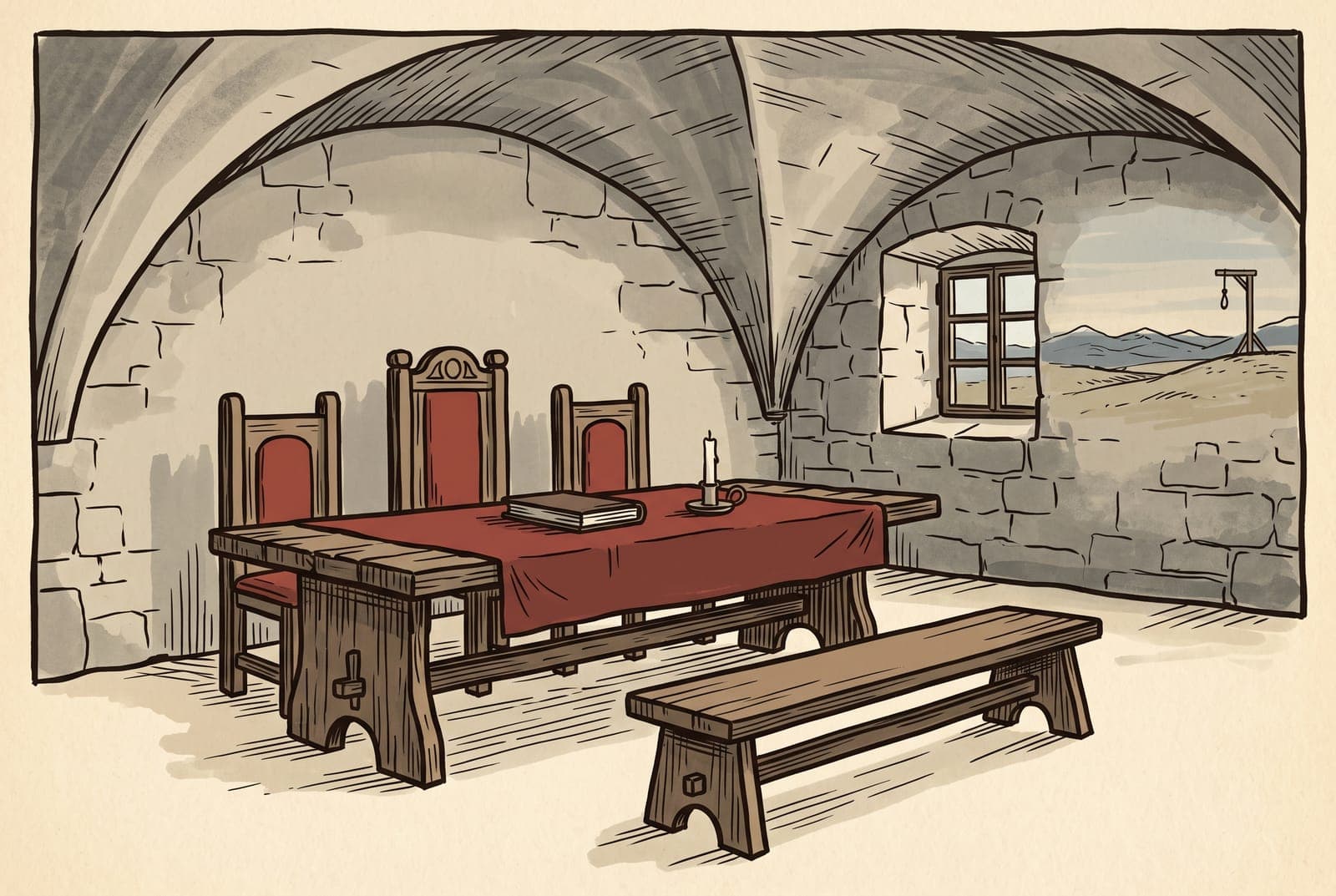
On the second day the court ordered that Jánošík be subjected to “ľahšiemu, potom i ťažšiemu mučeniu” – lighter, then heavier torture – because he had not named his helpers or where the loot was hidden5. Under torture he answered seven questions, admitted the robberies of Mrs von Schardon and of Zmeškal, and described a vague hiding place: a beech and a fir “with a cut hand” on the way from Jablonka to Klenovec5. (Vítek, however, dates the record of the torture interrogation to 16 March2.) The defender pleaded Jánošík's youth and that he had killed no one45. Then came the sentence:
“… má být na hák na levém boku prehnatý a tak na príklad jinších takových zločincov má být zavesený.” – “… he shall be pierced with a hook through the left side and hung up as an example to other such criminals.”5
The execution: 17 or 18 March 1713
No record of the execution is known, and so there is no exact date. The town of Liptovský Mikuláš gives 17 March, the Žilina Regional Library 18 March 1713310. Miroslav Nemec of the Janko Kráľ Museum said in 2026: “Nevieme presne kedy, ale v nasledujúcich dňoch bol vykonaný aj ten samotný rozsudok” – we don't know exactly when, but the sentence was carried out in the following days4.
Disputed Place and manner of execution: Tradition puts the place of execution at “Šibeničky”, east of the town between Okoličné and Vrbica, where a memorial with a replica gallows stands today210. In 1929 Houdek proposed instead the toll place by the Váh near the Palúdzka bridge2. Whether the sentence was carried out exactly as pronounced – on the hook – is likewise undocumented5. Where Jánošík is buried is unknown2.
What became of Uhorčík, his brother Ján and the companions
Jánošík's silence did not save Uhorčík. The man who called himself “Martin Mravec” was unmasked and sentenced by the same court; his case follows directly after Jánošík's in the record2. He was broken on the wheel “from the neck”, the quicker form12. According to Liščák, proceedings began on 19 April and he was executed on 21 April 17137.
The family was hit too. Jánošík's younger brother Ján was sentenced to death by hanging by the manorial court at Teplička nad Váhom on 18 December 1713 for having helped his brother2. On 24 May 1713 the same court had already had two helpers, Martin Hatala of Klenovec and Ján Mikulčík of Poland, beheaded2. The parents still appear as godparents in the Varín register in 1715 and 17172.
What the archives preserve
It is often said that the original records were lost in the 19th century. That is only half true. According to Vítek, the Liptov record with indictment, defence and verdict survives in the original: in the State Archive at Bytča, protocol volume 1710–1717, pages 563–5672. What was lost is the record of the torture interrogation, the Fassio Janossikiana. It survives as a copy, made with the help of the poet Janko Kráľ and certified on 15 September 1844; it is held by the Slovak National Museum in Martin2.
How the legend grew
According to the Slovak encyclopaedia Beliana, the Jánošík tradition arose “relatively soon after his death”11. The oldest known printed mention is an anonymous anecdote of 1785 in the Banská Bystrica newspaper Staré noviny literního umění2. In 1809 Bohuslav Tablic made Jánošík a benefactor of poor students2. In 1814 Pavol Jozef Šafárik described him as a brave robber who takes from the rich and gives to the poor12.
The decisive step was taken by the Romantic poets of Ľudovít Štúr's generation. For Janko Kráľ, Samo Chalupka and Ján Botto the robber became a symbol of freedom and, after 1848, of national liberation1112. Botto's verse romance Smrť Jánošíkova (The Death of Jánošík, 1862) is the key text1112. In the 20th century every regime claimed the hero: partisan groups and a partisan brigade bore his name, and in 1952 the ethnologist Melicherčík interpreted him as a fighter in the “anti-feudal” class struggle2. Films were made from 1921 to 200911.
Legend A magic shirt, belt and valaška given to him by fairies or witches; an old woman scattering peas under his feet in a tavern; the dance beneath the gallows and the defiant reply “Keď ste si ma upiekli, tak si ma aj zjedzte!” (“Since you have roasted me, eat me too!”) – all these are motifs from folk songs, tales and literature. The peas already appear in an 18th-century broadside song, the last words in folk verse212. None of them occurs in the records; the only documented element is the sentence to hang him on the hook2.
Why Jánošík matters today
For Slovakia, Jánošík is still more than a historical figure. Above Terchová stands a 7.5-metre statue of sheet steel by Ján Kulich, unveiled in 1988 for the 300th anniversary of his birth13. The folklore festival Jánošíkove dni, first officially held in 1963 for the 250th anniversary of his death and international since 1991, drew around 75,000 visitors in 200414. Liptovský Mikuláš commemorates the trial and the execution10.
Precisely because the legend is so powerful, the records are worth reading. They show no fairy-tale hero but a young man from a mountain village whom war, comradeship and opportunity led into a robber band, and who died at twenty-five. That this short life became a myth is itself a historical fact1112.
Frequently asked questions
When and where was Juraj Jánošík born?
His date of birth is not recorded. What is documented is his baptism on 25 January 1688 in the parish of Varín, to which his home village of Terchová belonged; he was probably born shortly before.25
When was Jánošík executed?
The sentence was passed on 17 March 1713 at Liptovský Mikuláš. No record of the execution is known, so the sources give 17 or 18 March 1713. The place of execution is traditionally “Šibeničky”, east of the town.3410
Was Jánošík a Slovak Robin Hood?
Not according to the records. He mainly robbed merchants, nobles, clergy and travellers, and no source shows that he gave loot to the poor. The motif of taking from the rich and giving to the poor comes from folk songs and 19th-century literature.2912
Did Jánošík kill anyone?
No surviving record attributes a killing to him personally. According to Jánošík's testimony, the priest Juraj Vrtík of Domaniža was shot in 1712 by his companions; the court nevertheless found that he had been present.56
Where was Jánošík captured?
According to most accounts, in Tomáš Uhorčík's house at Klenovec, around the turn of 1712/1713 or in early March 1713. The court records themselves are silent on the matter.128
Do the original records of Jánošík's trial survive?
Yes. The Liptov county record with the indictment and verdict survives in the original in the State Archive at Bytča. Only the record of the torture interrogation was lost; it survives in a certified copy of 1844 in the Slovak National Museum in Martin.2
Sources
- Bol Jánošík väznený v kaštieli Vranovo? – Miroslav Nemec, Historický časopis 70 (2022) 1, Historický ústav SAV (2022) [sk]
- Zbojníctvo na Slovensku. Zborník z vedeckej konferencie, Liptovský Mikuláš 4. 11. 2013 – Miroslav Nemec, Peter Vítek (eds.), Spolok Slovákov v Poľsku (2014) [sk]
- Juraj Jánošík 1688–1713. Výberová personálna bibliografia – Krajská knižnica v Žiline (2018) [sk]
- Liptovský Mikuláš si pripomína 313. výročie rozsudku nad Jánošíkom – TASR / teraz.sk (2026) [sk]
- Juraj Jánošík – Wikipédia (slovenská) (2026) [sk]
- Dvakrát Juraj – Rudolf Šujanský, Farnosť Domaniža [sk]
- Všetkým známy a predsa nepoznaný príbeh Tomáša Uhorčíka – Marián Liščák (Kysucké múzeum), mojeKysuce.sk [sk]
- Historické osobnosti – Obec Klenovec [sk]
- Hrdina alebo zlodej? Jánošík lup chudobe nerozdával, tvrdia historici – noviny.sk (2018) [sk]
- Legenda Jánošík – Mesto Liptovský Mikuláš [sk]
- jánošíkovská tradícia – Encyclopaedia Beliana, Encyklopedický ústav SAV (2013) [sk]
- Jánošíkovská legenda na Slovensku (bakalárska práca) – Jana Hrajnohová, Univerzita Karlova, Praha (2010) [cs]
- Socha Jánošíka – Obec Terchová [sk]
- História festivalu – Jánošíkove dni Terchová [sk]
Transparency notice (Art. 50 EU AI Act): research and text were produced with the help of an AI language model and editorially checked against the sources listed. Illustrations are AI-generated and are not historical depictions.
This article is also available in Deutsch, Slovenčina
More on Janosik.de
Trial and Execution 1713 – Jánošík Before the Liptov County Court
Two days in March 1713 decided the fate of Juraj Jánošík. The Liptov County protocol survives – and tells a soberer story than the songs.
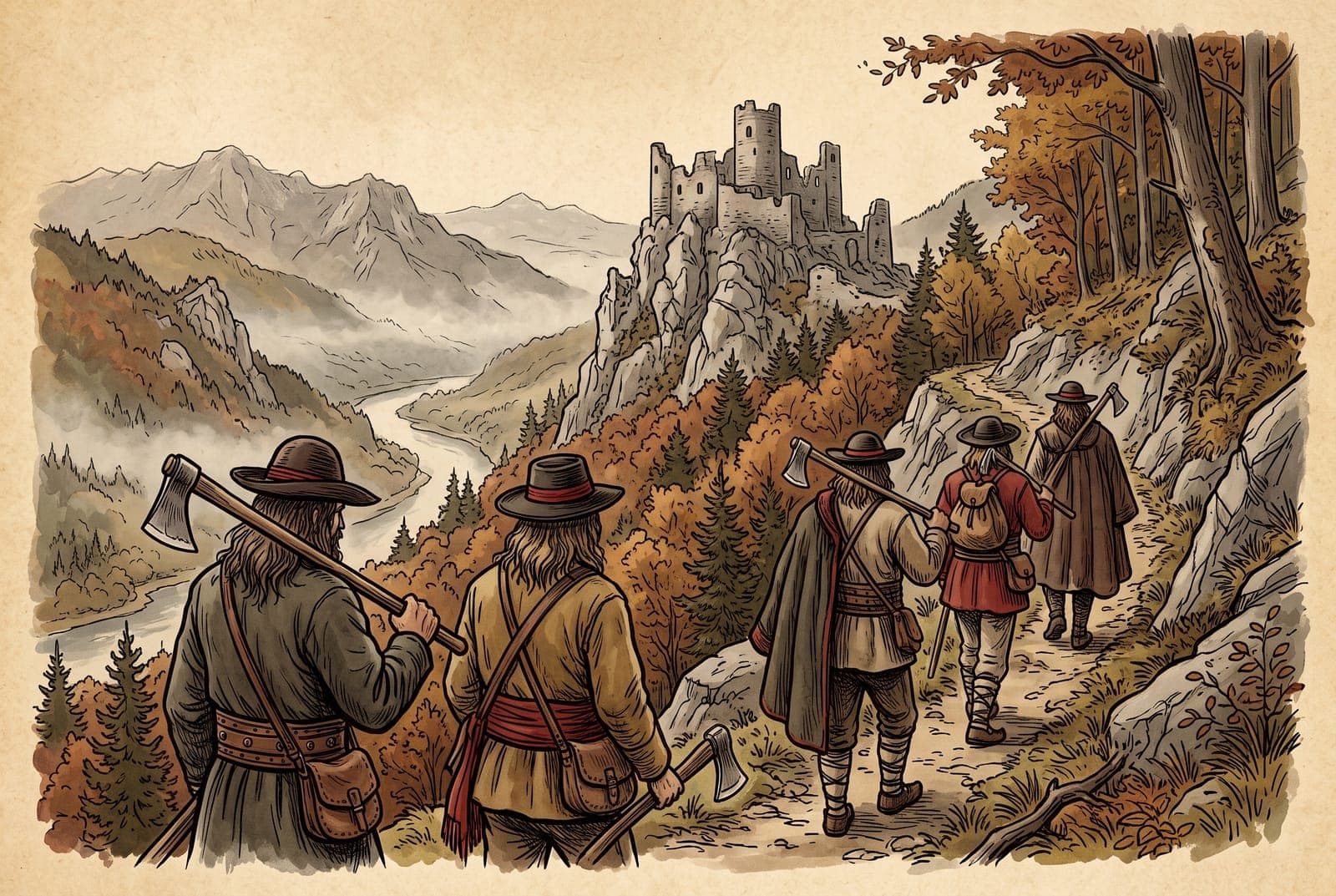
Jánošík’s Outlaw Years 1711–1713: Raids, Band and Loot
Juraj Jánošík was an outlaw for barely eighteen months. What the court records reveal about his oath, raids, loot and helpers – told step by step.
Tomáš Uhorčík – the outlaw captain who made Jánošík a highwayman
Without him there would probably have been no outlaw Jánošík. Tomáš Uhorčík brought the young man from Terchová into his band, went to ground in Klenovec as “Martin Mravec” – and died on the wheel a few weeks after him.