

Jánošík’s Outlaw Years 1711–1713: Raids, Band and Loot
Juraj Jánošík was an outlaw for barely eighteen months. What the court records reveal about his oath, raids, loot and helpers – told step by step.
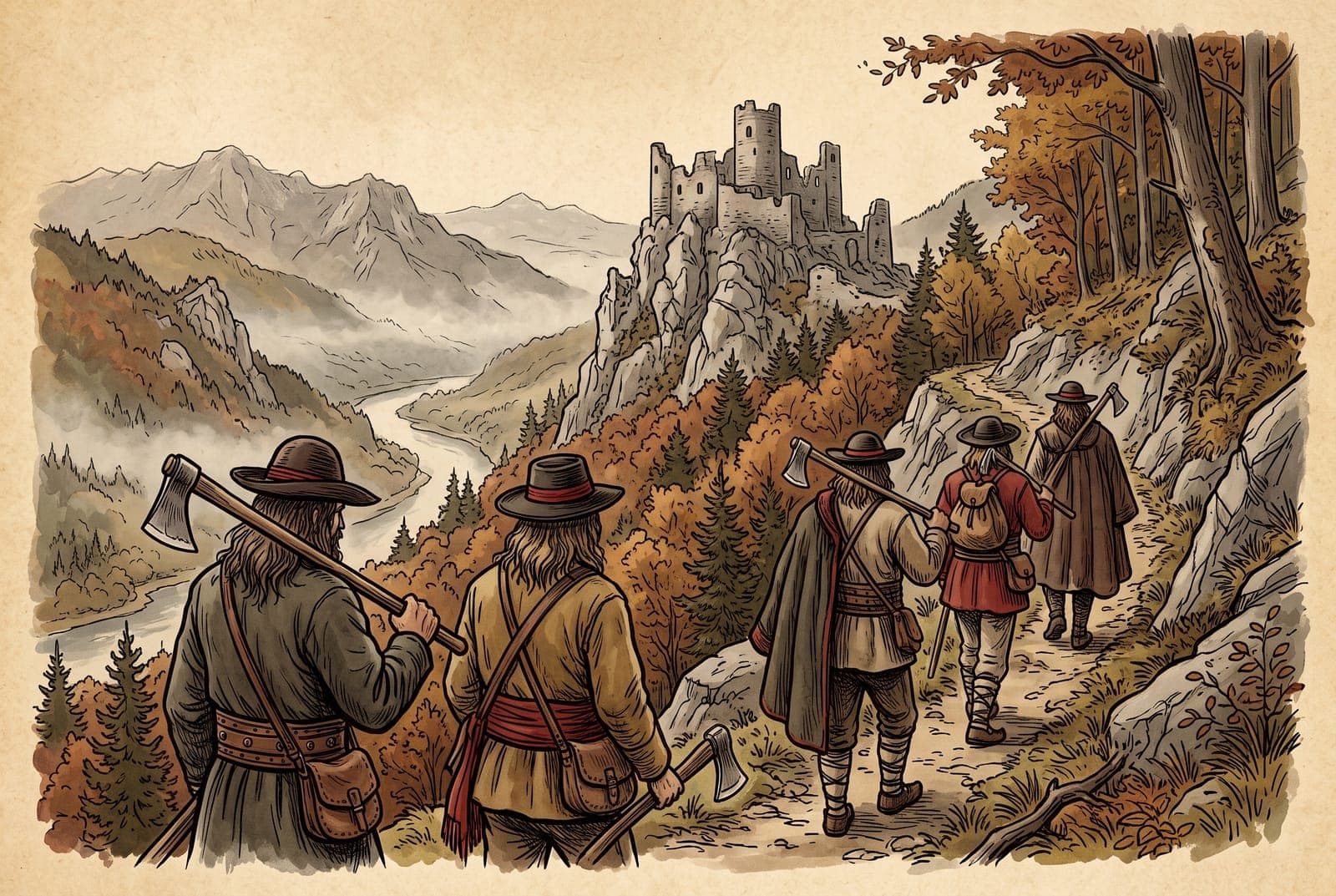
Juraj Jánošík was an outlaw for only about eighteen months: around Michaelmas (29 September) 1711 he swore the robbers’ oath in Tomáš Uhorčík’s band, became its captain before the winter, and stood trial in the spring of 1713. The court records name about a dozen raids between Žilina and the High Tatras – on merchants, noblemen, a goldsmith and an officer’s widow. The loot was mostly cloth, clothing, weapons, rings and small sums of money.13
Almost everything we know about these years comes from a single group of sources: the record of the Liptov county court of 16 and 17 March 1713, the questions put by Trenčín County, and a copy of his interrogation under torture. It is the prosecutors’ view, together with what a prisoner admitted – sometimes freely, sometimes in pain. No diary, no letters and no victims’ eyewitness accounts survive.13 With that caveat, the story of the outlaw years can be told with surprising precision.
The oath at Michaelmas 1711
When Jánošík turned outlaw in 1711, he already had a soldier’s life behind him: first with the Kuruc insurgents, then as a guard on the imperial side at Bytča castle. There, among others, he guarded the imprisoned robber captain Tomáš Uhorčík of Predmier. In 1710 his parents bought him out of the army.23
In the autumn of 1711 Uhorčík sought him out in Terchová and recruited him. His admission to the band fell around Michaelmas, 29 September 1711.3 The oath preserved in the trial documents bound the newcomer to unconditional loyalty:
Documented “Prisahám večnému Bohu, Svätej Trojici, Panenke Márii a všetkým božím svätým, že svojich tovarišov nevyzradím, neoklamem a neopustím ani v šťastí ani v nešťastí. Tak mi Pánboh pomáhaj!” – “I swear to eternal God, the Holy Trinity, the Virgin Mary and all God’s saints that I shall not betray, deceive or abandon my companions in fortune or misfortune. So help me God!” (Wording from the trial documents, as quoted by Melicherčík.)3
Oaths like this were common among Carpathian outlaws. Liptov records describe one case in which the men knelt in the forest on a Sunday, laid two fingers on an axe and swore never to betray the band, not even under torture.1
The first expedition went straight across the border, to Moravia, where the band seized linen cloth. A few days later, on 5 October 1711, came the first raid that the records date precisely. The victim was Ján Šipoš, a burgher and merchant of Žilina, whom the robbers relieved of cloth and linen. The goods were sold, and 70 zlatých from the proceeds were lent to Stoliga, a shepherd from Jablunkov.38 Šipoš was to see Jánošík again eighteen months later – as a witness with whom the accused was confronted in court.3
Uhorčík steps back, Jánošík becomes captain
Before the winter of 1711 the band’s leadership changed. Uhorčík married the daughter of that same Jablunkov shepherd, Stoliga, and settled in Klenovec in Malohont County – under a false name, as “Martin Mravec”. Jánošík took over the band.23 The records call his role kapitán, hajtman or hadnad; the verdict says he made himself “vúdcem aneb hajtmanem”, “leader or captain”.3
Even the records disagree on how long he held that role. The verdict says he took up robbery “predo dvema roky”, two years earlier; the indictment speaks of three years.3 Counting from the documented oath in the autumn of 1711, it was in fact a little under eighteen months.
Other Liptov trials show what being a “captain” meant at the time. Small bands had about three members and large ones ten or more; the leader was called hajtman or, in Hungarian, hadnagy (“lieutenant”), the members were tovariši, and the loot was usually shared equally.1 In summer such bands lived in the forest and on the mountain sheep farms (salaše); in winter they scattered to relatives and acquaintances.1 Jánošík seems to have wintered in the same way: Ondrej Kovalčík of Kokava hid him for three weeks in the winter of 1712.314
Czech literature mentions a robbery of merchants near Vsetín in Moravia in November 1711.9 No citation from the records has yet been found for it, so we list it only as an unconfirmed report.
Who belonged to the band
This was no fixed troop with uniforms and a roster of ranks. Its make-up changed, and men came and went.3 Even so, the testimonies of Jánošík and Uhorčík yield a long list of names: Jakub Chlastiak of Oščadnica; Turiak, known as Huncaga or Hunčiak, of Staškov; Plavčík of Dunajov; Kováčik alias Moravčík of Moravia; Vavrek of Poland; Ondráš Kundis of Dlhé Pole; an Ondráš of Dlhá nad Kysucou; Satora of Sól in Poland; Bartek of Predmier; Pavol Gašparec alias Mlynarčík “Zradovský”; Orešiak of Poland; Adam Šušolka of Turzovka; Pivovarčík of Jablonka; Zupica of Ostravice, Kovalčík of Čeladná, Holúbek and Valičiak, all from Moravia; and one Tálik.3
The home villages tell their own story: many of the men came from Kysuce, the borderland with Silesia and Poland, and others from beyond the frontiers. The historian Ivan Mrva stresses that Kysuce in particular supplied a large part of Jánošík’s band.1 By the time of the trial, Satora, Mlynarčík, Bartek and Ondráš of Dlhá had already been executed at Cieszyn (Těšín).3
The raids: what the records say
The table below brings together the deeds that the records tie to a place or a date. “Records” means named in the trial protocol or the interrogation, as transmitted by the editions of Melicherčík and Hlavienka; the Liptov cases were also checked by Nemec (2014).13
| Date | Place | Victim | Loot | Status |
|---|---|---|---|---|
| c. 29 Sep 1711 | Moravia | unknown | linen cloth | records3 |
| 5 Oct 1711 | near Strečno/Žilina | merchant Ján Šipoš of Žilina | cloth, linen; 70 zlatých of the proceeds lent to Stoliga | records38 |
| Nov 1711 | near Vsetín (Moravia) | merchants | not stated | unconfirmed9 |
| 10 May 1712 | below Strečno | Ján Šipoš again | belt, 4 zlatých | records310 |
| 1711/12 | below Strečno, on the Váh | a priest on a raft | fur jacket (mentieka) | records3 |
| 1711/12 | below Strečno | townsmen of Žilina | horses, gear | records3 |
| 1711/12 | not stated exactly | goldsmith Ján Skalka of Žilina | 7 rings, silver spoons, a broadsword | records3 |
| 1712 | Sokol below Kraľovany, on the Váh | wife of the Lutheran pastor of Liptovský Ján | money, clothes | records13 |
| 1712 | Žiar Mountains (Turiec) | nobleman Pavol Révay | valuable guns, sabre in a silver scabbard | records3 |
| 1712 | Žaškov | Mrs Kaforka | 200 silver zlatých per the indictment; one imperial thaler per Jánošík | records, disputed3 |
| 1712 | Malatiná valley | Orava nobleman Zmeškal | not stated in the sources | confessed under torture13 |
| 1712 | between Východná and Važec | wine merchants | wine | records13 |
| after 29 Sep 1712 | Kremnica Mountains | nobleman Ján Radvanský | not stated in the sources | records3 |
| autumn 1712 | Garajov potok between Východná and Važec | widow (or wife) of the officer von Schardon | jewellery, a gun, wigs | confessed under torture13 |
Below Strečno castle
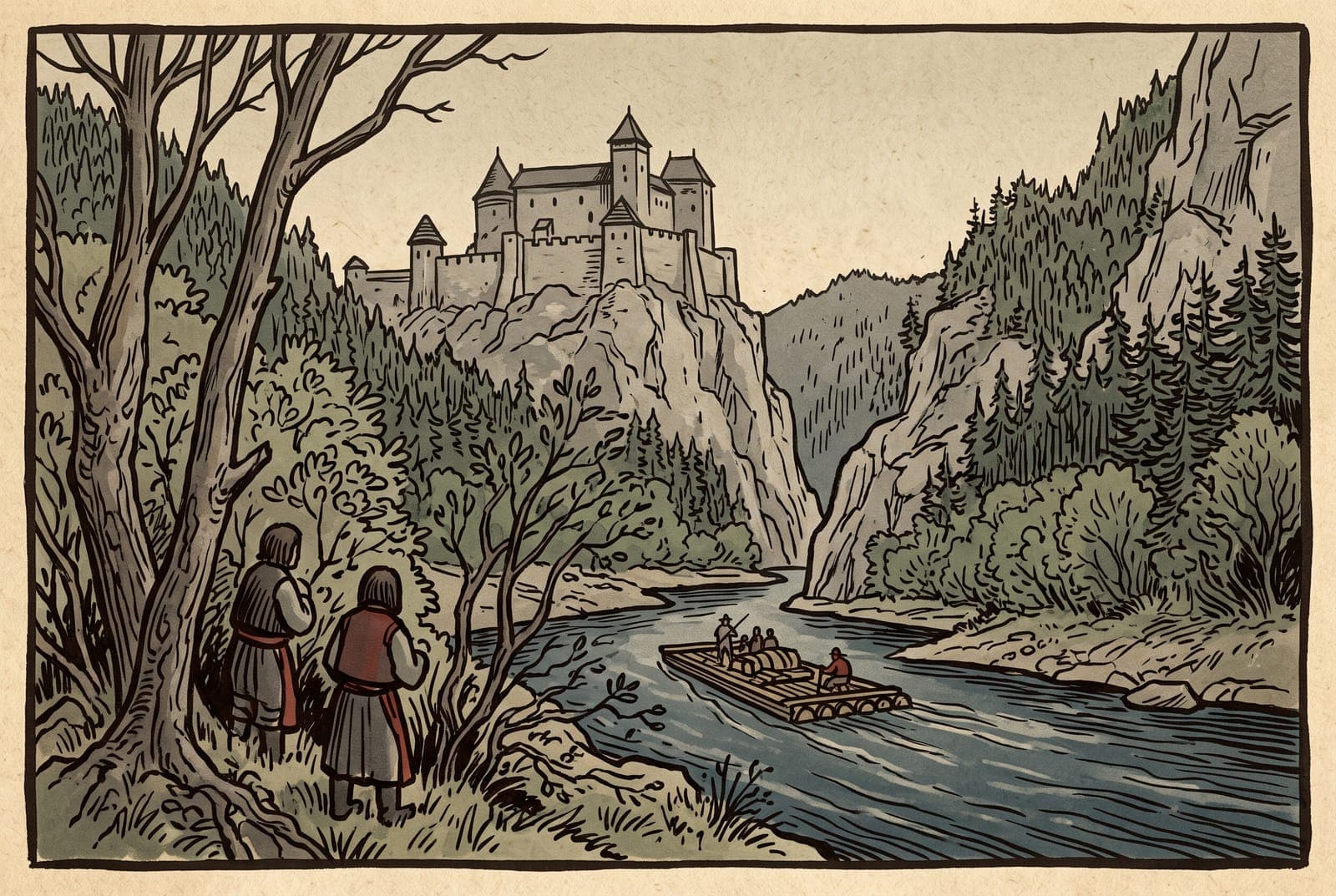
The first year centred on the Váh gorge below Strečno castle, not far from Terchová. People from Žilina were hit here more than once: townsmen who lost horses and gear, a priest on a raft whose fur jacket Jánošík took, and, on 10 May 1712, the merchant Šipoš once again. This time the haul was a belt and 4 zlatých.310
The Žilina goldsmith Ján Skalka was also among the victims: seven rings, silver spoons and a broadsword. Like Šipoš, Skalka was confronted with Jánošík at the trial in 1713.3 The rings appear once more in the records – Jánošík gave them to girls in Terchová.38
Easter in Krásno, summer in the mountains
At Easter 1712, on 27 March, the band drank at the inn of Hvezdák in Krásno nad Kysucou.3 The village was a base: the brothers Juraj and Jakub Šutka supplied the band with food and gunpowder there and gave it shelter.3
In the course of 1712 the radius widened. At Sokol below Kraľovany the band robbed the wife of the Lutheran pastor of Liptovský Ján – probably Andrej Brosík – of money and clothes on a raft.13 In the Žiar Mountains in Turiec the victim was the nobleman Pavol Révay of Turčianska Štiavnička, who lost valuable guns and a sabre in a silver scabbard.3 In Žaškov in Orava a Mrs Kaforka was robbed. This case shows how far the indictment and the confession could diverge: the indictment spoke of 200 silver zlatých, while Jánošík admitted to a single imperial thaler.3
Liptov: sheep farms, wine merchants and an officer’s widow
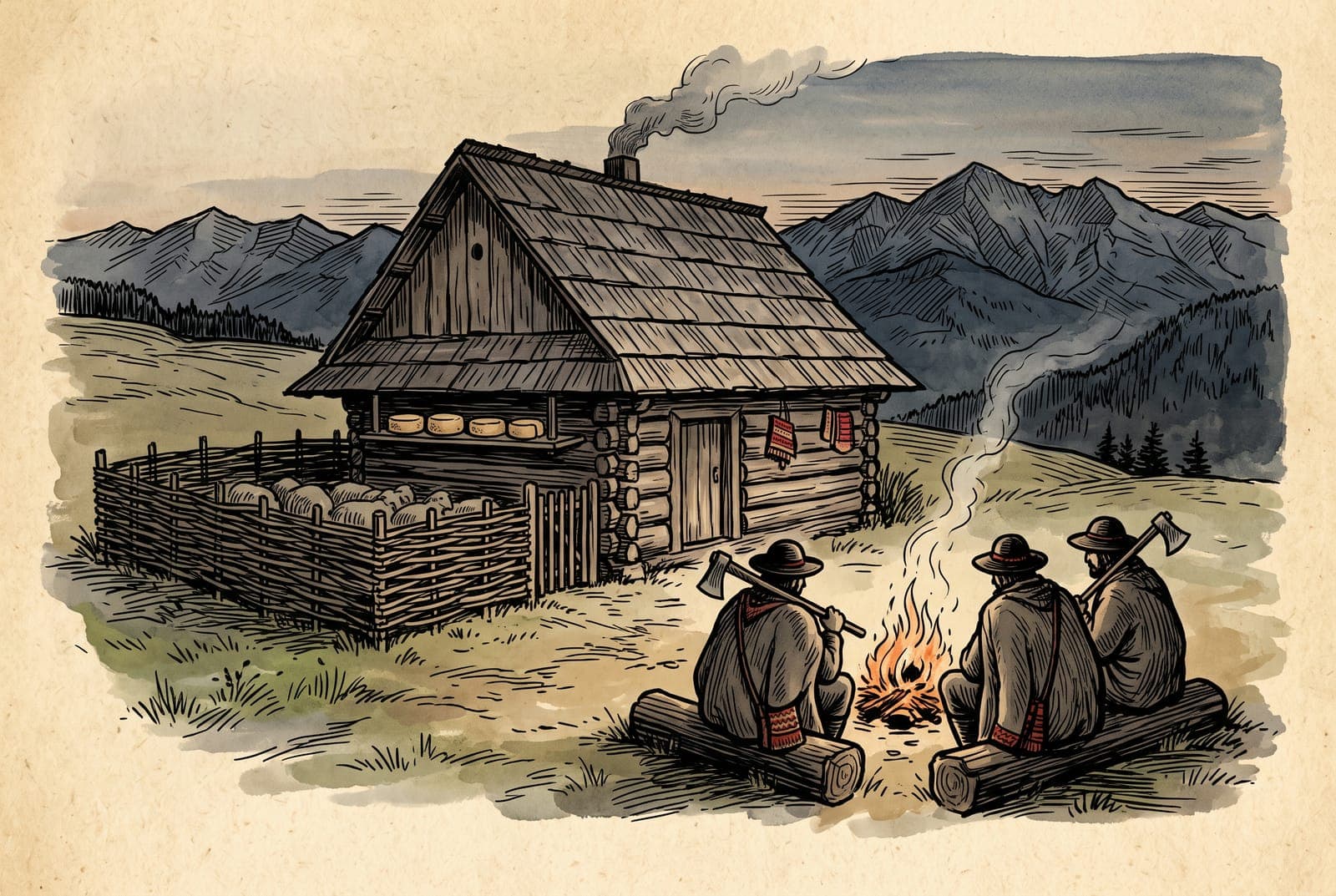
In Liptov the band moved from one salaš to the next. Jánošík named the sheep farms of Revúce, Likavka, Bobrovec, Poruba, Hybe and Važec, and testified that they slaughtered one or more sheep at each.1 Between Važec and Štrba or Východná the band robbed wine merchants.13 In the Malatiná valley, between Malatiná and Liptovská Anna, the victim was the Orava nobleman Zmeškal; his first name is uncertain in the literature, given as Václav in some places and Ladislav in others.13
The raid with the gravest consequences came in the autumn of 1712 at the Garajov potok between Východná and Važec. The victim was the widow – or, on another reading, the wife – of the imperial officer von Schardon, “Schardonka” in the records. The band took jewellery, a gun and wigs.13 Because Liptov County had to compensate the lady, it now had a very practical interest in catching the culprit.3 Jánošík admitted this robbery, like the one on Zmeškal, only under torture.3
The Kremnica Mountains and a funeral
General Štefan Petróczy died at the end of September 1712. On his way to the funeral, the nobleman Ján Radvanský of Radvaň was robbed in the Kremnica Mountains; the band had first stopped a post-boy.3 One deed was of a very different kind: at the Žilina gallows the outlaws secretly took the executed robber Mikuláš Šustek down from the wheel and buried him.3
The Domaniža shooting
The gravest charge did not concern a robbery. In September 1712 Juraj Vrtík, parish priest of Domaniža since 1694 and a native of Zliechov, was shot in the Suchá area on his way back from Frivald (today Rajecká Lesná) to Domaniža.45 He died of the wound weeks later. The Domaniža death register records his burial on 5 October 1712 with the terse words “a duobus praedonibus traiectus est” – “he was shot through by two robbers”.4
In court, answering the 13th question of Trenčín County, Jánošík described the incident like this: “Dva tovarišia Plavčík z Dunajova a Turiak predpsaní strelili naňho a on v ten čas vodu pil na studni, a že od toho pátera nič nevzali a že ho Huncaga postrelil.” – “Two companions, Plavčík of Dunajov and the aforementioned Turiak, shot at him while he was drinking water at a well; they took nothing from the priest; Huncaga wounded him.”34 Whether “he was drinking water” refers to Jánošík or to the priest, the sentence does not say.
Disputed Both the date and Jánošík’s role are disputed. Local literature dates the attack to 4 September 1712, the Necrologium of the Nitra diocese to 8 September; the date of death is given as 2 October, though one passage says 1 October.45 The verdict does not accuse Jánošík of firing the shot himself: his companions shot the priest “kde on též bol prítomný” – “where he too was present”. His defender countered that he had killed or wounded no one.3
What was the loot worth?
The lists sound rich; the values are modest. Cloth, linen, a belt, four zlatých, a thaler, rings, spoons, weapons, wigs, sheep and cheese: the historian Diana Duchoňová of the Institute of History of the Slovak Academy of Sciences sums it up by saying that Jánošík “lúpil predovšetkým veci osobnej potreby” – “mainly robbed things for personal needs”.8
Exchange rates between the zlatý (florin), the thaler and the ducat of the period cannot be given reliably from the sources we have checked. But a few documented sums help to gauge the scale:
| Sum | Context | Source |
|---|---|---|
| 1 florin per household per year | “Smoke tax” under the law of 1514 | 13 |
| 4 florins per plot per year | Cash commutation of 52 days’ robot on the Esterházy estates, 1711–12 | 13 |
| 4 zlatých | Cash taken in the second robbery of Šipoš, 10 May 1712 | 3 |
| 40 gold florins | Legal “price” (homagium) of a peasant; of a nobleman: 200 | 1 |
| 70 zlatých | Proceeds of Šipoš’s goods lent to Stoliga, 1711 | 38 |
| 200 silver zlatých | The indictment’s claim in the Kaforka case (Jánošík admitted one thaler) | 3 |
Four florins, then, was roughly what a peasant on a large estate might pay to buy himself out of a whole year’s labour service – not nothing for a single raid, but no fortune. The only sum on the scale of a peasant’s whole worth, Mrs Kaforka’s 200 zlatých, is precisely the one Jánošík denied.313
Legend No primary source shows Jánošík taking from the rich to give to the poor. The only documented “giving” is the rings for girls in Terchová; Uhorčík also testified that Jánošík gave or lent eight and ten gold coins to people in Klenovec.3811 The image of the benefactor arose later, in folk song and Romantic literature.1
Territory: from Moravia to the Tatras
The indictment lists the counties in which Jánošík robbed: “v Trenčianskej, Nitrianskej, Turčianskej, Liptovskej, Oravskej stolici aj v Sliezsku” – in Trenčín, Nitra, Turiec, Liptov and Orava “and others”, even in Silesia.13 The records add Malohont, where Uhorčík lived, Moravia and the Polish borderland.3 That sounds like a vast area, yet the dated raids cluster along two axes: the Váh valley between Žilina and Kraľovany, and the road through upper Liptov between Východná and Važec.
Helpers in Terchová
No band could have survived without backing in the villages. Shepherds and innkeepers provided food and shelter, bought gunpowder and gave warning of the county haiduks.1 For Jánošík, besides the Šutka brothers and the innkeeper in Krásno, the records name an innkeeper’s wife and the miller in Terchová.3
How the authorities saw this is shown by a document that does not come from the trial: on 17 August 1712 the manorial court at Teplička nad Váhom, seat of the Strečno estate, recorded that inhabitants of Terchová had supplied robbers with food and shelter. The record is in the Illésházy family archive in the State Archive at Bytča.1 For Jánošík’s family this had consequences: on 18 December 1713 the same court sentenced his brother Ján to death by hanging for helping him.1
The first arrest at Hrachovo
In the autumn of 1712 Jánošík visited Uhorčík, alias “Mravec”, in Klenovec. After a robbery of merchants from Banská Bystrica in Malohont County, both men were arrested there and held in the manor house at Hrachovo, where the county held its proceedings.36 The date is usually given as 26 October 1712; the municipality of Klenovec says simply October 1712.711
The two proved that they had taken no part in that robbery and were released, helped by the intervention of the Malohont deputy county head Pavol Láni. They thanked the “county gentlemen” with fox furs and cheeses.3614 The historian Miroslav Nemec notes that letters of good character were issued at the time “even for the innocence of Uhorčík and Jánošík” – a sign of how little such testimonials were worth.1
Legend Folk tales and some reference works claim that Jánošík escaped from Hrachovo. The records speak of a release.3
The end
His freedom lasted only months. Back in Klenovec, at Uhorčík’s house, Jánošík was arrested by Liptov county haiduks.27 Exactly when remains open.
Disputed The historian Miroslav Nemec dates the second arrest to “around the turn of 1712/1713”; the municipality of Klenovec and Diana Duchoňová give early March 1713.27812 As early as 1929, I. Houdek observed that the court records are silent on the matter: “Ako a kde sa to stalo, o tom niet v súdnych spisoch ani zmienky” – “How and where it happened, there is not even a mention in the court records.”1
On 16 and 17 March 1713 Jánošík stood before the county court in Svätý Mikuláš, today’s Liptovský Mikuláš. Under torture he admitted the robberies of Schardon and Zmeškal, and gave as the hiding place of the loot a beech next to a fir “with a cut hand” on the way from Jablonka to Klenovec.3 He also claimed that Uhorčík had died in the Kremnica Mountains – which protected “Mravec”, held in the same custody.3 The sentence was the hook.23 The outlaw years were over, barely eighteen months after the oath.
Frequently asked questions
How long was Jánošík an outlaw?
About eighteen months. He swore the robbers’ oath around Michaelmas (29 September) 1711 and was arrested around the turn of 1712/1713 or in early March 1713. The verdict speaks of two years, the indictment of three.23
When did Jánošík become captain of the band?
Before the winter of 1711. Tomáš Uhorčík married and settled in Klenovec as “Martin Mravec”, and Jánošík took over the band. The verdict calls him “vúdcem aneb hajtmanem”, leader or captain.23
Whom did Jánošík rob?
According to the records, mainly merchants, noblemen and travellers: the Žilina merchant Ján Šipoš (twice), the goldsmith Ján Skalka, the noblemen Révay, Radvanský and Zmeškal, a pastor’s wife on a raft and the widow of the officer von Schardon. Sheep and food were also taken from shepherds’ huts.13
Did Jánošík kill the priest of Domaniža?
According to his testimony, his companions Plavčík and Turiak “Huncaga” shot at the priest Juraj Vrtík, who died of the wound in the autumn of 1712. The court did not accuse Jánošík of firing himself, but held him complicit because he was present.34
Sources
- Zbojníctvo na Slovensku. Zborník z vedeckej konferencie, Liptovský Mikuláš 4. 11. 2013 (Uličný; Nemec; Floreková; Vítek) – Nemec, Miroslav – Vítek, Peter (eds.), Spolok Slovákov v Poľsku (2014) [sk]
- Bol Jánošík väznený v kaštieli Vranovo? – Nemec, Miroslav – Historický časopis 70/1, Historický ústav SAV (2022) [sk]
- Juraj Jánošík – Wikipédia (slovenská), podľa Melicherčíka, Hlavienku, Sroku a Antolovej (2026) [sk]
- Dvakrát Juraj – Šujanský, Rudolf – Farnosť Domaniža [sk]
- Vrtik, Juraj (databáza kňazov Nitrianskej diecézy) – Knihy dominikáni [sk]
- Všetkým známy a predsa nepoznaný príbeh Tomáša Uhorčíka – Liščák, Marián (Kysucké múzeum) – mojeKysuce.sk [sk]
- Historické osobnosti – Obec Klenovec [sk]
- Hrdina alebo zlodej? Jánošík lup chudobe nerozdával, tvrdia historici – noviny.sk (2018) [sk]
- Juraj Jánošík – Wikipedie (česká) (2026) [cs]
- Život Jánošíka – Obec Terchová / terchova-info [sk]
- Tomáš Uhorčík – Wikipédia (slovenská) (2026) [sk]
- Liptovský Mikuláš si pripomína 313. výročie rozsudku nad Jánošíkom – TASR / teraz.sk (2026) [sk]
- Land Reform and the Hungarian Peasantry c. 1700–1848 (PhD thesis) – Gray, Robert W. B. – University College London (2009)
- Kokava nad Rimavicou: V rázovitej slovenskej obci kedysi slúžil Jánošík – rimava.sk [sk]
Transparency notice (Art. 50 EU AI Act): research and text were produced with the help of an AI language model and editorially checked against the sources listed. Illustrations are AI-generated and are not historical depictions.
This article is also available in Deutsch, Slovenčina
More on Janosik.de
Trial and Execution 1713 – Jánošík Before the Liptov County Court
Two days in March 1713 decided the fate of Juraj Jánošík. The Liptov County protocol survives – and tells a soberer story than the songs.
Tomáš Uhorčík – the outlaw captain who made Jánošík a highwayman
Without him there would probably have been no outlaw Jánošík. Tomáš Uhorčík brought the young man from Terchová into his band, went to ground in Klenovec as “Martin Mravec” – and died on the wheel a few weeks after him.
Juraj Jánošík: Life, Trial and Legend of Slovakia's National Hero
A serf's son from Terchová, a soldier in two armies, an outlaw captain for little more than a year – and, after his execution in 1713, Slovakia's most famous hero. What the records really say about Juraj Jánošík.