

Trial and Execution 1713 – Jánošík Before the Liptov County Court
Two days in March 1713 decided the fate of Juraj Jánošík. The Liptov County protocol survives – and tells a soberer story than the songs.
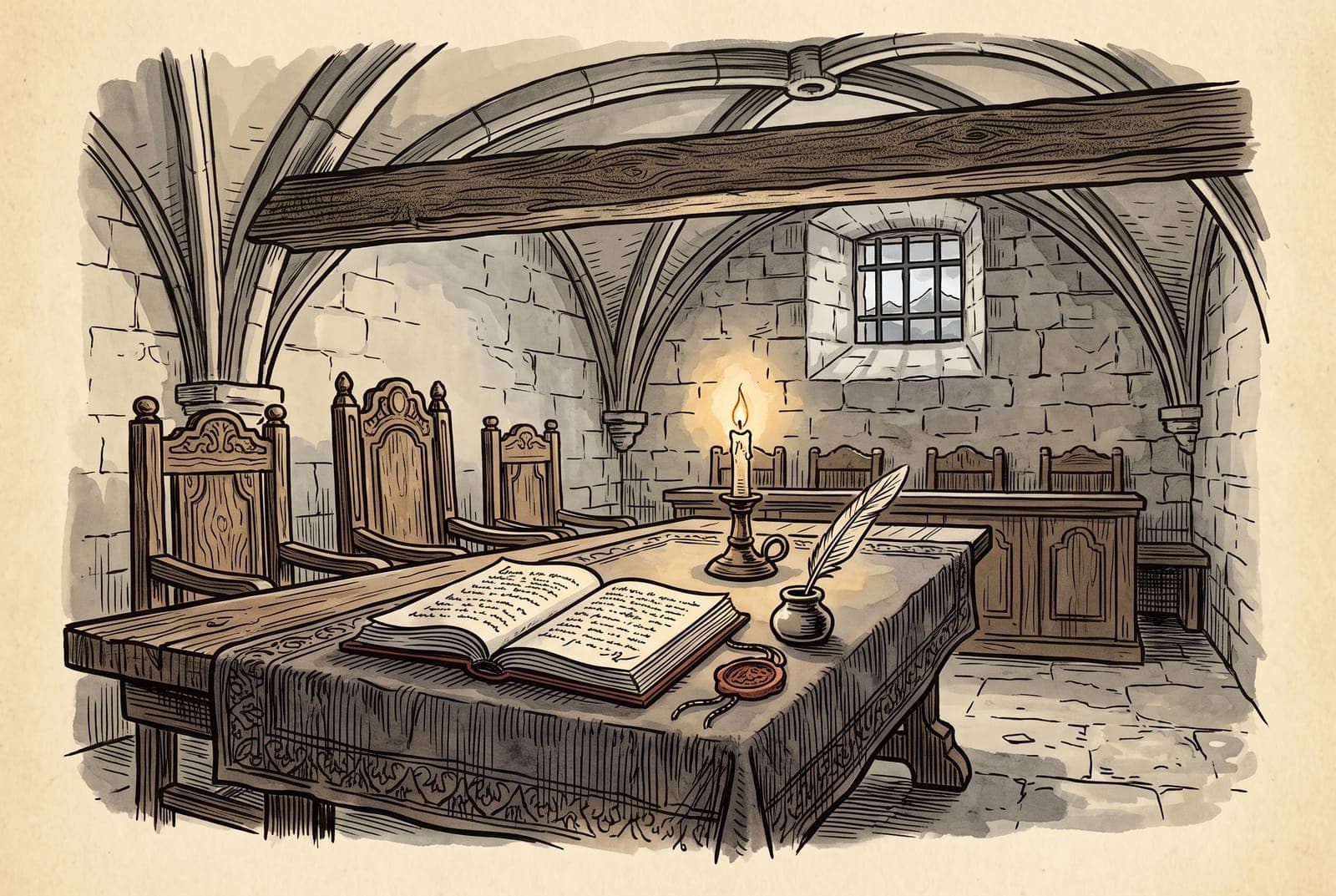
Juraj Jánošík was interrogated, tortured and sentenced by the Liptov County court in Svätý Mikuláš (today Liptovský Mikuláš) on 16 and 17 March 1713: he was to be pierced through the left side with a hook and hung up12. When and where the sentence was carried out was not recorded. Tradition gives 17 or 18 March 1713 and the execution ground of “Šibeničky” east of the town346.
Few periods of his life are as well documented as these two days. The protocol is still kept in the State Archive in Bytča, and a copy of the lost torture interrogation survives in the hand of the poet Janko Kráľ2. That is exactly why a close look pays off. The records show no hero dancing beneath the gallows, but a 25-year-old robber captain who tried to shield his friend, confessed under torture and was condemned under the Hungarian law of his day.
The final arrest in Klenovec
The court records do not say how Jánošík was caught. The historian Ivan Houdek put it plainly as early as 1929: “Ako a kde sa to stalo, o tom niet v súdnych spisoch ani zmienky, odkázaní sme v tom len na podanie” – “How and where it happened, the court records do not mention at all; we must rely on tradition alone.”2
Most of the literature places the arrest in Klenovec, then in Malohont County. Jánošík’s former captain Tomáš Uhorčík was living there under the false name “Martin Mravec”, and Liptov county haiduks seized the robber at his house129. Drawing on older research, the Slovak Wikipedia speaks of some 25 to 30 county guards under the nobleman Andreánsky, with the search organised from Liptov under Emerich Kubínyi11. The spot is still called “Mravcov vŕšok” in Klenovec11.
Why Liptov? In autumn 1712, between Východná and Važec, Jánošík had robbed the wife – or widow – of an imperial officer named von Schardon. The county had to compensate her and so had its own reason to catch the culprit611.
It was not his first arrest. In autumn 1712 Jánošík and “Mravec” had already been detained in Klenovec and held in the manor house at Hrachovo, but they were released after the Malohont deputy county head Pavol Láni intervened – they did not escape, as later stories claim911.
Disputed When and where was Jánošík finally arrested? Miroslav Nemec dates the arrest “around the turn of 1712/1713”14. The municipality of Klenovec and the historian Diana Duchoňová give “early March 1713”910. Klenovec as the place is broadly agreed in the scholarly literature; the version that he was caught in Valaská Dubová comes from folk tradition2. Because the records are silent, both questions remain open.
Custody: the Palúdzka manor or the town prison?
Where was Jánošík held before the trial? Liptovský Mikuláš has long told that he was imprisoned in the Vranovo manor house in Palúdzka, which at the time belonged to the later presiding judge, Ladislav Okolicsányi611.
In 2022 the historian Miroslav Nemec of the Janko Kráľ Museum examined this tradition in Historický časopis. It goes back to a note written by the poet Samo Chalupka in 1868 – a family story set down 155 years after the event1.
Disputed Vranovo or Svätý Mikuláš? According to Nemec, detention at Vranovo is “improbable”: the county was already holding its criminal sessions in Svätý Mikuláš, a town prison is attested there from the late 17th century, and the county later used it for its own prisoners. He does not rule Vranovo out entirely1. The town of Liptovský Mikuláš still mentions the Palúdzka tradition6.
The court and its law
The case was heard before the sedria, the criminal court of Liptov County, in Svätý Mikuláš. Representatives of Trenčín County also attended and put their own questions – after all, the band had committed many of its robberies there, around Žilina and Strečno211.
The roles were clearly assigned111:
| Role | Person |
|---|---|
| Presiding judge | Ladislav Okolicsányi, deputy head of Liptov County (from 1712, in office until 1725) |
| Prosecutor (fiscalis) | Alexander Čemický |
| Court-appointed defender | Baltazár Palugyay |
| Accused | Juraj Jánošík (“Georgius Janossik”, “Juro Janošak”) |
The indictment opens in Latin and calls him “providum Georgium Janossik publicum praedonem seu malefactorem” – “the provident Georgius Janossik, a public robber or malefactor”2. The Slovak part accuses him of having rejected God’s commandments and the prohibitions of the law of the land, of becoming a “zbojnyczkim wudczem”, a robber leader, of robbing, wounding and murdering merchants and others, and of wounding the parish priest so gravely that he had to die2. The mix of Latin and Slovak in the record was deliberate: the accused was meant to understand the charges2.
The indictment cited Hungarian law as its basis: article 13 of 1625, article 26 of 1655 and István Werbőczy’s Tripartitum (part I, title 15), together with the Fifth and Seventh Commandments2. The Tripartitum assigned the gallows to thieves and the stake or the wheel to robbers: “fures scilicet patibulo; praedones vero palo, vel rota, caeteri autem gladio” – “thieves, namely, to the gallows; robbers, however, to the stake or the wheel; all others by the sword”2. The court also drew on Kitonich’s procedural handbook, Directio methodica processus iudiciarii11.
Documented No “Carolina”. One sometimes reads that Jánošík was condemned under the Constitutio Criminalis Carolina. That is wrong. The Carolina (1530/1532) was the criminal code of the Holy Roman Empire, and the Kingdom of Hungary was not part of the Empire12. The protocol itself invokes Hungarian law2. Criminal procedure in Hungary was also shaped by the Habsburg Praxis criminalis of 1656: printed for Hungary at Trnava in 1687, it never gained the force of law there but remained influential into the 19th century13.
Other cases show how Liptov dealt with robbers. The documented punishments were hanging, hanging on a hook, beheading by the sword and breaking on the wheel, after which the body could be woven into a wheel and put on display. Around 1700 the prosecutor demanded the hook or quartering for one Peter Štefančík; the sentence was reduced to hanging2.
Day one, 16 March 1713: confession and confrontation
The trial began with a voluntary confession, known in the sources as the Fassio Janossikiana211. First came the 17 questions from Trenčín County. Jánošík answered them fairly openly, and he was confronted with two of his victims: the Žilina merchant Ján Šipoš, whom the band had robbed in October 1711 and again in May 1712, and the goldsmith Ján Skalka, also of Žilina, from whom they had taken rings, silver spoons and a broadsword211.
The 29 questions from Liptov were another matter. Jánošík gave no answer at all to 14 of them and only evasive answers to 10211. And he lied to protect a friend: Uhorčík, he claimed, had died in the Kremnica Mountains. In fact “Martin Mravec” was sitting in the same custody – not yet recognised11.
The prosecutor, Čemický, demanded death by the stake, the hook or the wheel, preceded by torture. The defender, Palugyay, asked for acquittal11.
Day two, 17 March 1713: torture
The next day the court ruled that, because Jánošík had revealed neither his helpers nor the whereabouts of the loot, he was to be subjected “ľahšiemu, potom i ťažšiemu mučeniu” – “to lighter, and then also to heavier torture”11. Interrogation under torture in a lighter and a heavier degree was standard in the criminal procedure of the time2.
We do not describe the methods here. What the record preserves is the outcome: Jánošík answered seven questions. He admitted the robberies of Mrs von Schardon and of the Orava nobleman Zmeškal, and he named a hiding place – a beech beside a fir “with a cut hand” on the way from Jablonka to Klenovec11.
The defender now put forward two grounds for leniency: Jánošík was young, and he had killed or wounded no one411.
One small uncertainty remains. The archivist Peter Vítek dates the record of the torture interrogation to 16 March 1713, while most other accounts place it on the second day of the trial211.
The priest of Domaniža
One case weighed heavily even though Jánošík had not fired the shot himself. In September 1712 – on the 4th or the 8th – Juraj Vrtík, parish priest of Domaniža, was shot on his way back from Frivald (today Rajecká Lesná); he died on 2 October. The Domaniža register of deaths records: “a duobus praedonibus traiectus est” – “he was shot through by two robbers”5.
In answer to the 13th question from Trenčín, Jánošík testified: “Dva tovarišia Plavčík z Dunajova a Turiak predpsaní strelili naňho a on v ten čas vodu pil na studni, a že od toho pátera nič nevzali a že ho Huncaga postrelil.” – “Two companions, Plavčík of Dunajov and the aforementioned Turiak, shot at him while he was drinking water at a well; they took nothing from the priest, and Huncaga wounded him.”511 Whether it was Jánošík or the priest who was drinking is left open by the sentence11.
The court found that his companions had shot the priest “kde on též bol prítomný” – “where he too was present”511. It did not charge him with firing the shot; his presence was enough for the court to hold him complicit.
The sentence in full
The sentence survives in the original Slovak wording of the protocol11:
“Poneváč predepsaný Juro Janošak zavrhujúce prikázaní jak božské, tak též zákon krajinský predo dvema roky dal sa na zbojstvo a vúdcem aneb hajtmanem takovým se učinil … jeho tovariši, kde on též bol prítomný, pána pátera z Domaniže prestrelili a bezbožne zamordovali … Protož pro takové zlé účinky a prikázaním prestúpení má být na hák na levém boku prehnatý a tak na príklad jinších takových zločincov má být zavesený.”
In English: “Whereas the aforesaid Juro Janošak, rejecting both the divine commandments and the law of the land, took to robbery two years ago and made himself leader or captain of such … and his companions, in his presence, shot and impiously murdered the reverend father of Domaniža … therefore, for such evil deeds and transgressions of the commandments, he shall be driven onto a hook through the left side and so hung up as an example to other such criminals.”11
Two details stand out. The sentence speaks of two years of robbery, the indictment of three11. And it states its purpose openly: deterrence, “na príklad jinších”. The hook did not appear in the Tripartitum, but it was among the punishments imposed in Liptov2.
The execution: what we know and what we don’t
No record of the execution is known211. From here on we are in the realm of conjecture.
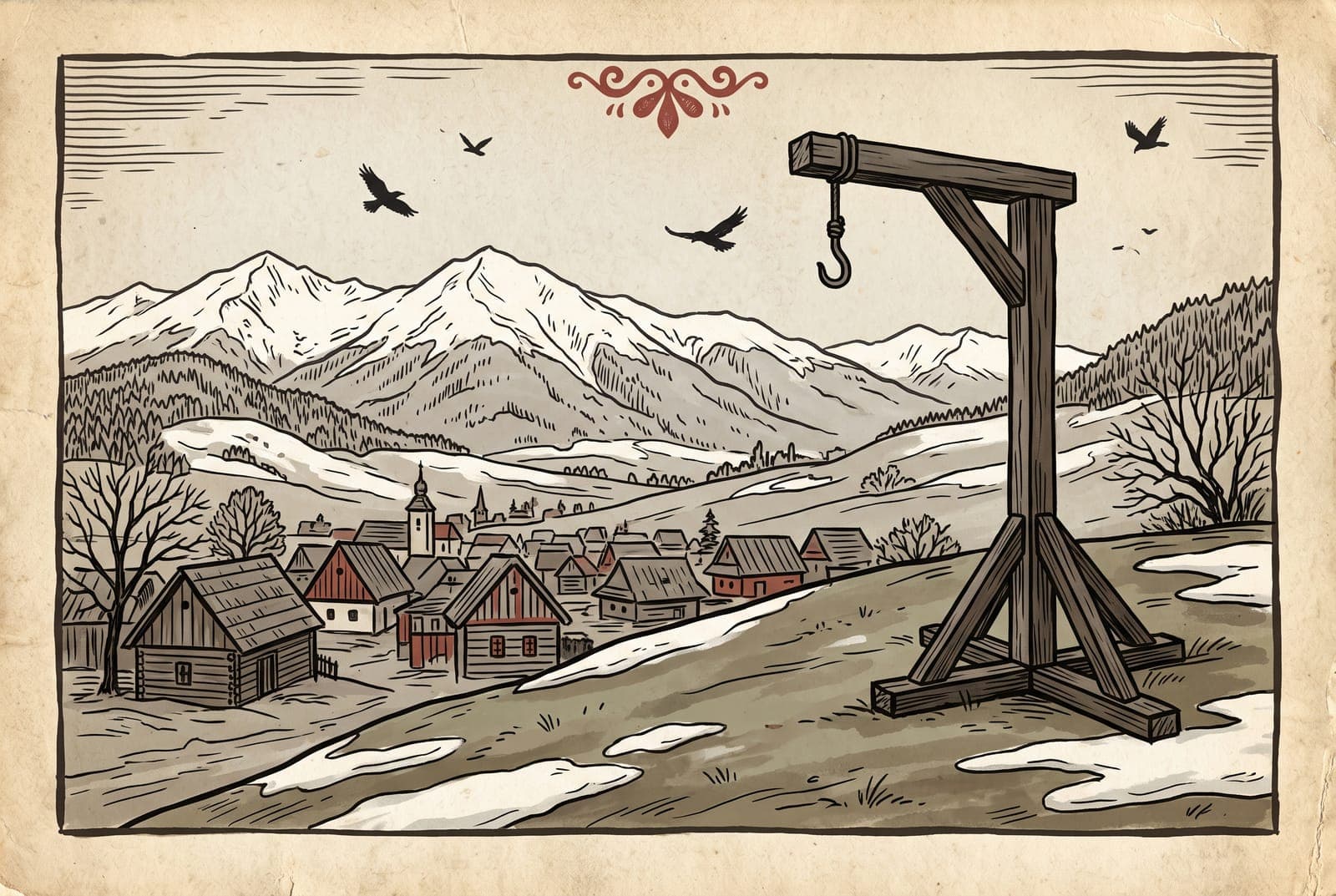
Disputed Day, place and manner of execution. The town of Liptovský Mikuláš gives 17 March6; the Žilina regional library and the municipality of Klenovec give 18 March 171339. Miroslav Nemec of the Janko Kráľ Museum said in 2026: “Nevieme presne kedy, ale v nasledujúcich dňoch bol vykonaný aj ten samotný rozsudok” – “We don’t know exactly when, but the sentence itself was carried out in the following days.”4 The traditional site is Šibeničky, east of the town between Okoličné and Vrbica; written sources place the town’s execution ground of the period on that eastern side. Ivan Houdek, by contrast, suggested the toll point on the Váh by the bridge to Palúdzka26. Whether the sentence was actually carried out with the hook or as a simple hanging is likewise undocumented11.
The executioner was probably brought in from Levoča, Banská Bystrica or Žilina – but that too is an assumption11. Nobody knows where Jánošík was buried. The tradition of a “Kuruc cemetery” at Čemice cannot be checked, because the register of deaths only begins in 17152. Today a memorial with a replica gallows on 1. mája Street marks the traditional site7.
Uhorčík, Hatala, Mikulčík and brother Ján
Jánošík’s lie about the dead Uhorčík did not last. “Martin Mravec” was unmasked and condemned by the same Liptov court; his case occupies pages 568–573 and 577–578 of the same protocol volume2. According to the historian Marián Liščák of the Kysuce Museum, proceedings opened on 19 April and Uhorčík was broken on the wheel on 21 April 17138. The tradition is that he was broken “from the neck”, the form that brought a quicker death12.
Helpers were punished too. On 24 May 1713 the manorial court at Teplička nad Váhom tried Martin Hatala alias Bartoviech of Klenovec and Ján Mikulčík of Poland; both were beheaded after torture for consorting with Jánošík and Uhorčík2. On 18 December 1713 the same court sentenced Jánošík’s younger brother Ján to death by hanging for helping his brother2.
Where the records are – and what was lost
A widespread error holds that the original trial records were lost in the 19th century. The archivist Peter Vítek has set the record straight2:
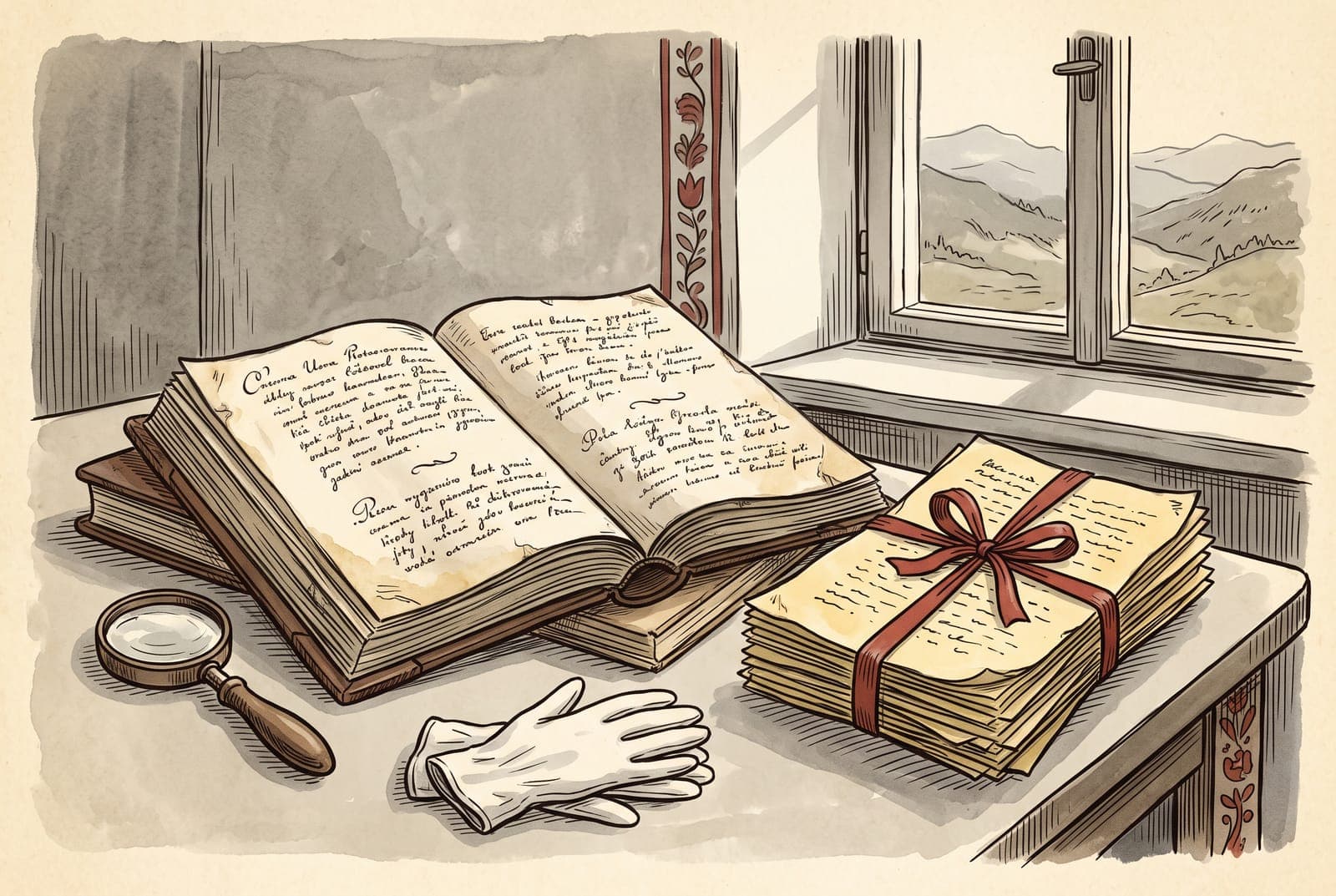
- Surviving: the protocol of the Liptov county congregation for 1710–1717 (Protocollum I. Comitatus Liptoviensis), section Series causarum criminalium, case no. 17, pages 563–567, now in the State Archive in Žilina, seat Bytča (fonds Liptov County I, inv. no. 21). It contains the indictment, an extract of the defence, the prosecutor’s reply, the court’s decision, the deeds admitted under torture and the sentence.
- Surviving: the questions of Trenčín County, with the confession made after the confrontation with Šipoš and Skalka (fonds Trenčín County, Iudicialia miscellanea).
- Lost: the original of the interrogation with the 29 Liptov questions and the torture interrogation. It vanished from the Liptov archive in the third quarter of the 19th century. It is known through a copy made by the poet Janko Kráľ, collated and signed by Gašpar Fejérpataky-Belopotocký on 15 September 1844 and now held by the Slovak National Museum in Martin.
A complete transcription was published in 1986 in the jubilee volume of the Janko Kráľ Literary Museum2.
Which building did the court sit in?
In 1712 the county bought the Hanzely family’s house in Svätý Mikuláš, rebuilt it and used it from 1713 as its first county house. Today it houses the Janko Kráľ Museum on Námestie osloboditeľov1. The town presents a courtroom and a “Jánošík torture chamber” there and describes the building as the probable trial site7.
It is not certain. Houdek (1936) and the historian Uličný (2010) also considered the neighbouring Pongrác curia, alongside the old Hanzely house12.
Where the gallows legends come from
Few images are as firmly tied to Jánošík as his last moments at the gallows. Remarkably, the hook is the only part of that picture that appears in the records2.
Legend The dance beneath the gallows. In folk song Jánošík smokes three pounds of tobacco on the way to the gallows, dances round it several times and refuses a pardon with the words “Keď ste si ma upiekli, tak si ma aj zjedzte!” – “Since you have roasted me, eat me too!” These verses are collected in anthologies of folk poetry (1958, 1988)2. In Martin Frič’s 1935 film he dances a last dance and leaps onto the hook himself; the “pardon that came too late” is a literary motif, used for instance by Jiří Mahen (1910)14. None of these motifs has any basis in the records.
The legend has an understandable core: the hook meant a slow death, and the sentence explicitly set out to make an example of him11. Folk poetry and Romanticism turned the example into a sign of defiance. That is cultural heritage – but not a source for what actually happened in March 1713.
Nor do the records support the image of a robber who gave to the poor: what was taken was cloth, linen, rings, weapons, wigs and small sums of money, and no source documents any sharing with the poor10.
Frequently asked questions
When was Jánošík executed?
The exact date has not come down to us. The sentence was passed on 17 March 1713, and the execution is dated to 17 or 18 March 1713. No record of the execution itself is known.346
Where was Jánošík tried?
Before the Liptov County court in Svätý Mikuláš, today’s Liptovský Mikuláš. The building is usually identified as the first county house, now the Janko Kráľ Museum, though some historians also consider the neighbouring Pongrác curia.17
What was Jánošík’s sentence?
He was to be pierced “on a hook through the left side” and hung up “as an example to other such criminals”. The grounds were robbery as captain of a band and his presence at the fatal attack on the priest of Domaniža.11
Was Jánošík tortured?
Yes. According to the protocol the court ordered “lighter, and then also heavier torture” because he would not name his helpers or hiding places. Under torture he answered seven questions and admitted further robberies.11
Was Jánošík really hung on a hook?
That was the sentence. Whether it was carried out in exactly that form is not documented, because no record of the execution survives. The dance beneath the gallows and the leap onto the hook are legend.21114
Do the records of Jánošík’s trial survive?
Yes, in part. The protocol with the indictment and sentence is in the State Archive in Bytča (pp. 563–567). The original torture interrogation is lost, but it is known from Janko Kráľ’s copy of 1844.2
Sources
- Bol Jánošík väznený v kaštieli Vranovo? – Miroslav Nemec, Historický časopis 70 (2022), č. 1, Historický ústav SAV (2022) [sk]
- Zbojníctvo na Slovensku. Zborník z vedeckej konferencie, Liptovský Mikuláš 4. 11. 2013 – Miroslav Nemec, Peter Vítek (eds.), Spolok Slovákov v Poľsku (2014) [sk]
- Juraj Jánošík 1688–1713. Výberová personálna bibliografia – Krajská knižnica v Žiline (2018) [sk]
- Liptovský Mikuláš si pripomína 313. výročie rozsudku nad Jánošíkom – TASR / teraz.sk (2026) [sk]
- Dvakrát Juraj – Rudolf Šujanský, Farnosť Domaniža [sk]
- Legenda Jánošík – Mesto Liptovský Mikuláš [sk]
- Jánošíkova mučiareň a súdna sieň – Mesto Liptovský Mikuláš [sk]
- Všetkým známy a predsa nepoznaný príbeh Tomáša Uhorčíka – Marián Liščák (Kysucké múzeum), mojeKysuce.sk [sk]
- Historické osobnosti – Obec Klenovec [sk]
- Hrdina alebo zlodej? Jánošík lup chudobe nerozdával, tvrdia historici – noviny.sk (2018) [sk]
- Juraj Jánošík – Wikipédia (slovenská) (2026) [sk]
- Constitutio Criminalis Carolina – Wikipedia (English) (2026)
- Praxis criminalis – Kislexikon [hu]
- Jánošíkovská legenda na Slovensku – Jana Hrajnohová, Bakalářská práce, Univerzita Karlova (2010) [cs]
Transparency notice (Art. 50 EU AI Act): research and text were produced with the help of an AI language model and editorially checked against the sources listed. Illustrations are AI-generated and are not historical depictions.
This article is also available in Deutsch, Slovenčina
More on Janosik.de
Jánošík’s Outlaw Years 1711–1713: Raids, Band and Loot
Juraj Jánošík was an outlaw for barely eighteen months. What the court records reveal about his oath, raids, loot and helpers – told step by step.
Juraj Jánošík: Life, Trial and Legend of Slovakia's National Hero
A serf's son from Terchová, a soldier in two armies, an outlaw captain for little more than a year – and, after his execution in 1713, Slovakia's most famous hero. What the records really say about Juraj Jánošík.
Tomáš Uhorčík – the outlaw captain who made Jánošík a highwayman
Without him there would probably have been no outlaw Jánošík. Tomáš Uhorčík brought the young man from Terchová into his band, went to ground in Klenovec as “Martin Mravec” – and died on the wheel a few weeks after him.