

Upper Hungary around 1700 – war, plague and law in Jánošík’s world
The Ottoman wars, Rákóczi’s uprising, the plague of 1709–1714 and a criminal law of wheel and hook – this was the world in which Juraj Jánošík became a soldier, a guard and an outlaw.
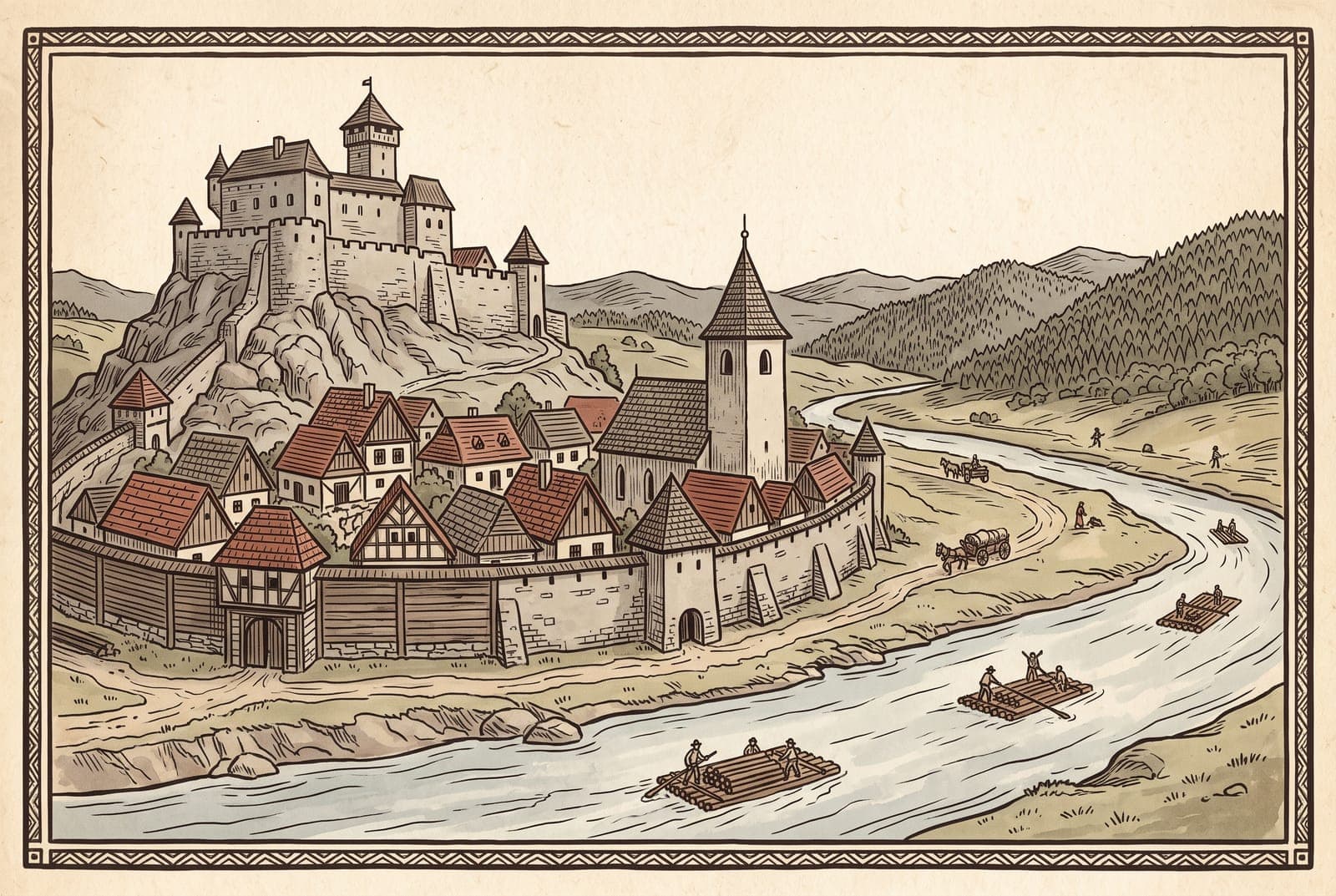
Juraj Jánošík lived from 1688 to 1713 in the north of the Kingdom of Hungary, which was ruled by the Habsburgs – in the region known as “Upper Hungary”, which corresponds roughly to present-day Slovakia34. His short life fell in an age of upheaval: the end of the Ottoman wars in 1699, Rákóczi’s uprising of 1703–1711 and the last great plague epidemic of 1709–17144511. In those years Jánošík was a kuruc soldier, an imperial guard and finally an outlaw captain – and each of these roles makes sense only against the background of his times12.
When the parish priest Michal Smutko baptised the child of Martin Jánošík and Anna Czisznik at Varín on 25 January 1688, the Prešov executions were less than five months in the past113. When the Liptov county court sentenced Jánošík to death in March 1713, the plague had not yet died out211. In between lie 25 years in which a young man from a mountain village was caught between high politics, lordship and an unforgiving criminal law.
A kingdom under the Habsburg crown
There was no Slovak state around 1700. The land between the Danube and the Tatras belonged to the Kingdom of Hungary, ruled by the Habsburgs from 1526 to 18674. Because Buda was in Ottoman hands until 1686, Pressburg (Bratislava, Hungarian Pozsony) served as the capital from 1536 to 17834.
The Habsburg King of Hungary also wore the imperial crown. Hungary, however, kept its own laws and its own Diet, and its nobility had its privileges confirmed again and again4814. The tension between Vienna and the Hungarian estates shaped the whole of Jánošík’s lifetime – and eventually erupted into war.
After Jánošík’s death, in 1715, King Charles III (as Emperor, Charles VI) set up a standing army which, in the words of the overview article, was “entirely funded and manned by the non-noble population”4. The direct war tax that paid for it, the contributio, was levied only on peasants and towns9.
What “Upper Hungary” actually meant
The Encyclopaedia Beliana of the Slovak Academy of Sciences gives the Latin forms Hungaria Superior or Partes regni Hungariae superiores, German Oberungarn and Hungarian Felsőmagyarország3. Originally the name covered only the north-eastern counties around Košice: Gemer, Spiš, Zemplín, Abov, Šariš, Turňa and Uh. Only later, until 1918, did it come to mean “practically the whole territory of Slovakia”3.
Strictly speaking, Trenčín, Liptov and Orava – Jánošík’s home and the scene of his deeds – were not part of the older, narrow “Upper Hungary” around Košice. For the period around 1710, however, the broader usage is common3.
The counties: Jánošík’s map
More important to people at the time than “Upper Hungary” was the county (Slovak stolica, Hungarian vármegye). It had its own police – the hajdúci or drábi – and, in its sedria (sedes iudiciaria), a court that could pass death sentences1. An outlaw active in several counties faced several authorities: at Jánošík’s trial in Liptov, representatives of Trenčín county also took part and put their own questions to him1.
The indictment of 1713 lists the counties in which he was said to have robbed: Trenčín, Nitra, Turiec, Liptov, Orava “and others”, and even Silesia1.
| County (SK / HU / DE) | Link to Jánošík | Source |
|---|---|---|
| Trenčianska stolica / Trencsén / Trentschin | home county: Terchová and the parish of Varín; guard duty at Bytča castle; Battle of Trenčín 1708 | 127 |
| Liptovská / Liptó / Liptau | robberies between Východná and Važec and in the Malatiná valley; salaše from Hybe to Važec; trial at Svätý Mikuláš 1713 | 1 |
| Oravská / Árva / Arwa | attack on the Orava nobleman Zmeškal; separate series of criminal records from 1688 | 1 |
| Turčianska / Turóc / Turz | named in the indictment of 1713 | 1 |
| Gemer and Malohont / Gömör and Kishont | origin of some band members; Klenovec, where Uhorčík lived as “Martin Mravec” and Jánošík was arrested | 12 |
In 1712 General János Pálffy reported that banditry was spreading in Trenčín, Orava and Liptov, and also in Spiš and Šariš1.
After the Ottoman wars: the Treaty of Karlowitz
Jánošík was born into a world in which the Ottomans still held large parts of Hungary. The turning point came with the failed siege of Vienna in 1683; in 1686 the Habsburgs retook Buda4. The Treaty of Karlowitz of 1699 finally gave the Habsburgs most of Ottoman Hungary; Transylvania remained formally autonomous but under Austrian governors4.
Peace abroad did not mean safety at home. In that same year, 1699, Emperor Leopold I complained that bandits were plundering villages near Pezinok and Svätý Jur, and even at the gates of Bratislava1. His mandates of 1699 and 1700 advised the counties to plant spies inside the bandit bands1. Jánošík was eleven at the time.
Kuruc against labanc: Rákóczi’s uprising, 1703–1711
Rákóczi’s War of Independence against the Habsburgs began on 15 June 1703 and formally ended on 1 May 17115. It was triggered in part by the persecution of Protestants and by land seizures4. On 13 June 1707 the Diet of Ónod declared the Habsburgs deposed in Hungary5.
The insurgents were called kuruc; the word probably comes from Turkish and means “rebel”. Their opponents, the side loyal to the emperor, were called labanc – originally a name for the Austrian soldiers6. According to the overview article, the kuruc armies consisted “mostly of impoverished lower Hungarian nobility and serfs, including Hungarian Protestant peasants and Slavs”6.
In the middle of the war, Jánošík appears in the records for the first time as an adult: a muster roll of the kuruc infantry regiment of Colonel Wilhelm (Viliam) Winkler, dated 2 December 1707, lists him1. That was half a year after Ónod. Jánošík was not quite twenty.
The historian Ivan Mrva writes that the eight-year kuruc war made banditry grow to “unprecedented dimensions”: peasants called up into the county regiments deserted and turned to robbery1. Tomáš Uhorčík, later Jánošík’s captain, had been robbing since about 17041.
The Battle of Trenčín, 3 August 1708
The decisive battle in the north was fought on 3 August 1708 near Trenčín, around Turná, Soblahov and Lehota. About 15,000 kuruc with 12 cannon faced some 5,000 imperial troops and 3,000 Serbian auxiliaries under Heister and Pálffy7. The kuruc were almost twice as strong – and still suffered a heavy defeat: about 3,000 dead and wounded, 500 prisoners and the loss of all 12 cannon. The imperial side lost only about 200 men7.
Chance decided the day: Rákóczi’s horse stumbled, the prince fell and lost consciousness. His troops thought he was dead and fled75.
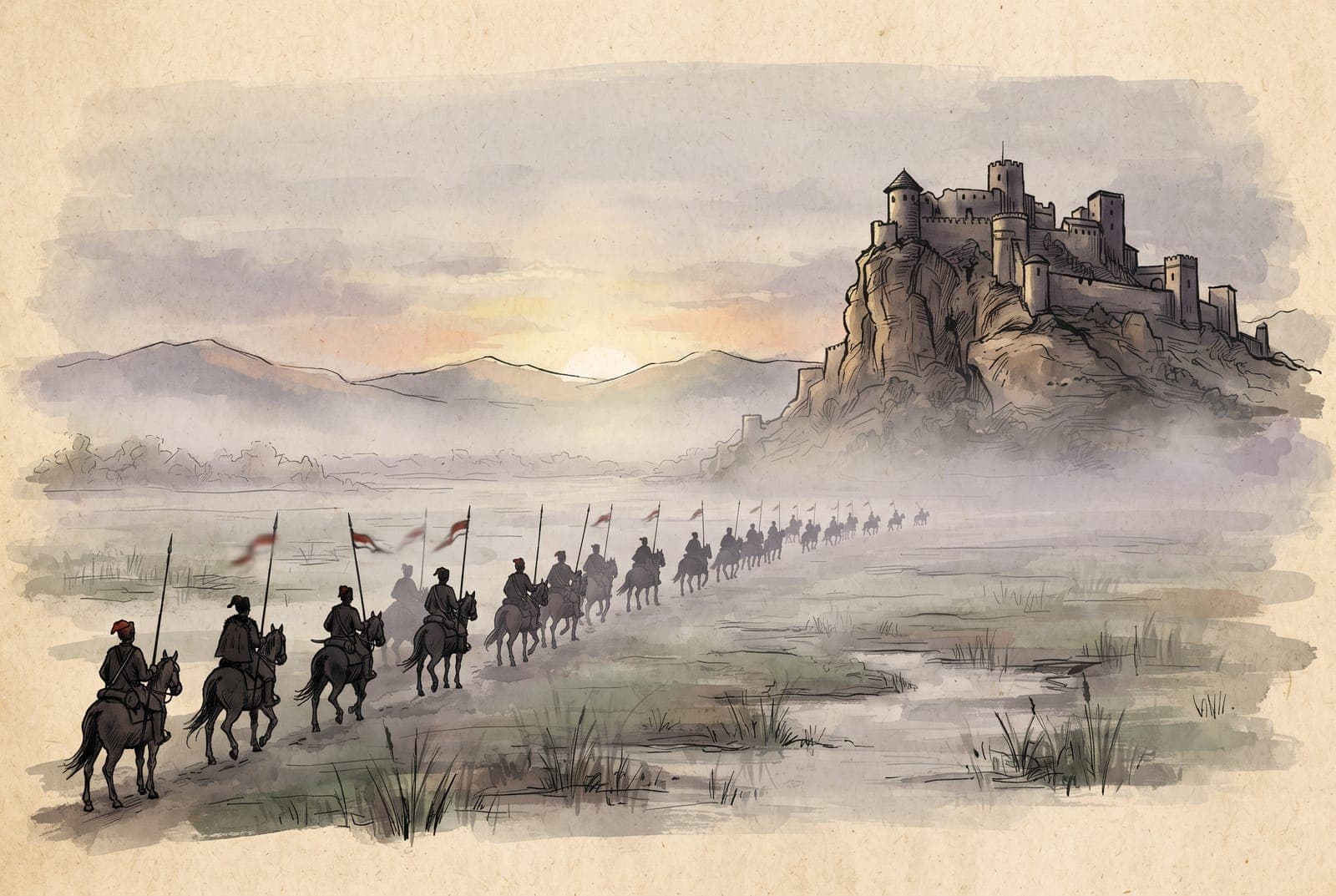
Disputed Was Jánošík at Trenčín? Only the muster roll of December 1707 is documented1. The historian Miroslav Nemec writes that Jánošík “probably” left the kuruc after the Battle of Trenčín2. No document is known that records his part in the battle or his capture there. An earlier enlistment, which some accounts place as early as 1703, is not documented either1.
What came next is certain: Jánošík served in the imperial army – with the labanc – as a guard at Bytča castle. There he guarded prisoners, among them the robber captain Tomáš Uhorčík of Predmier2. The kuruc had become a labanc. In 1710 his parents bought him out of the army2.
Szatmár 1711: peace without Rákóczi
On 29 April 1711, Pálffy for the Habsburgs and Károlyi for the kuruc signed the Peace of Szatmár. Rákóczi rejected it and left for Poland. On 1 May 1711 about 12,000 kuruc swore allegiance to the king at Majtény8. The peace brought a general amnesty, guarantees of religious freedom and of the constitution, and confirmation of the nobility’s privileges in return for an oath of loyalty8; the nobility’s exemption from direct taxation was confirmed as part of the settlement9.
Barely six months after Majtény, in the autumn of 1711, Jánošík joined Uhorčík’s band2.
Subjects, robot and the ninth
The peasants of the kingdom were the subjects of a landlord. The legal basis was the law of 1514, passed after the peasant revolt led by György Dózsa and taken over into Werbőczy’s Tripartitum. It condemned the peasants to “mere and perpetual rusticity” (mera et perpetua rusticitas) and fixed their dues9:
- a 1-forint “smoke tax” per household,
- one day of robot a week,
- one chicken a month and two geese a year,
- the ninth to the lord and the tenth (tithe) to the Church,
- one fattened pig for every ten plots.
On paper this was a heavy burden. Practice was different, and that matters: in former Royal Hungary and the northern uplands, robot of “around ten or twelve days a year” was common before the Urbarium reform. Only from the late 1750s did demands rise towards the 52 days of the 1514 law9. The historian Robert Gray stresses that local custom varied greatly, and regards even the translation of rusticus as “serf” as debatable9.
Peasants’ freedom of movement had been restored between 1538 and 1547. From 1608 the counties held authority over relations between lord and subject, and peasants also owed 12 days’ labour a year on roads and fortifications9. On the Esterházy estates, peasants negotiated in 1711–1712 to limit robot to 52 days a year with no more than two days a week, or to commute it for 4 forints per plot9.
How little a subject counted before the law is shown by the homagium, the legal “price” of a person: 40 gold florins for a peasant, 200 for a nobleman1. Even so, the historian Floreková found no “targeted fight against the lords” in the Orava bandit trials; she names economic pressure, rising feudal rent and the wish to get rich quickly as motives1.
Wallachians and shepherds: the world of the salaš
The mountains around Terchová, in Liptov and in Orava were shaped by pastoral farming. From the 14th to the 17th century, settlers under Wallachian law (valašské právo) colonised the mountains of northern and central Slovakia. Romanian and Ruthenian groups came first; later the settlers were mostly local Slovaks, Poles and Ruthenians. The movement reached Gemer, the upper Hron valley and Liptov, Orava and Trenčín10.
After their initial tax-free years the settlers owed a twentieth of their sheep, plus dues on cattle, cheese, bryndza, game, leather and homespun cloth. They performed guard duty and later forest work; their villages were led by hereditary judges, the šoltýs or vajda. By the 17th century the Wallachians had merged with the rest of the village population10.
This pastoral world was the breeding ground of banditry. According to the court records, the outlaws of Liptov and Orava were mostly shepherds (valasi, bačovia), then farmhands, less often soldiers or former kuruc, and usually aged between 20 and 401. Shepherds and innkeepers gave them food and shelter, bought gunpowder for them and warned them of the county haiduks1. Jánošík himself moved through Liptov from one salaš (shepherds’ hut) to the next – Revúca, Likavka, Bobrovec, Porúbka, Hybe, Važec – and had a sheep slaughtered at each1. And on 17 August 1712 the manorial court at Teplička nad Váhom recorded that people from Terchová gave bandits food and shelter1.
Legend It is often said that outlaws roamed “from St George’s Day to Michaelmas” (24 April to 29 September). The scholarly literature does not confirm this as a fixed rule. What is documented is a pattern from Orava in 1735: “In summer they stayed in the forest and went to the salaše, where the shepherds gave them food and sometimes lodging. In winter they dispersed to their homes or hid with acquaintances or relatives.” Yet the same band met again in the mountains as early as mid-January1.
Plague and hunger, 1709–1714
As the war was winding down, an enemy arrived against which no army could help. The last great plague epidemic in the territory of Slovakia lasted from 1709 to 171411. Some towns lost up to a third of their inhabitants; Prešov’s burial register for 1710 records plague deaths11.
For the Kingdom of Hungary as a whole, a Hungarian educational portal estimates around 400,000 plague deaths in 1708–1711 – compared with about 80,000 killed in the whole war12. Such totals are estimates; counted deaths in individual places, as shown in the chart, are more reliable.
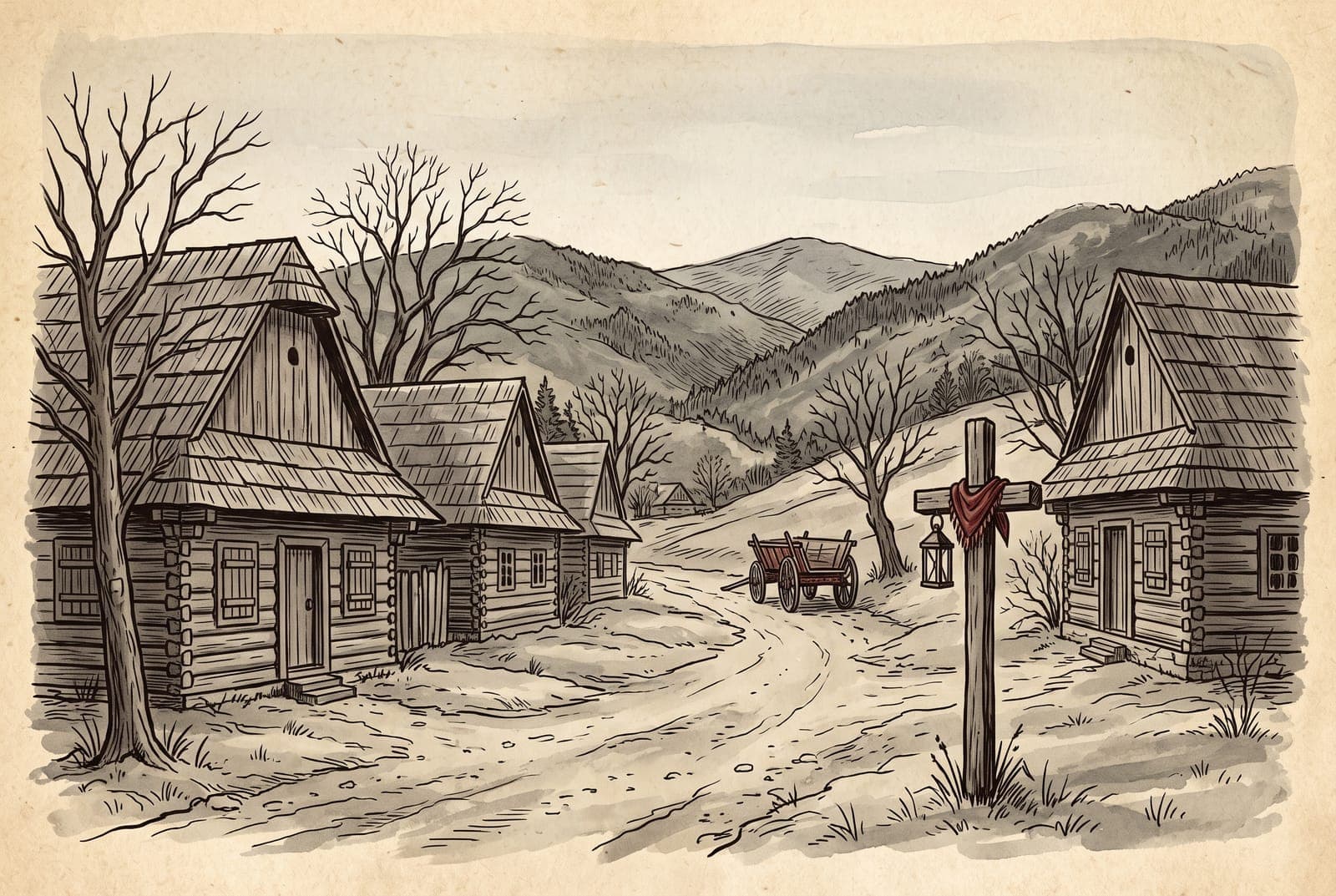
Deserted farms followed the epidemic. An estate survey of Michalovce from 1715 lists abandoned holdings11; across Hungary, many plots and whole villages were recorded as puszta – deserted – in 1715–17219. War and plague left an exhausted land, but the sources used here give no reliable figures for harvest failure and hunger in Jánošík’s home region.
Jánošík’s outlaw years – from autumn 1711 to his arrest around the turn of 1712/13 or in early March 1713 – fell squarely within the plague years211. Whether the epidemic affected the band’s movements, the records do not say.
Faith and the Counter-Reformation
Around 1700, religion was not a private matter but politics. Between 5 March and 12 September 1687, the special court of General Antonio Caraffa executed 24 Protestant burghers and nobles in Prešov, accusing them of conspiring with Thököly’s rebels. The event went down in history as the “Prešovské jatky” – the “Prešov slaughterhouse”13.
The kuruc movement drew support from Protestants resisting the Counter-Reformation6, and Rákóczi’s war was sparked partly by the persecution of Protestants4. The Peace of Szatmár therefore expressly guaranteed religious freedom8.
Jánošík himself was baptised a Catholic – in the parish of Varín, to which Terchová belonged1. Among his victims was the wife of a Lutheran pastor from Liptovský Ján, whom he robbed on a raft on the Váh near Kraľovany1. The sources name no religious motive.
Law and punishment: the Tripartitum and the Praxis criminalis
Hungarian criminal law rested on István Werbőczy’s Tripartitum of 1517. Title I/15 lays down: “fures scilicet patibulo; praedones vero palo, vel rota, caeteri autem gladio” – “thieves on the gallows, robbers on the stake or the wheel, the rest by the sword”1.
Disputed How to translate palo is disputed. The legal historian Uličný reads it as impalement1. Ivan Mrva renders it as “kolom alebo kolesom” – stake or wheel1.
Alongside it stood the Praxis criminalis of Ferdinand III, issued in Vienna on 30 December 1656. Cardinal Kollonich had it printed for Hungary at Trnava (Nagyszombat) in 1687, and in 1696 it was appended to the edition of the Corpus Juris Hungarici. The Diet of 1728–29 examined it but never enacted it as law – yet it shaped criminal procedure until the mid-19th century14.
The laws against bandits were harsh; their enforcement was weak. Bandits were to be executed by the road where they had robbed and left hanging as a warning; in 1548 the forest was to be cleared for 200 ells on either side of the roads1. Law 38/1655 even forbade pardoning a captured bandit of noble birth1. There was a reason why such laws had to be renewed again and again: noblemen protected bandits or shared their loot1.
Interrogation under torture, in lighter and heavier degrees, was standard1. Jánošík’s indictment cited law 13/1625, law 26/1655, the Tripartitum I/15, and the Fifth and Seventh Commandments1. The record of his interrogation under torture, the “Fassio Janossikiana”, survives only in a copy made by Janko Kráľ in 18441. On 17 March 1713 he was sentenced to be pierced through the left side with a hook and hung up2. Whether the sentence was carried out in exactly this way, and whether on 17 or 18 March, is not documented1.
Documented In 18th-century Liptov, hanging, hanging on a hook, beheading and breaking on the wheel are all documented; often the body was then “woven” into a wheel and displayed1. Uhorčík was broken on the wheel in 1713, and Jánošík’s brother Ján was sentenced to death by hanging by the manorial court at Teplička nad Váhom on 18 December 171312.
How many people lived in the country?
Population figures for the years around 1700 are uncertain, because the first tax conscriptions of 1715–1721 were incomplete9.
Disputed Robert Gray infers from these lists a population of about 4.5 million for Hungary9. The English-language overview of the kingdom, on the other hand, states that the population more than tripled to 8 million between 1720 and 1787 – which implies fewer than 2.7 million in 17204. Every total is an extrapolation.
What is certain is that war and plague had exhausted the country and that many farms stood empty911. Through this land moved small bands of about three men and large ones of ten or more – always dependent on helpers1.
Jánošík’s life in the mirror of his age
Set Jánošík’s documented life against the events of his time and the two interlock: baptised a few months after the Prešov executions113, a kuruc soldier half a year after Ónod15, an imperial guard after the defeat at Trenčín72, bought out of the army in the middle of the plague years211, an outlaw in the autumn after the Peace of Szatmár82, and sentenced a year after Pálffy’s report on rampant banditry1.
Jánošík was no exception but a child of his time: “Carpathian banditry” peaked from the 16th century until roughly the middle of the 18th1. What sets him apart from other outlaws is not his life but what later generations made of it.
Frequently asked questions
What does “Upper Hungary” mean?
“Upper Hungary” (Hungaria Superior, Slovak Horné Uhorsko) originally meant only the north-eastern counties of the Kingdom of Hungary around Košice. Later, until 1918, it came to mean practically the whole territory of present-day Slovakia3.
Which state did Slovakia belong to in Jánošík’s time?
The territory of present-day Slovakia was the northern part of the Kingdom of Hungary, ruled by the Habsburgs from 1526 to 1867. From 1536 to 1783 its capital was Pressburg, today’s Bratislava4.
Who were the kuruc and the labanc?
The kuruc were the anti-Habsburg insurgents of 1671–1711; the labanc were the side loyal to the emperor, originally the Austrian soldiers6. Jánošík served first with the kuruc – documented by a muster roll of 2 December 1707 – and then as a guard in the imperial army at Bytča12.
Did Jánošík fight at the Battle of Trenčín in 1708?
That is not documented. What is certain is that he served in a kuruc regiment at the end of 1707; the historian Miroslav Nemec believes he probably left the kuruc after the battle of 3 August 170812. No source recording his part in the battle is known.
Sources
- Zbojníctvo na Slovensku. Zborník z vedeckej konferencie, Liptovský Mikuláš 4. 11. 2013 – Nemec, Miroslav – Vítek, Peter (eds.), Spolok Slovákov v Poľsku (2014) [sk]
- Bol Jánošík väznený v kaštieli Vranovo? – Nemec, Miroslav – Historický časopis 70/1, Historický ústav SAV (2022) [sk]
- Horné Uhorsko – Encyclopaedia Beliana, Encyklopedický ústav SAV (2010) [sk]
- Kingdom of Hungary (1526–1867) – Wikipedia (English) (2026)
- Rákóczi's War of Independence – Wikipedia (English) (2026)
- Kuruc – Wikipedia (English) (2026)
- Battle of Trenčín – Wikipedia (English) (2026)
- Treaty of Szatmár – Wikipedia (English) (2026)
- Land Reform and the Hungarian Peasantry c. 1700–1848 (PhD thesis) – Gray, Robert W. B. – University College London (2009)
- Valaská kolonizácia – Horváth, Stanislav – Centrum pre tradičnú ľudovú kultúru (encyklopédia) (2026) [sk]
- Epidémie v minulosti (prezentácia) – Štátny archív v Prešove, Ministerstvo vnútra SR (2026) [sk]
- Pestis Magyarországon – Sulinet Hírmagazin (2026) [hu]
- Prešovské jatky – Wikipédia (slovenská) (2026) [sk]
- Praxis criminalis – Kislexikon (2026) [hu]
Transparency notice (Art. 50 EU AI Act): research and text were produced with the help of an AI language model and editorially checked against the sources listed. Illustrations are AI-generated and are not historical depictions.
This article is also available in Deutsch, Slovenčina
More on Janosik.de
Zbojníctvo: Carpathian outlaw bands of the 17th and 18th centuries
In the 17th and 18th centuries bands of shepherds and farmhands roamed the forests and passes of the Carpathians. Court records show how they lived, shared their loot and died – and how little of it resembles the legend.
Juraj Jánošík: Life, Trial and Legend of Slovakia's National Hero
A serf's son from Terchová, a soldier in two armies, an outlaw captain for little more than a year – and, after his execution in 1713, Slovakia's most famous hero. What the records really say about Juraj Jánošík.
Trial and Execution 1713 – Jánošík Before the Liptov County Court
Two days in March 1713 decided the fate of Juraj Jánošík. The Liptov County protocol survives – and tells a soberer story than the songs.