

Zbojníctvo: Carpathian outlaw bands of the 17th and 18th centuries
In the 17th and 18th centuries bands of shepherds and farmhands roamed the forests and passes of the Carpathians. Court records show how they lived, shared their loot and died – and how little of it resembles the legend.
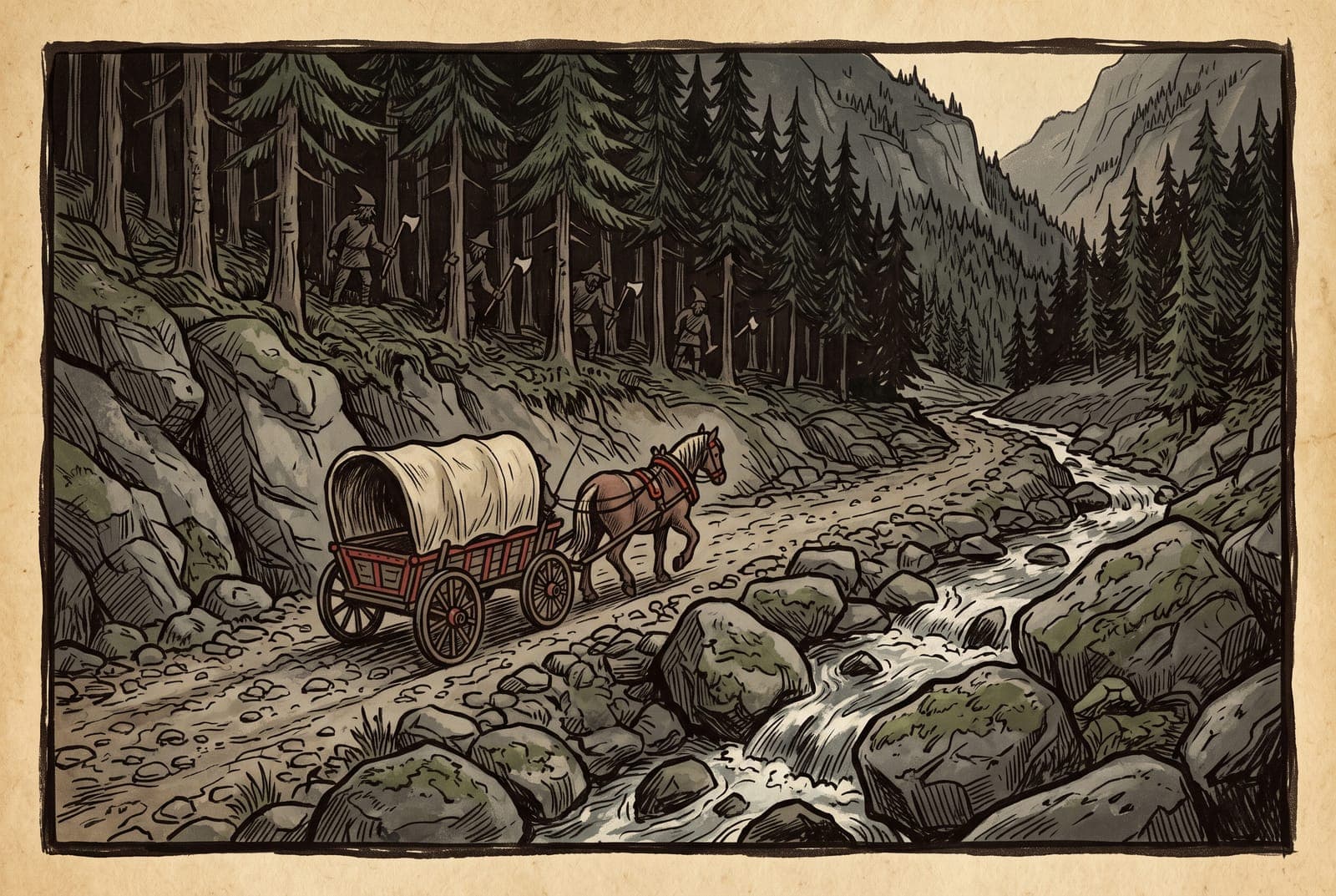
Zbojníctvo is the term Slovak historians use for the highway banditry of the Carpathians, which peaked from the 16th century until roughly the middle of the 18th2. The outlaws were mostly young shepherds aged 20 to 40, who raided merchants, nobles and shepherds’ huts in small bands of three to ten or more men1. Juraj Jánošík was one of them – not an exception but part of a phenomenon that the courts fought for generations with the gallows, the hook and the wheel.
A phenomenon, not a lone hero
Open the court records of 17th- and 18th-century Liptov, Orava or Trenčín and the same patterns keep recurring: young men from mountain villages who spend the summer in the forests, lie in wait for merchants at narrow places and relieve shepherds of their cheese and lambs. Hungarian law calls them praedones; ordinary people called them zbojníci4. The historian Ivan Mrva dates the peak of this “Carpathian banditry” from the 16th century to roughly the middle of the 18th2.
The outlaws were not merely a problem of remote mountain valleys. In 1699 Emperor Leopold I complained that bands were plundering villages near Pezinok and Svätý Jur, and even robbing at the gates of Pressburg (Bratislava)2. And it could be bloody: in 1622 bandits attacked Lučenec, killed 130 people and extorted 3,000 gold florins in protection money from the town2.
Causes: what Slovak historians point to
Mrva sees a structural cause in the law itself. Hungarian law punished robbery harshly but often failed to enforce it. Above all, nobles protected bandits or shared their loot. Laws of 1486, 1492, 1548 and 1655 tried to stop this, and Leopold I’s mandates of 1699–1700 tried again2.
Then came war. According to Mrva, the eight-year kuruc uprising led by Francis II Rákóczi made banditry grow “to unprecedented dimensions”: peasants called up into the county regiments deserted and turned to robbery2. In 1712 General János Pálffy reported banditry spreading in the counties of Trenčín, Orava and Liptov, as well as in Spiš and Šariš3.
The Orava historian Iveta Floreková names economic pressure, rising feudal rent and the wish to get rich quickly as motives. In the Orava trials she finds no “targeted fight against the lords”3. Ferdinand Uličný draws a sober conclusion: bandits were criminals and their robberies were crimes; the image of a hero who “took from the rich and gave to the poor” grew up only later, in folk tradition4.
Who the outlaws were
The 18th-century Liptov records analysed by the historian Miroslav Nemec give a clear profile. Most outlaws were shepherds – valasi (shepherd lads) and bačovia (head shepherds) – followed by farmhands and, less often, soldiers or former kuruc. Most were aged between 20 and 40; one boy was only 151. They came from Liptov, Orava, Kysuce, Spiš, Gemer, Malohont and Zvolen, but also from Poland and Moravia1.
Kysuce in particular, Mrva notes, supplied a large part of Jánošík’s band; as late as 1740 the scholar Matej Bel still called Vysoká nad Kysucou a “bandit nest”2. Women appear too: in the Orava band of 1735, the wife of its leader Ján Kovalík kept watch dressed in men’s clothes3.
The records even describe what the outlaws wore. Michal Mlynarčík’s band in 1782 had black “Wallachian” shirts, white decorated trousers made to order and hats bound with red cloth; one Matej Garaj was described in 1743 wearing krpce (leather moccasins) and a širica coat, with a shoulder bag and a powder flask made of deer horn1. Every outlaw carried a valaška (shepherd’s axe) or an axe and a knife; firearms appear as flinty (flintlocks), karabíny (carbines), the larger mordárka and pištole (pistols)1.
Bands, captains and loot
An outlaw band was small. Nemec distinguishes small bands of about three members from large ones of about ten or more1. The documented cases show the range:
| Band | Year | Region | Members | Source |
|---|---|---|---|---|
| Portašik | 1688 | Turiec, Orava, Kysuce, Poland | c. 25 | 3 |
| Peter Štefančík | c. 1700 | Upper Liptov | at least 3 | 1 |
| Kovalík / Bačinský | 1735 | Orava – Poland | 7–10 | 3 |
| Kovalík’s own group | 1735 | Orava | 1 leader + 4 | 3 |
| Michal Mlynarčík “Vlk” | 1782 file | Liptov | c. 10 | 1 |
| Typical small / large band | 18th c. | Liptov | c. 3 / c. 10+ | 1 |
The records call the leader hajtman or hadnagy – Hungarian for “lieutenant” – and the members tovariši, companions1. The version of Jánošík’s trial published in the 1830s calls him “hlavník (hadnad)”5. Folk tradition prefers kapitán. The term “harnadník”, which is sometimes seen, could not be found in the scholarly sources checked.
Loot was usually shared in equal parts1. New members swore loyalty. In one documented case the men knelt in the forest on a Sunday, laid two fingers on an axe and swore never to betray the band, not even under torture1.
Documented Shepherds’ huts (salaše) were the most frequent target: outlaws took sheep, cheese, bryndza and oštiepky; one salaš at Hybe lost about twelve lumps of cheese in a single raid. These raids were usually not very violent. The real money came from merchants, nobles and Jews, often on tips from informers – and some bands tortured their victims with fire to find hidden money13.
An Orava case shows what a raid could bring in: in 1688 the wife of an official held by the Portašik band brought 300 ducats in ransom3.
Summer in the forest, winter in the village
Outlaw life followed the rhythm of the mountain year. Floreková summarises the testimony of the 1735 Orava band roughly as follows: in summer the men stayed in the forest and went to the salaše, where shepherds gave them food and sometimes lodging; in winter they dispersed to their homes or hid with acquaintances or relatives3.
This was not a fixed rule: the same band met again in the mountains as early as mid-January 17353. A frequently quoted saying that the bandit season ran “od Jura do Michala” (from St George’s Day to Michaelmas) could not be confirmed in any scholarly source.
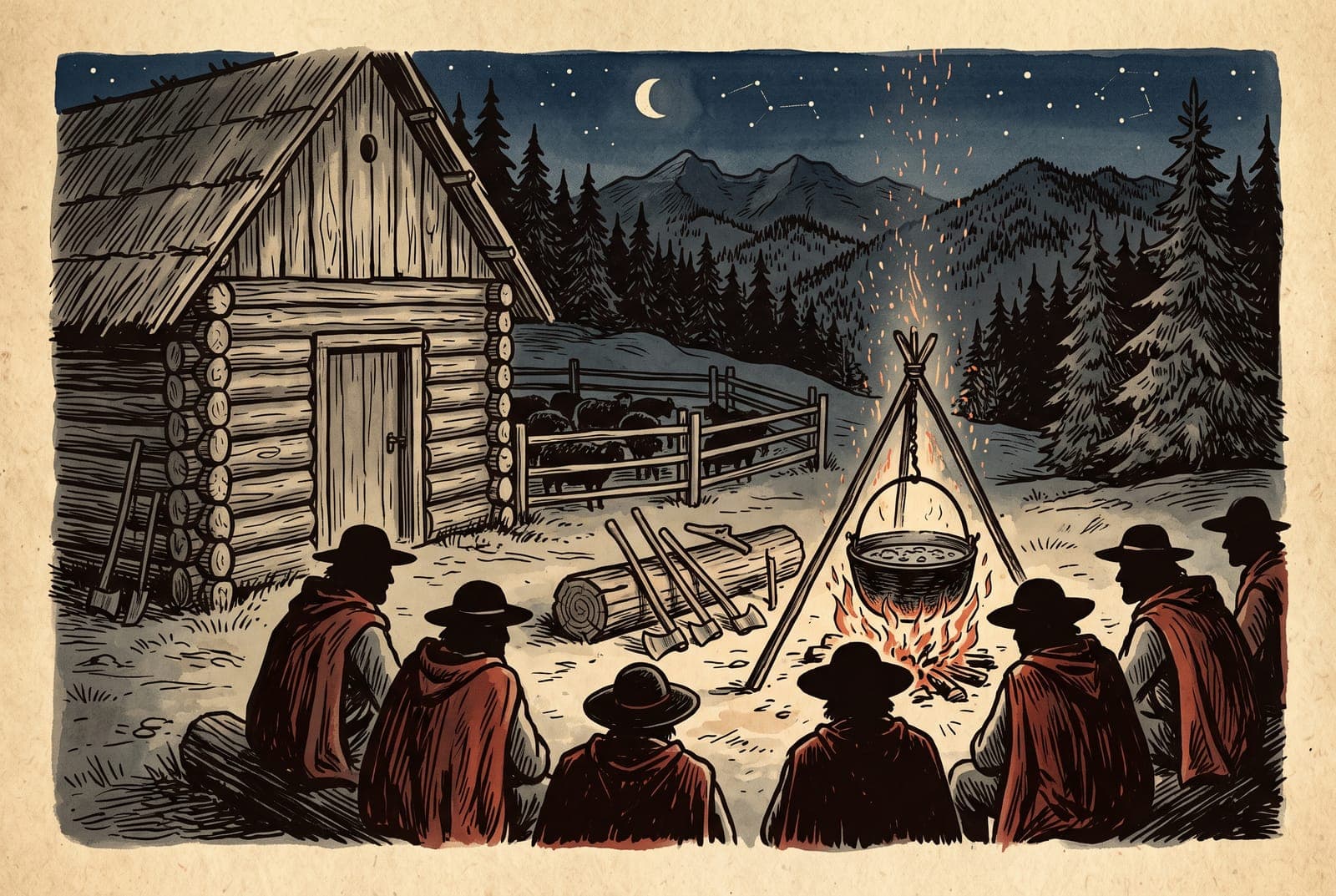
The most important hideouts, then, were not caves full of treasure but people. Shepherds and innkeepers provided food and shelter, bought gunpowder and gave warning of approaching hajdúci, the county police1. For Jánošík’s home village this is on record: in 1712 a court at Teplička nad Váhom noted that people of Terchová, below the Malá Fatra, associated with bandits and gave them food and shelter5.
Jánošík’s own route through Liptov ran via the salaše of Revúca, Likavka (two), Bobrovec, Porúbka, Hybe and Važec; at each of them the men slaughtered a sheep1. Between Východná and Važec they robbed merchants of wine, and near Kraľovany they held up the wife of a Lutheran pastor on a raft on the Váh1.
How the authorities struck back
The law was unambiguous. Bandits were to be executed by the roadside where they had robbed and left hanging as a warning (laws 1546/51, 1548/48 and 1622/64). In 1548 the Diet ordered the forest to be cleared for 200 ells on either side of the roads2. Law 38/1655 even forbade pardoning a captured bandit of noble birth2.
Leopold I’s mandate of around 1699 advised the counties to plant agents inside the bands2. Further decrees followed: in 1717 Charles VI ordered the royal roads to be protected and anyone who helped bandits to be punished3; mandates of 1726 and 1735 added military assistance and the use of local inhabitants2.
On the ground, the counties’ drábi or hajdúci hunted the bands1. Sometimes villagers took matters into their own hands: in 1735 people in Zubrica caught outlaws themselves3. Interrogation under torture, in a lighter and a heavier degree, was standard. Jánošík answered 29 questions under torture; the text survives only in an 1844 copy, the “Fassio Janossikiana”5.
Gallows, hook, sword and wheel
The basis for punishment was István Werbőczy’s Tripartitum of 1517:
Documented “fures scilicet patibulo; praedones vero palo, vel rota, caeteri autem gladio” – “thieves to the gallows, robbers to the stake or the wheel, the rest by the sword” (Tripartitum I/15). Jánošík’s indictment in 1713 cited this passage together with the laws 13/1625 and 26/16554.
Disputed Historians read palo differently: Uličný translates it as impalement4, Mrva as “kolom alebo kolesom”, i.e. the stake or the wheel2.
In practice the Liptov courts of the 18th century carried out four kinds of death sentence: hanging, hanging on a hook, beheading with the sword and breaking on the wheel. In every case the body could afterwards be “woven into a wheel” and put on display1. Helpers did not escape either: an innkeeper from Liptovský Ondrej received eight months in prison and 240 strokes of the cane1.
| Convicted | Year | Court / region | Punishment | Source |
|---|---|---|---|---|
| Peter Štefančík | c. 1700 | Liptov | prosecution asked for hook or quartering; sentence: hanging | 1 |
| Ján Kružnica | active 1710–1713 | Liptov | hanging | 1 |
| Juraj Jánošík | March 1713 | Liptov | hook | 6 |
| Tomáš Uhorčík | 1713 | Liptov | wheel | 6 |
| Martin Hatala, Ján Mikulčík | 24 May 1713 | Teplička nad Váhom | beheading | 5 |
| Ján Jánošík (brother) | 18 Dec 1713 | Teplička nad Váhom | sentenced to hanging | 5 |
| Ján Kovalík and companions | 1735 | Orava | beheading, body raised on a wheel, head on a stake | 3 |
| Jakub Surovec | 10 Nov 1740 | Brezno | wheel | 7 |
| Klanica and Krátky | 1741 | Liptov | beheading, then put on the wheel | 1 |
| Michal Mlynarčík “Vlk” | 1782 file | Liptov | wheel | 1 |
The sources give no overall count of executions for the region; the table lists only documented individual cases. In Jánošík’s case the sentence is certain, but the day and place of execution – 17 or 18 March 1713 in Liptovský Mikuláš – are not6.
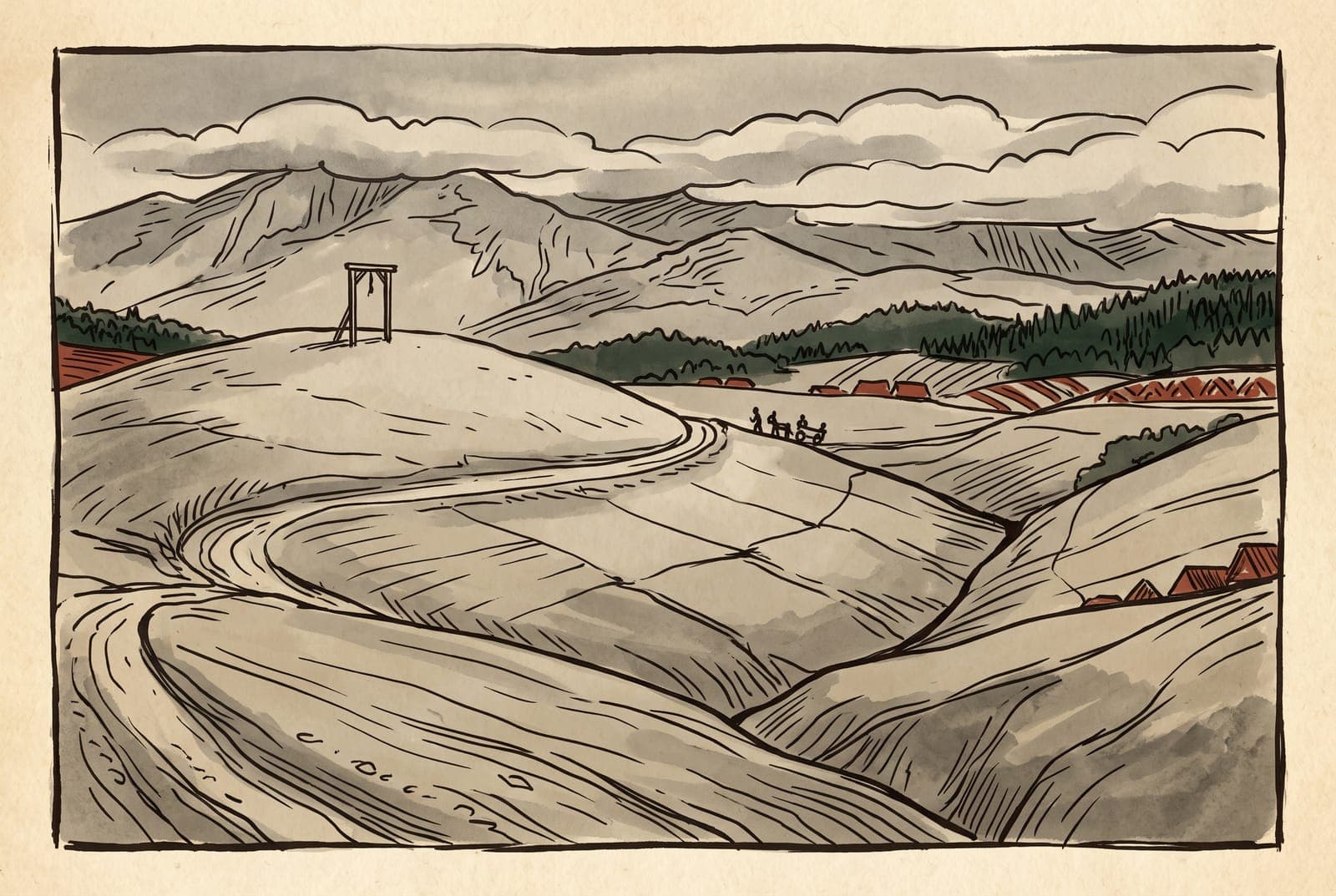
Other outlaws: portraits with dates
Jánošík was neither the first nor the last. The following men can be traced in the records or in serious scholarship – and their dates dispel more than one legend.
Tomáš Uhorčík of Predmier (now part of Turzovka) was already robbing around 1704, according to Mrva2. Jánošík guarded him as a soldier at Bytča and joined his band in 1711; Uhorčík then settled in Klenovec under the name “Martin Mravec”65. “Martin Mravec” is therefore not a separate outlaw but Uhorčík’s alias5. He was broken on the wheel in 17136.
Ján Kružnica was active in Lower Liptov from 1710 to 1713 – exactly in Jánošík’s time – and ended on the gallows1. Peter Štefančík led a band of at least three men in Upper Liptov around 1700; the prosecution demanded the hook or quartering, but the court reduced the sentence to the rope1.
Ondráš of Janovice (Ondřej Fuciman), born on 13 November 1680, robbed in the Silesian Beskids from 1711 to 1715. In 1715 he was killed by his comrade Juráš (Jiří Fuciman), who was executed at Těšín on 17 April 17178. The very headline of an article in the Czech Deník sums up current knowledge: Ondráš did not kill, but he was no protector of the poor either8.
Jakub Surovec, born in 1715 at Tisovec, robbed in 1739–1740 in the upper Hron valley (Horehronie), Gemer, Liptov, Orava and Poland. Captured on 16 September 1740, he was broken on the wheel at Brezno on 10 November 17407. His band robbed the church at Valaská, a dyer at Slanica and the toll house at Mýtna3.
Oleksa Dovbush (1700 – 24 August 1745) led the opryshky in the Hutsul Carpathians of the Polish–Lithuanian Commonwealth, chiefly in 1738–1745, until he was shot by Stepan Dzvinchuk9. In Ukraine he is a folk hero much as Jánošík is in Slovakia9.
“Ilčík” is sometimes placed close to Jánošík, but he lived some 70 years earlier: Ilja Jašek of Dubňany in Moravia was hanged near Hodonín in 164210. He cannot have been a member of Jánošík’s band.
Michal Vdovec (also Vdovčík), the “Jánošík of Gemer”, was baptised on 28 February 1803 and hanged at the end of December 1832112. He shows that individual outlaws still appeared well into the 19th century – long after the phenomenon had peaked.
Hobsbawm and the “noble robber”
In 1959 the British historian Eric Hobsbawm coined the term social bandit in Primitive Rebels, and developed it in his 1969 book Bandits1213. He meant peasant outlaws whom the lord and the state regard as criminals, but who remain within peasant society and are seen by their people as heroes, champions, avengers and fighters for justice12. Hobsbawm distinguished the noble robber, the avenger and the haiduk; alongside Robin Hood and Diego Corrientes he named Jánošík as a model case of the noble robber13. His best-known line on him: “Nobody who is insignificant has several hundred songs made about him, like Janošik”14.
Legend The robber who takes from the rich and gives to the poor is, for Hobsbawm, the defining trait of the “noble robber”13. In Jánošík’s case the image does not come from the records but from later folk tradition and literature4.
Where Jánošík fits: he was a village son, not an outsider, and Terchová demonstrably gave outlaws food and shelter5. His fame, the songs and the legends make him exactly the kind of figure whose afterlife Hobsbawm describes14.
Where he does not: the records show an ordinary band. It robbed merchants of wine, held up a pastor’s wife on a raft and slaughtered the shepherds’ sheep – the very small people it was supposedly helping1. Floreková finds no targeted fight against the lords in the trials3, and Uličný regards the outlaws simply as criminals4. Hobsbawm’s model is itself contested; Anton Blok challenged it as early as 197214, and further objections are summarised in the scholarship on social banditry12. For the Carpathians there is also Mrva’s finding that nobles protected bandits and shared their loot2 – the opposite of a fight against the lords.
Hobsbawm’s concept, then, explains well how a robber became a hero – but hardly who the outlaws really were. For that question, the court records of Liptov and Orava remain the most reliable source.
Frequently asked questions
What does “zbojník” mean?
A zbojník is an outlaw who lived with a band in the mountains and forests and robbed travellers, merchants and manors. Hungarian law called such men praedones. The phenomenon peaked in the Carpathians from the 16th century until roughly the middle of the 18th.42
Who became an outlaw in the 18th century?
Mostly shepherds – shepherd lads and head shepherds – followed by farmhands and some former soldiers. Most were aged 20 to 40 and came from Liptov, Orava, Kysuce and neighbouring regions, but also from Poland and Moravia.1
How big was a Carpathian outlaw band?
Small bands had about three members, large ones about ten or more. The largest documented Orava band, Portašik’s of 1688, had about 25 men.13
How were outlaws punished?
The Tripartitum of 1517 prescribed the stake or the wheel for robbers. In the 18th century the Liptov courts used hanging, hanging on a hook, beheading and breaking on the wheel; the body was often displayed on a wheel as a deterrent.41
Was Jánošík a social bandit in Hobsbawm’s sense?
Hobsbawm cited him as a model “noble robber”. The court records, however, show no sharing of loot with the poor and no targeted fight against the lords. He fits Hobsbawm’s model through his posthumous fame rather than through his deeds.1334
Was Ilčík one of Jánošík’s companions?
No. The Moravian outlaw Ilčík, whose real name was Ilja Jašek of Dubňany, was hanged near Hodonín as early as 1642 – some 70 years before Jánošík became an outlaw.10
Sources
- Organizácia a fungovanie zbojníckych bánd na území Liptova v 18. storočí (in: Zbojníctvo na Slovensku, S. 73–83) – Miroslav Nemec; Nemec, M. – Vítek, P. (eds.), Spolok Slovákov v Poľsku (2014) [sk]
- Zbojníctvo v zrkadle uhorských zákonov a kráľovských nariadení (in: Zbojníctvo na Slovensku, S. 19–33) – Ivan Mrva; Nemec, M. – Vítek, P. (eds.), Spolok Slovákov v Poľsku (2014) [sk]
- Zbojnícke procesy v súdnej praxi Oravskej stolice (in: Zbojníctvo na Slovensku, S. 84–96) – Iveta Floreková; Nemec, M. – Vítek, P. (eds.), Spolok Slovákov v Poľsku (2014) [sk]
- Zbojníctvo ako trestný sociálny jav (in: Zbojníctvo na Slovensku, S. 9–18) – Ferdinand Uličný; Nemec, M. – Vítek, P. (eds.), Spolok Slovákov v Poľsku (2014) [sk]
- Jánošík – pramene a literatúra (in: Zbojníctvo na Slovensku, S. 138–146) – Peter Vítek; Nemec, M. – Vítek, P. (eds.), Spolok Slovákov v Poľsku (2014) [sk]
- Bol Jánošík väznený v kaštieli Vranovo? (Historický časopis 70/1, S. 143–152) – Miroslav Nemec, Historický ústav SAV (2022) [sk]
- Jakub Surovec – Wikipédia (sk) [sk]
- Zbojník Ondráš nezabíjel, ale ochráncem chudých nebyl – Deník.cz [cs]
- Oleksa Dovbush – Wikipedia (en)
- Ilčík – Wikipédia (sk) [sk]
- Lepšie je zbojníkovu lebku mať ako živého zbojníka si chovať – MajGemer.sk [sk]
- Social banditry – Wikipedia (en)
- Bandits (book) – Wikipedia (en)
- Social Banditry and Nation-Making: The Myth of a Lithuanian Robber (Past & Present 198, S. 111–145) – Tomas Balkelis (2008)
Transparency notice (Art. 50 EU AI Act): research and text were produced with the help of an AI language model and editorially checked against the sources listed. Illustrations are AI-generated and are not historical depictions.
This article is also available in Deutsch, Slovenčina
More on Janosik.de
Jánošík – Legend and Truth: How a Robber Became a National Hero
The historical Juraj Jánošík was the captain of a small outlaw band, sentenced in Liptovský Mikuláš in 1713. The folk hero who robbed the rich to give to the poor was made by songs, poets and ideologies – traced here motif by motif.
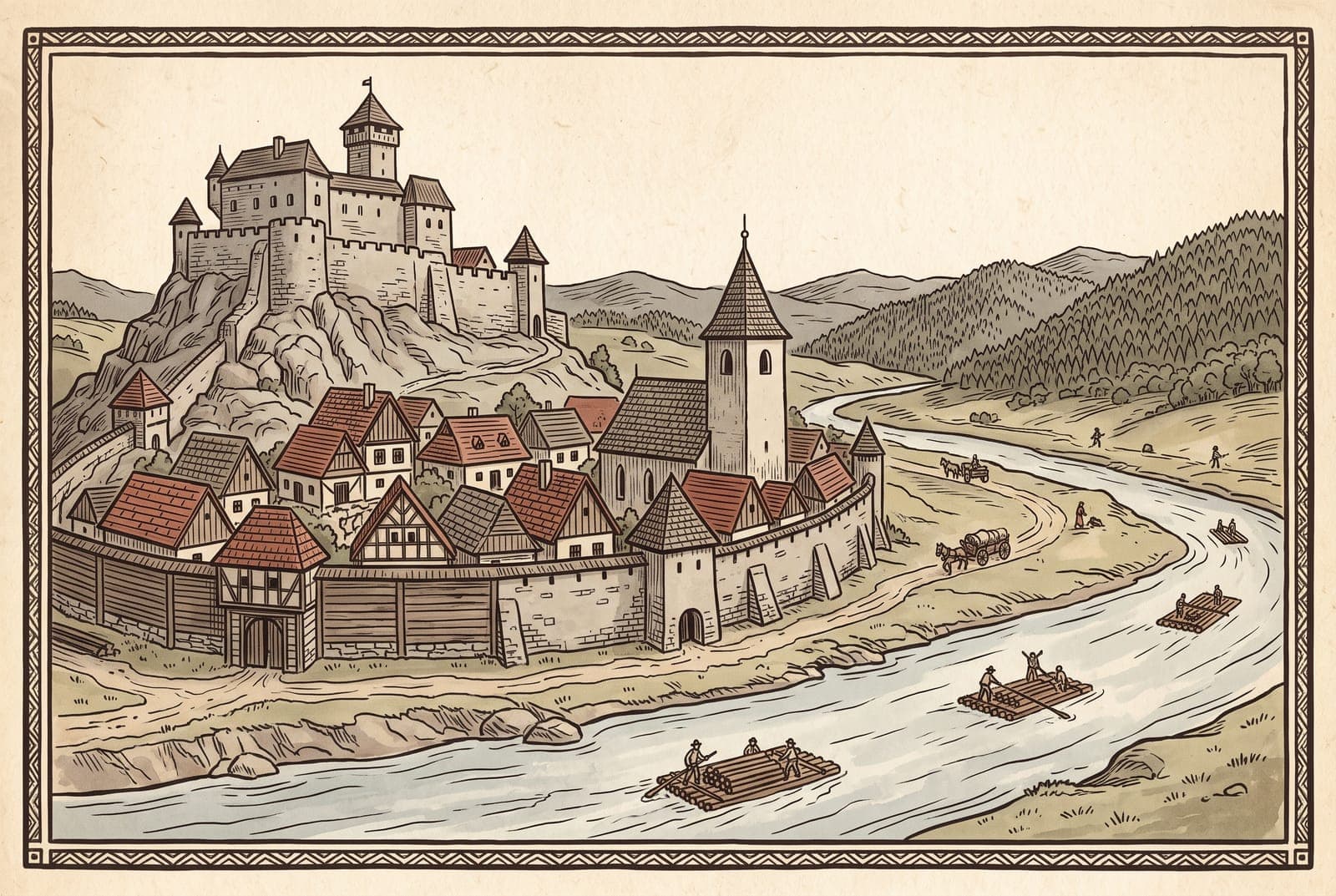
Upper Hungary around 1700 – war, plague and law in Jánošík’s world
The Ottoman wars, Rákóczi’s uprising, the plague of 1709–1714 and a criminal law of wheel and hook – this was the world in which Juraj Jánošík became a soldier, a guard and an outlaw.
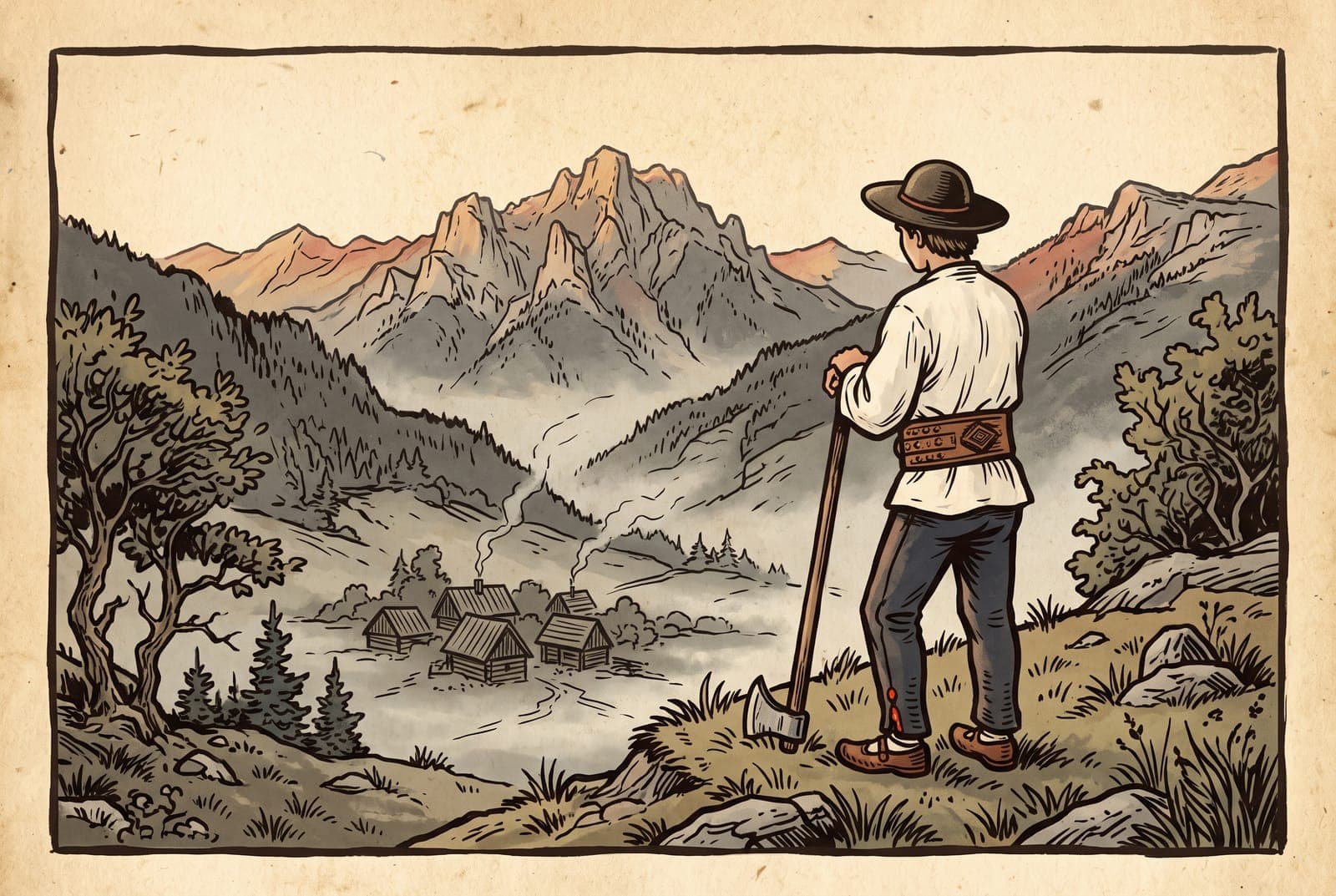
Juraj Jánošík: Life, Trial and Legend of Slovakia's National Hero
A serf's son from Terchová, a soldier in two armies, an outlaw captain for little more than a year – and, after his execution in 1713, Slovakia's most famous hero. What the records really say about Juraj Jánošík.