

Jánošík in Film, Literature and Music: from Folk Song to Screen
Since 1785 the highwayman from Terchová has been printed, versified, filmed and set to music. A journey through 240 years of reception – from a newspaper anecdote to a screen epic, from a banknote to a parody.
Juraj Jánošík (1688–1713) became famous above all through art: the oldest known printed mention of him is an anecdote of 1785, Ján Botto's romance Smrť Jánošíkova (1862) turned him into a symbol of national freedom, and since the first Slovak feature film in 1921 he has been a screen hero. Each era has painted him differently – from damned sinner to freedom fighter to “hero of the anti-feudal struggle”.126
The records on the historical man are sparse. The court of Liptov County tried him on 16 and 17 March 1713 in Liptovský Mikuláš and sentenced him to be hanged from an iron hook through the ribs.3 Everything else – the magic shirt, the belt, the peas under his feet, the dance beneath the gallows, the loot for the poor – was added by folk song, poetry and, later, film and stage. This article traces how that happened.
From newspaper anecdote to broadside ballad: the beginnings
The legend grew in layers. Bandit songs about Jánošík were probably sung as early as the first half or middle of the 18th century; the Encyclopaedia Beliana of the Slovak Academy of Sciences says the tradition arose “relatively shortly after his death”.12 The literary historian Ján Vilikovský found a manuscript in the Tranoscius library in Liptovský Mikuláš containing three semi-folk broadside songs, among them Píseň o Jánošíkovi, zbojníkovi (“Song of Jánošík, the Highwayman”). He dated it to around 1761–1778; other accounts give the 1780s and 1790s.23 Even this song knows two motifs that survive in cinema to this day: betrayal by his closest friend, and the old woman who scatters peas under the robber's feet.4
Jánošík first appeared in print in May 1785. The Banská Bystrica newspaper Staré noviny literního umění carried the anecdote Znamenitá kázeň jednoho kazatele za dnů hlavního zbojníka Jánošíka (“A Remarkable Sermon by a Preacher in the Days of the Robber Captain Jánošík”). In it, robbers waylay a preacher in Liptov, and the text draws a parallel with Christ and with Judas's betrayal. Scholars attribute it to Augustín Doležal.23
In 1809 Bohuslav Tablic printed the song “Jánošík, loupežník liptovský” in Slovenští veršovci and added something found in no court record: Jánošík as a benefactor of poor students. “Nuzným dobře činil, zvlášte pilným žakúm, / dával jim na šaty soukna…” – “He did good to the needy, especially to diligent pupils, / he gave them cloth for clothes…”2 In 1814 Pavol Jozef Šafárik called him a brave robber who takes from the rich and gives to the poor.4 And in 1832–1833 Gašpar Fejérpataky-Belopotocký published in his Vlastenský kalendár the first detailed account based on the trial records.3
Not every poet celebrated him. In 1832 Ján Kollár, in sonnets 572–573 of his cycle Slávy dcera, placed Jánošík in hell, condemned to dance for ever to the bagpipes – a moralising counter-image.4
The Štúr generation: Jánošík as a symbol of freedom
From the 1840s to the 1860s the Romantic poets around Ľudovít Štúr made the robber a parable of freedom and, after 1848, of national liberation – with messianic overtones.14 Between 1844 and 1847 Janko Kráľ wrote poems that critics later gathered under the title Výlomky z Jánošíka (“Fragments from Jánošík”).14 Kráľ also had a very tangible link to the historical case: he helped copy the trial record. The copy was certified on 15 September 1844 and is now kept in the Slovak National Museum in Martin; the original has not survived.3
Samo Chalupka wrote “Jánošíkova naumka” in 1846, later known as Likavský väzeň (Beliana dates this version to 1860), and “Kráľohoľská” in 1868.14 In the same year, 1846, Ján Botto began Pieseň Jánošíkova.4
Botto's Smrť Jánošíkova (1862)
The central work was written between 1848 and 1858 and appeared in 1862 in the almanac Lipa: Ján Botto's Smrť Jánošíkova (“The Death of Jánošík”), a romance in an introduction and nine songs, reissued in 1880.14 Its opening is perhaps the best-known verse about Jánošík:
“Horí, ohník, horí, na Kráľovej holi, / ktože ho navatril? Dvanásti sokoli.” – “A fire is burning on Kráľova hoľa, / who has kindled it? Twelve falcons.”4
The twelve falcons are the twelve men of the band – a fairy-tale number, not a historical roll of members. Botto also takes up the folk motif that Jánošík's strength lies in his belt and that only a blow there can overcome him.2
Jonáš Záborský put the formula of the good robber bluntly in his play Jánošíkova večera: “Jánošíka, dobrého zbojníka, / ktorý panov lúpi, biednym dáva” – “Jánošík, the good robber, / who robs the lords and gives to the poor”.2
Prague, Zakopane, Chicago: Jánošík beyond the borders
In the 19th century the figure travelled into neighbouring literatures. In 1894 Alois Jirásek included “O Janošíkovi” in his Staré pověsti české (Old Czech Legends) and wrote that Jánošík would return when things were at their worst for the Slovaks.4 In the same year Gustáv Maršall-Petrovský published a novel in the USA about the “captain of the mountain lads”, which later served as a source for the first film.46
Jiří Mahen opened the way to the big stage. His five-act tragedy Jánošík premiered in 1910 at the National Theatre in Prague, with Eduard Vojan in the title role. Mahen introduced the literary motif of the pardon that arrives too late (“milost přišla pozdě”); Martin Rázus translated the play into Slovak, and it was staged in Slovakia in 1925.4 In Poland, Kazimierz Przerwa-Tetmajer naturalised the robber in his cycle Legenda Tatr: Maryna z Hrubego (1910) was followed by Janosik Nędza Litmanowski (1911).5
Novels, parodies, demythologising: the 20th and 21st centuries
Ján Hrušovský first published his novel Jánošík in 1933–1934 as a newspaper serial.4 Mária Rázusová-Martáková wrote, with Ján Marták, a five-act verse play that premiered in 1941 and was printed in 1943; her children's book Rozprávky o Jánošíkovi followed in 1955.14 Vlastimil Milota based his documentary novel Ja musím byť zbojník (1964) on the court records.4
From the 1970s the tone turned ironic. Ľubomír Feldek's satirical play Jánošík podľa Vivaldiho (“Jánošík after Vivaldi”) premiered in Košice in 1979.14 Margita Figuli responded in 1980 with Balada o Jurovi Jánošíkovi.4 Milan Ferko produced a three-volume historical novel.34 The most recent major attempt came in 2019 from Mariana Čengel Solčanská, with a novel that deliberately dismantles the myth.3
| Year | Author | Work | Genre |
|---|---|---|---|
| 1785 | anonymous (attr. Augustín Doležal) | Znamenitá kázeň jednoho kazatele… | anecdote, oldest printed mention23 |
| 1809 | Bohuslav Tablic (ed.) | “Jánošík, loupežník liptovský” | broadside song2 |
| 1832 | Ján Kollár | Slávy dcera, sonnets 572–573 | sonnet cycle, counter-image4 |
| 1844–47 | Janko Kráľ | Výlomky z Jánošíka | poems14 |
| 1846 | Samo Chalupka | “Jánošíkova naumka” (Likavský väzeň) | poem14 |
| 1862 | Ján Botto | Smrť Jánošíkova | romance, key text14 |
| 1867 or 1870 | Jonáš Záborský | Jánošíkova večera | play2 |
| 1894 | Alois Jirásek | “O Janošíkovi” | Czech legend4 |
| 1910 | Jiří Mahen | Jánošík | tragedy, National Theatre Prague4 |
| 1910/1911 | Kazimierz Przerwa-Tetmajer | Legenda Tatr | Polish novels5 |
| 1933–34 | Ján Hrušovský | Jánošík | novel4 |
| 1941/1943 | Mária Rázusová-Martáková | Jánošík | verse play14 |
| 1970 | Stanislav Štepka | Jááánošííík | parody4 |
| 1978 or 1987 | Milan Ferko | Jánošík | novel in three volumes34 |
| 1979 | Ľubomír Feldek | Jánošík podľa Vivaldiho | satire14 |
| 2019 | Mariana Čengel Solčanská | Jánošík | demythologising novel3 |
Disputed Several dates in Jánošík literature conflict between sources. Záborský's Jánošíkova večera is dated 1867 or 1870, Pavel Beblavý's serialised novel Jánošík 1889 (Slovenské pohľady) or 1910, and Milan Ferko's novel 1978 or 1987 – possibly first and later editions. We therefore give both dates.234
Film and television: Jánošík on screen
1921: the first Slovak feature film
The film regarded as the first Slovak feature film was made with American money. The Tatra Film Corporation, founded by Slovak emigrants in Chicago, financed Jánošík with about 14,500 US dollars; Jaroslav “Jerry” Siakeľ directed, his brother Daniel was behind the camera and Theodor Pištěk played the title role. It was shot near Blatnica in the Veľká Fatra mountains. Premieres: Prague on 25 November 1921, Chicago/Cicero on 1 December 1921, Žilina on 3 January 1922.16 The screenplay drew on Maršall-Petrovský's novel and Mahen's play.46
Documented The 1921 silent film was long thought lost. In 1970 the producer Ján Závodný brought an almost complete print from Chicago and donated it to the Slovak Film Institute. Ivan Rumanovský reconstructed the film in 1975 and added sound, with music by Jozef Malovec.6
1935: Frič and Bielik
The film that fixed Jánošík's image for generations came from Prague. Martin Frič made Jánošík for the Lloyd company, based on Mahen's play, with Karel Plicka and Karel Hašler among the co-writers. The young Paľo Bielik played the title role. The film was shown at the 4th Venice film festival in 1936 and sold to 32 countries. The execution scene was shot on Oblaz hill above Terchová; the “Terchovské srdce” lookout tower that stands there today recalls the film's gallows in its shape.7 A single source speaks of about ten million viewers in 1936 alone – a figure to be treated with caution.4
Disputed The premiere date of Frič's Jánošík is disputed. Czech Wikipedia gives 17 January 1935; other accounts point to a gala premiere in January 1936, and in 1996 the Slovak post office called it the 1936 film on a stamp. What is certain is that it was produced in 1935.716
Legend In Frič's film Jánošík dances a last dance and throws himself onto the hook.4 The image has settled into many retellings, but it has no basis in the records. Only the sentence is documented – hanging from an iron hook through the ribs.3
1963: Bielik's colour epic
Almost three decades later Paľo Bielik directed the story himself. For the 250th anniversary of Jánošík's death, his two-part Jánošík in colour and widescreen reached cinemas in August 1963, with František Kuchta in the title role. At 8.7 million Kčs it was the most expensive Slovak film up to that time, and about 5 million viewers saw it.8
1974: Janosik in Poland
In Poland Jánošík became a television star. Jerzy Passendorfer's 13-part series Janosik, shot in 1972–1973, was broadcast on TVP's first channel from 26 July to 18 October 1974. Marek Perepeczko played the lead, Tadeusz Kwiatkowski wrote the script and Jerzy Matuszkiewicz the music. A cinema film edited together from several episodes was released as early as April 1974.9
1976 to 2009: animation, opera, a “true story”
Viktor Kubal drew Zbojník Jurko (1976) himself – the first Slovak feature-length animated film, 76 minutes long, with awards including Gottwaldov in 1977 and Bourg-en-Bresse in 1982.10 The peas scene is not missing here either.4 In 1987 a television film of Cikker's opera was made, and in 1991 the 28-part animated series Zbojník Jurošík.3
The most recent major project had a long history. Agnieszka Holland and her daughter Kasia Adamik began a Polish-Slovak-Czech-Hungarian co-production from a screenplay by Eva Borušovičová, with Václav Jiráček as Jánošík. In December 2002 shooting stopped for lack of funds; it resumed only in July 2008 with Polish television, TVP. Janosik. Prawdziwa historia / Jánošík – Pravdivá história premiered on 26 August 2009 in Nowy Sącz (140 minutes); a four-part television version followed in 2011.11 There is no separate Polish feature film of 2002 – 2002 is simply the year the shoot was interrupted.
| Year | Title | Country | Director | Jánošík | Source |
|---|---|---|---|---|---|
| 1921 | Jánošík | Czechoslovakia/USA | Jaroslav Siakeľ | Theodor Pištěk | 6 |
| 1935 | Jánošík | Czechoslovakia | Martin Frič | Paľo Bielik | 7 |
| 1963 | Jánošík I–II | Czechoslovakia | Paľo Bielik | František Kuchta | 8 |
| 1974 | Janosik (TV series, 13 episodes) | Poland | Jerzy Passendorfer | Marek Perepeczko | 9 |
| 1976 | Zbojník Jurko (animated) | Czechoslovakia | Viktor Kubal | – | 10 |
| 1987 | Juro Jánošík (TV opera) | Czechoslovakia | J. Zachar | Ľ. Paulovič | 3 |
| 1991 | Zbojník Jurošík (animated series) | Czechoslovakia | Jaroslav Baran | – | 3 |
| 2009 | Janosik. Prawdziwa historia | PL/SK/CZ/HU | Agnieszka Holland, Kasia Adamik | Václav Jiráček | 11 |
Music and stage
In the beginning was the song. Folk tradition knows lyrical bandit songs, ballads, romances and “novel-like” songs; in them the hero is often called Janko, Janík or Janíčko.1 In folk verse Jánošík smokes three pounds of tobacco on the way to the gallows, dances round the gallows several times and refuses a pardon with the words: “Keď ste si ma upiekli, tak si ma aj zjedzte!” – “Since you have roasted me, eat me too!”2
Art music followed in the 20th century. Ján Levoslav Bella wrote a cantata in 1922, Alexander Moyzes an orchestral prelude in 1934.1 Between 1929 and 1934 the Czech composer Karel Hába wrote the opera Jánošík to a libretto by Antonín Klášterský; it is sometimes wrongly attributed to his brother Alois.12
The most important opera is by Ján Cikker. Juro Jánošík, to a libretto by Štefan Hoza, was explicitly shaped to the expectations of socialist realism; the censoring Theatre and Dramaturgy Council approved the libretto on 5 March 1953. The opera premiered on 10 November 1954 at the Slovak National Theatre in Bratislava.2 In 1987 it was filmed for television.3
Na skle maľované (“Painted on Glass”) sounds quite different: a musical by the Polish composer Katarzyna Gärtner to a text by Ernest Bryll. The Polish original of 1970 reached almost 600 performances. The Slovak version premiered at the Slovak National Theatre on 19 October 1974, directed by Karol L. Zachar, with Michal Dočolomanský as Jánošík. By its final performance in 2004 it had been played 648 times (another count gives 647).132 In the historians' judgement, the production had virtually no propaganda effect.2
The least reverent take came from Stanislav Štepka: the Radošinské naivné divadlo staged his parody Jááánošííík in 1970.4
Politics, money and stamps
Jánošík has always been a banner too. Between the wars Štefan Krčméry celebrated 1918 in his Jánošíkovská, while Martin Rázus criticised the republic in Jánošík's name in Zbojnícka.4
The Slovak State (1939–1945) gave him only modest space, as a symbol of the lowest classes rather than of the nation; he appears in Hrušovský's school textbook of 1942.2 Even so, the 500-koruna note with Jánošík, with the High Tatras on the reverse, was issued in July 1941.14 On 15 November 1944 the regime paper Náš boj used his image to call men into the Hlinka Guard's emergency units.2 At the same time the regime's opponents claimed him: “Jánošík groups” formed from 1942, the underground magazine Jánošík – časopis slovenského protifašistického frontu appeared from December 1943 to July 1944, and a partisan brigade bore his name.2
After 1945 the communist regime gave him a Marxist reading. Andrej Melicherčík's Jánošíkovská tradícia na Slovensku (1952) and Juraj Jánošík, hrdina protifeudálneho odboja slovenského ľudu (1956) read the tradition as class struggle; the 1954 history textbook called the bandits “avengers of the enslaved people”.2 From the 1960s the ideological charge faded.2
Philately followed the anniversaries. In 1963, the 250th anniversary of his death, Czechoslovakia issued the first securely documented Jánošík stamp, designed by Martin Benka; “Jánošík a hôrni chlapci” after Karol Svolinský followed in 1971, and a Polish stamp in a series of Polish legends in 1986. On 5 May 1996 Slovakia marked the centenary of cinema with a stamp showing frames from Frič's film.16 For the 300th anniversary of his birth, the Kremnica mint struck a silver 50 Kčs coin in 1988 (Ag 500/1000, 7 g), designed by Ján Kulich.15
Why every era reinvents Jánošík
Precisely because the established facts are so thin, Jánošík offers an almost blank surface: a young man from Terchová, little more than a year as a robber, a two-day trial, a cruel sentence.3 Every age could write in the rest for itself.
For the preacher of 1785 he was the backdrop to a moral tale; for Kollár he was one of the damned. The Štúr generation saw in him the sleeping strength of the nation, and Botto gave him the verses still quoted today.14 The Slovak State printed him on money, the partisans carried his name underground, the communists made him a class warrior – three irreconcilable readings in less than ten years.214 From 1970 people were allowed to laugh at him, and the 2009 film promised a “true story” in its title, which Mariana Čengel Solčanská tried once more to tell against the myth in 2019.3411
The constants remain: the belt, the valaška, the twelve companions, the dance at the gallows, the loot for the poor. They come from fairy tale, folk song and Romantic poetry, not from the records.24 Anyone who meets Jánošík in film, literature or music therefore always meets two figures at once – the robber condemned in 1713, and the mirror each generation holds up to itself.
Frequently asked questions
What is the most important literary work about Jánošík?
Ján Botto's romance Smrť Jánošíkova (“The Death of Jánošík”) is regarded as the key text. Written in 1848–1858 and published in 1862 in the almanac Lipa, it consists of an introduction and nine songs and made Jánošík a symbol of national freedom.14
When was the first Jánošík film made?
In 1921. Jánošík by the Siakeľ brothers, financed by the Tatra Film Corporation in Chicago and shot near Blatnica, is regarded as the first Slovak feature film. It premiered in Prague on 25 November 1921.16
Who has played Jánošík on screen?
Theodor Pištěk in the 1921 silent film, Paľo Bielik for Martin Frič (1935), František Kuchta in Bielik's own 1963 film, Marek Perepeczko in the 1974 Polish TV series and Václav Jiráček for Agnieszka Holland and Kasia Adamik (2009).678911
Is there an opera about Jánošík?
Yes, more than one. Karel Hába composed the opera Jánošík in 1929–1934, and Ján Cikker's Juro Jánošík premiered at the Slovak National Theatre on 10 November 1954. There is also the musical Na skle maľované, which ran in Bratislava from 1974 to 2004.12213
Was Jánošík ever on banknotes or coins?
Yes. The Slovak State issued a 500-koruna note with Jánošík in July 1941. For the 300th anniversary of his birth in 1988, Czechoslovakia struck a silver 50 Kčs coin designed by Ján Kulich.1415
Does the dance beneath the gallows come from the records?
No. The dance round the gallows and the defiant line “Keď ste si ma upiekli, tak si ma aj zjedzte!” come from folk verse; in Frič's 1935 film Jánošík even throws himself onto the hook. Only the sentence to hang him from a hook through the ribs is documented.234
Sources
- jánošíkovská tradícia – Encyclopaedia Beliana, Encyklopedický ústav SAV (2013) [sk]
- Zbojníctvo na Slovensku (zborník; o. i. P. Račko: Zbojníctvo v slovenskej umeleckej literatúre 18.–19. storočia; A. Hruboň – J. Krištofík: Medzi dobrým úmyslom a zneužitím. Jánošíkovská tradícia na Slovensku v rokoch 1938–1989) – M. Nemec – P. Vítek (eds.), Spolok Slovákov v Poľsku (2014) [sk]
- Juraj Jánošík – Wikipédia (sk) (2026) [sk]
- Jánošíkovská legenda na Slovensku (bakalářská práce) – Jana Hrajnohová, Univerzita Karlova (2010) [cs]
- Kazimierz Przerwa-Tetmajer. Piewca piękna Tatr – Urząd Miasta Zakopane [pl]
- Film Jánošík z roku 1921 patril medzi najpremietanejšie svetové diela – TASR / teraz.sk [sk]
- Jánošík (film, 1935) – Wikipedie (cs) (2026) [cs]
- Rok 1963: V Bratislave mal premiéru film Paľa Bielika Jánošík – vtedy.sk (TASR) [sk]
- Janosik (serial telewizyjny) – Wikipedia (pl) (2026) [pl]
- Zbojník Jurko – Wikipédia (sk) (2026) [sk]
- Janosik. Prawdziwa historia – Wikipedia (pl) (2026) [pl]
- Karel Hába – Wikipedie (cs) (2026) [cs]
- Muzikál Na skle maľované mal premiéru pred 40 rokmi – TASR / teraz.sk (2014) [sk]
- Koruna slovenská (1939–1945) – Wikipedie (cs), podle Bajer: Papírová platidla Československa (1999) (2026) [cs]
- 50 Kčs/1988 – Juraj Jánošík – 300. výročie narodenia – numizmatik.eu [sk]
- Juraj Jánošík – Alegória slovenského národa na poštových známkach – Infofila.cz [sk]
Transparency notice (Art. 50 EU AI Act): research and text were produced with the help of an AI language model and editorially checked against the sources listed. Illustrations are AI-generated and are not historical depictions.
This article is also available in Deutsch, Slovenčina
More on Janosik.de
Jánošík – Legend and Truth: How a Robber Became a National Hero
The historical Juraj Jánošík was the captain of a small outlaw band, sentenced in Liptovský Mikuláš in 1713. The folk hero who robbed the rich to give to the poor was made by songs, poets and ideologies – traced here motif by motif.
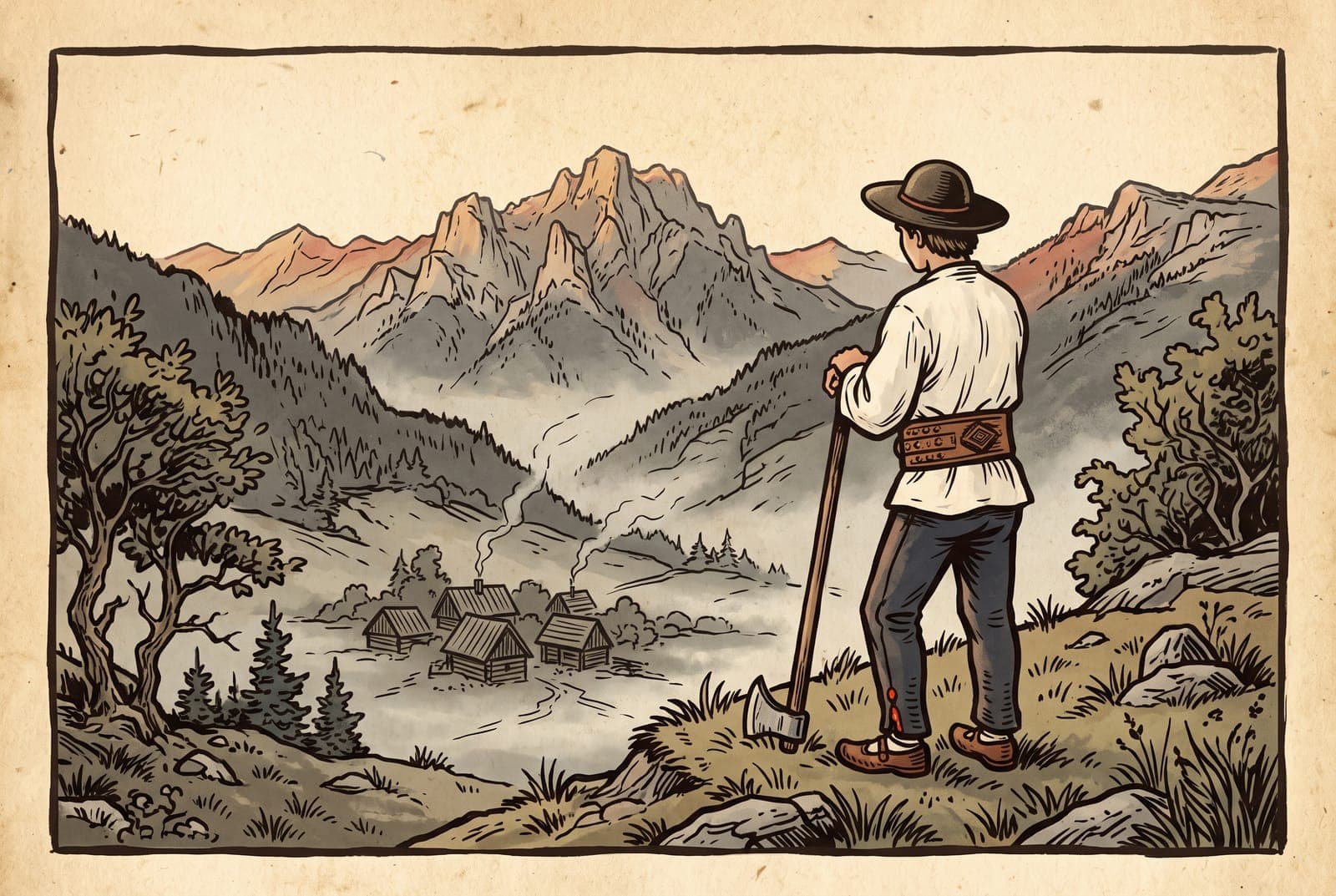
Juraj Jánošík: Life, Trial and Legend of Slovakia's National Hero
A serf's son from Terchová, a soldier in two armies, an outlaw captain for little more than a year – and, after his execution in 1713, Slovakia's most famous hero. What the records really say about Juraj Jánošík.
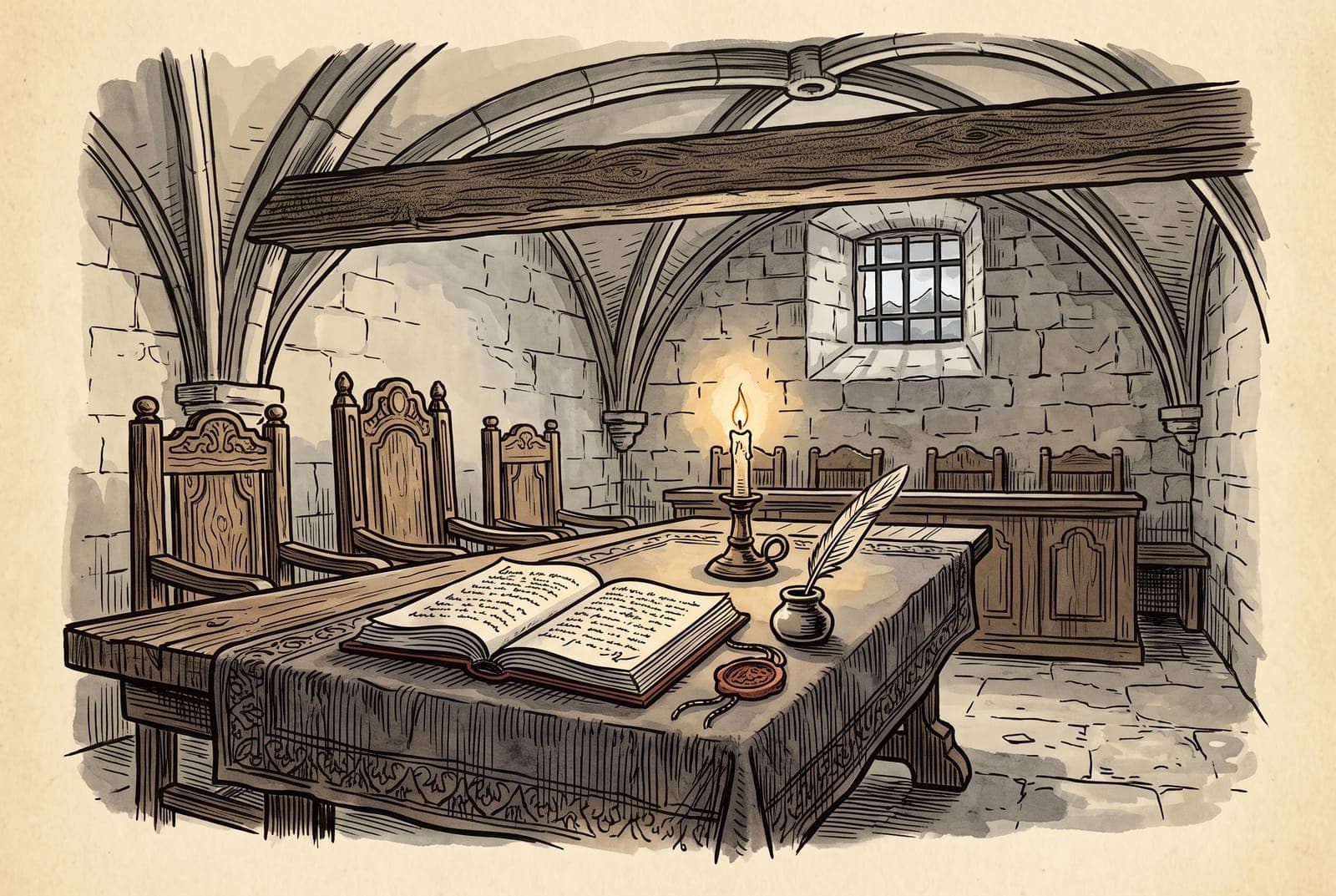
Trial and Execution 1713 – Jánošík Before the Liptov County Court
Two days in March 1713 decided the fate of Juraj Jánošík. The Liptov County protocol survives – and tells a soberer story than the songs.