

In Jánošík’s Footsteps: From Terchová to Liptovský Mikuláš
From the baptismal parish of Varín to the courtroom in Liptovský Mikuláš: a route through the places of Jánošík’s life and legend, with coordinates and a clear line between record and folklore.
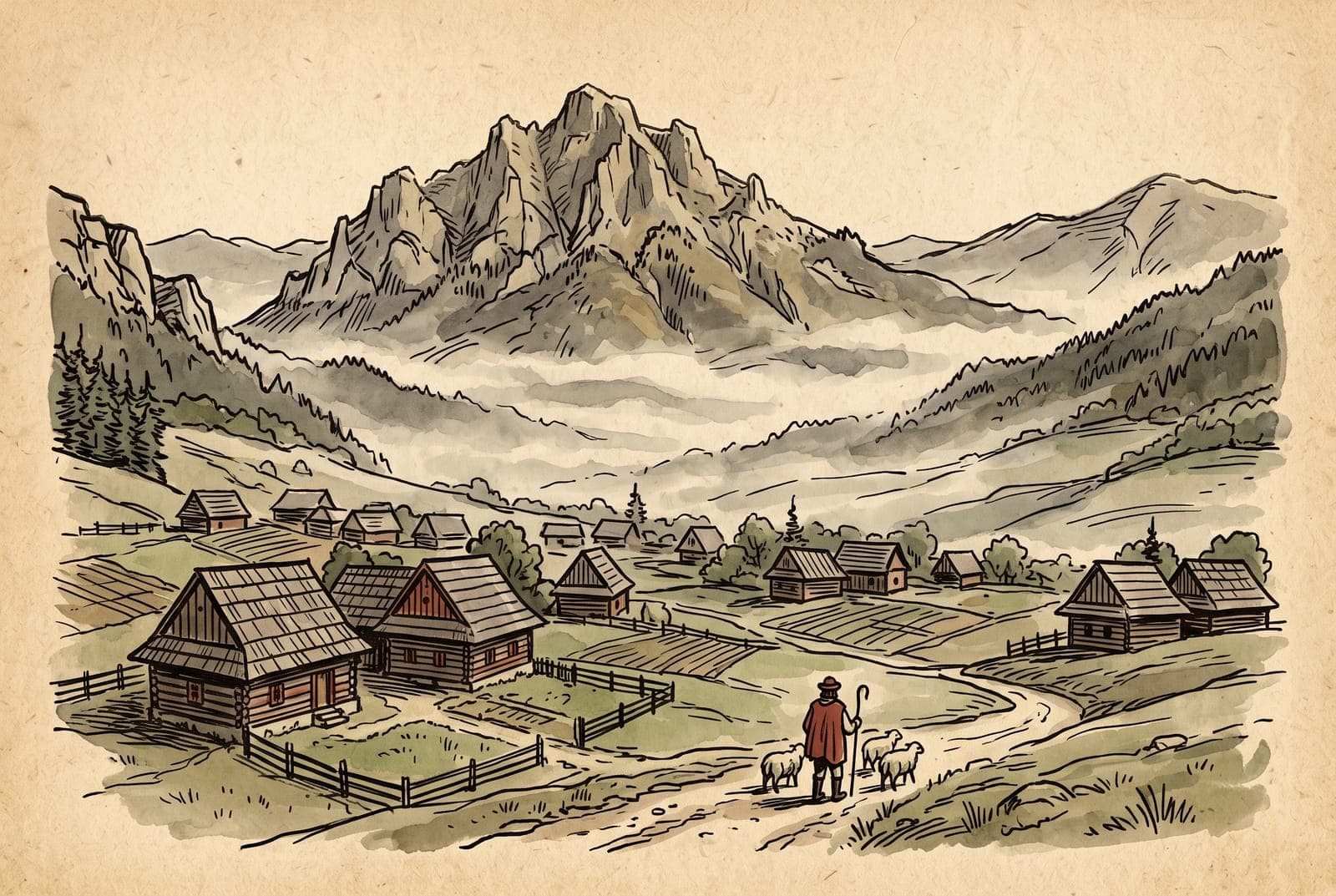
Where can you follow Juraj Jánošík today? The documented stations of his short life lie in north-western and central Slovakia: baptised in the parish of Varín, at home in Terchová, a guard at the chateau in Bytča, raids below Strečno, arrests in Klenovec and Hrachovo, and a trial in March 1713 in Liptovský Mikuláš12. To these come places shaped only later by legend and memory: the steel statue above Terchová, the Jánošíkove dni festival and the Jánošíkove diery gorge345.
This guide arranges the places as a route, from the mountains around Terchová through the Váh valley to Liptov and south to Malohont. For each place it sets out what the records say, what tradition adds and what you will find there today. We deliberately give no opening hours, admission prices or walking times: they change, and our sources say nothing about them. Please check current information with the municipality, the museum or the local tourist office before any visit.
The route at a glance
Jánošík’s world was the Kingdom of Hungary under the Habsburgs, divided into counties. Terchová belonged to Trenčín County, Klenovec and Hrachovo lay in Malohont County, and the Liptov county court sat in Svätý Mikuláš, today’s Liptovský Mikuláš92. The indictment lists the counties of Trenčín, Nitra, Turiec, Liptov and Orava as the scene of his crimes, and even Silesia1.
For travellers this gives a line in three sections: first the mountains around Terchová with the Vrátna valley; then the Váh valley with Varín, Strečno, Teplička nad Váhom and Bytča, plus a detour to Domaniža; and finally Liptovský Mikuláš in the east and, much further south, Klenovec and Hrachovo. The map shows the sites.
Terchová: the village below the Malá Fatra
Terchová lies in the Krivánska part of the Malá Fatra, whose highest peak is Veľký Kriváň at 1,709 metres10. No date of birth survives for Jánošík, only his baptism. Tradition places his birth in the hamlet of “U Jánošov” below Pupov hill, some four to five kilometres above the village9.
How closely the village was tied to the outlaws is shown by a record, not a tale: on 17 August 1712 the manorial court at Teplička nad Váhom noted that people of Terchová had supported robbers with food and shelter1. At the trial it emerged that Jánošík had given rings stolen from a Žilina goldsmith to girls in Terchová – the only documented “sharing out” of loot9.
Ján Kulich’s statue
Above the village, on a hill towards the Vrátna valley, stands Terchová’s Jánošík monument. The academic sculptor Ján Kulich made the figure from sheet steel; it is 7.5 metres tall. It was unveiled in 1988 during Jánošíkove dni for the 300th anniversary of his birth, in the presence of the culture minister Miroslav Válek3. The statue is a work of late Czechoslovakia, not a portrait: no contemporary likeness of Jánošík exists.
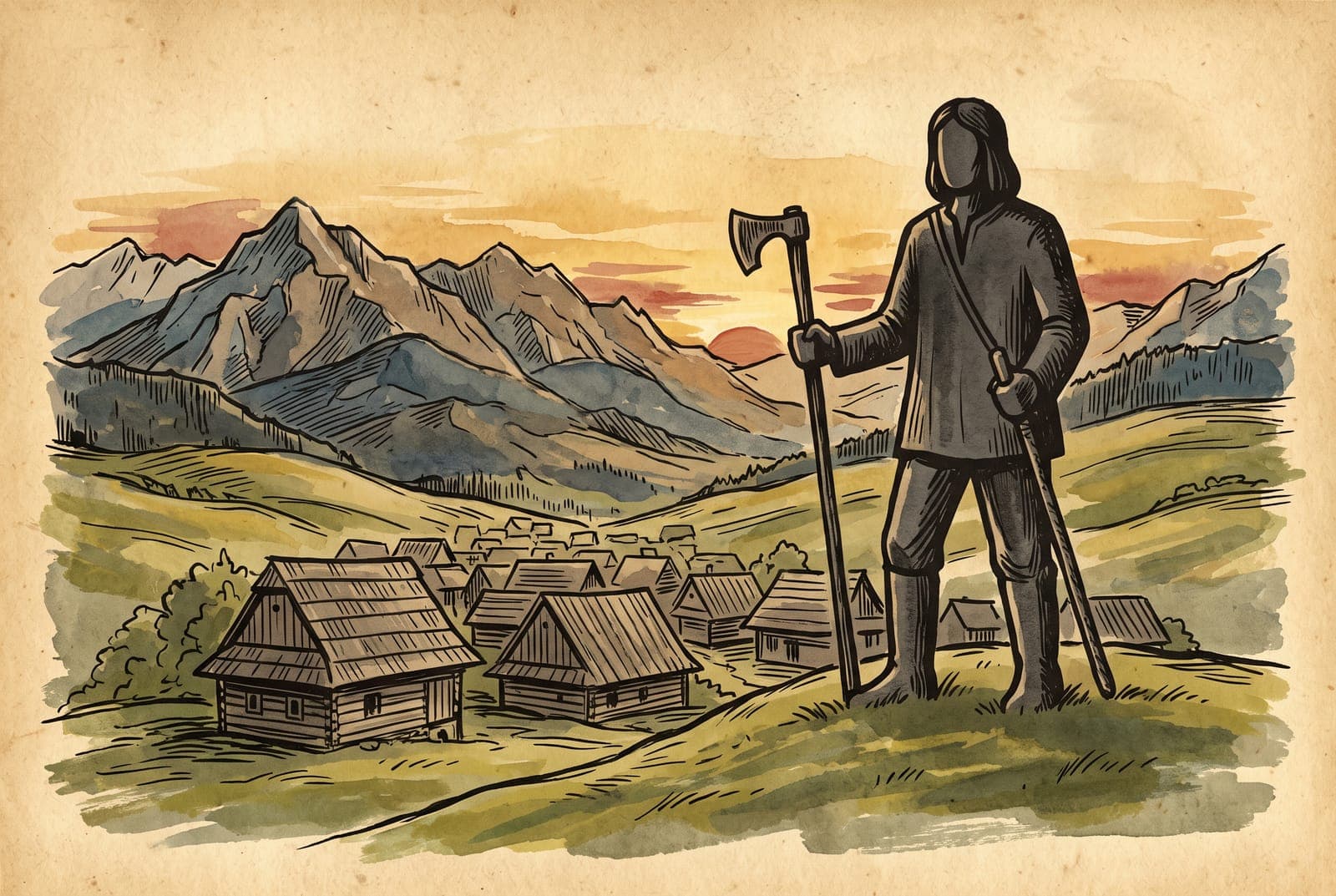
Oblaz and the Terchovské srdce
On Oblaz hill above Terchová, Martin Frič filmed the execution scene of his film Jánošík (1935) with Paľo Bielik. Today the Terchovské srdce (“Heart of Terchová”) lookout tower stands there, its shape recalling the gallows from the film11. The spot therefore commemorates not Jánošík’s death, which took place in Liptov, but the cinema that carried his legend around the world.
Jánošíkove dni: a festival since 1963
After a preliminary event in 1959, the Jánošíkove dni folklore festival was officially held for the first time on 24–25 August 1963, for the 250th anniversary of his death. In 1988 it moved from Vrátna to the Nad bôrami amphitheatre in Terchová, and it has been international since 19914. The organiser’s visitor figures show its growth:
About 18,000 people came in 1963, 20,000 in 1981, 40,000 in 1998 and 50,000 in 2001. The organiser gives the record as 75,000 in 2004; in 2009–2012 attendance was between 60,000 and 75,0004. Dates and programmes change, so please check with the organiser.
Terchovská muzika: the region’s heritage
On 5 December 2013, meeting in Baku, UNESCO inscribed the Terchovská muzika, the musical tradition of Terchová, on the Representative List of the Intangible Cultural Heritage of Humanity12. It has nothing directly to do with Jánošík. It belongs, however, to the region he came from, and anyone visiting Terchová meets the two traditions side by side.
The Vrátna valley and Jánošíkove diery
Right by Terchová lies the Vrátna valley (Vrátna dolina), like the village in the Krivánska part of the Malá Fatra10. East of it, within Terchová’s municipal area, is the gorge system of Jánošíkove diery (“Jánošík’s holes”). It has three sections – Dolné, Nové and Horné diery – with more than twenty waterfalls, and lies in the Rozsutec national nature reserve inside Malá Fatra National Park5. Visitors are in a protected area: please ask the national park administration or the tourist office on site about routes, closures and rules.
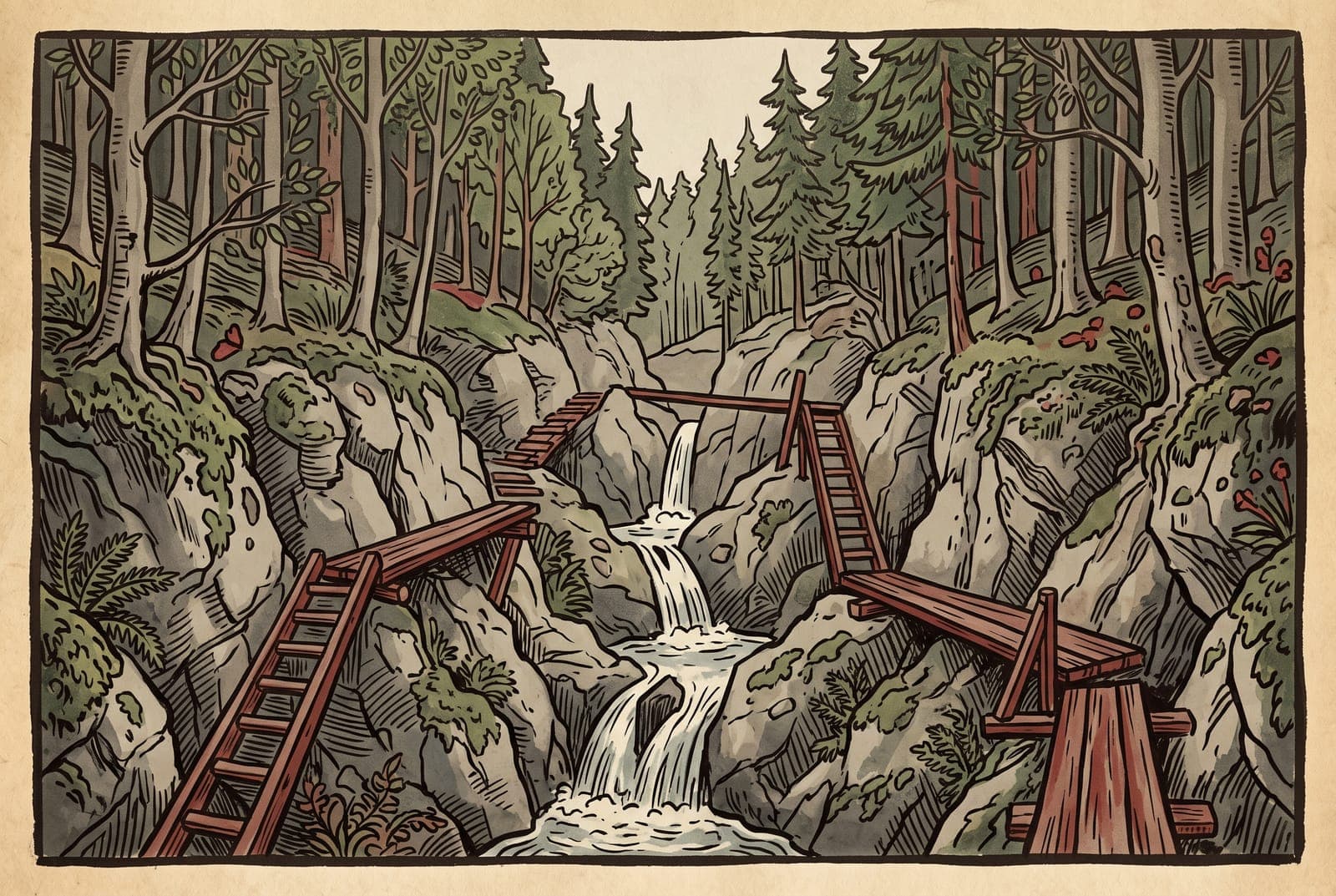
Legend The gorge is named after Jánošík, but only the name is documented5. That he hid here, or stowed loot in the rock crevices and sealed it with a boulder, is told in popular and tourist writing; the records say nothing of it. The trial papers know only one vague hiding place, elsewhere: a beech beside a fir “with a cut hand” on the way from Jablonka to Klenovec, named under torture9.
Varín: the baptismal parish
At the time Terchová belonged to the parish of Varín in the Váh valley. In the Roman Catholic baptismal register of Varín for 1686–1718, page 34 records the baptism of 25 January 1688, performed by the parish priest Michal Smutko1.
Documented The entry reads: “Eadem die baptizavi infantem natum de Martin Janosik et Anna Czisznik cui datum est nomen Georgii. Patrini erant Jacobus Mergad et Barbara Kristofik de Terchova.” – “On the same day I baptised a child born of Martin Jánošík and Anna Czisznik, who was given the name Juraj. The godparents were Jakub Mergad and Barbara Krištofík of Terchová.” The original is held by the State Archive in Žilina, based in Bytča91.
The same register records his siblings, among them his brother Ján, baptised on 19 November 1689. As late as 1715 and 1717 his parents appear in it as godparents1. In Varín, then, you see the parish where the family had its children baptised; the document itself is in the archive.
Strečno: raids at the Váh gorge
East of Žilina, the Váh forces its way through the Strečno gorge, a twelve-kilometre pass guarded by Strečno Castle10. Several raids that came up at the trial took place in this area. On 5 October 1711, near Strečno or Žilina, the band robbed the Žilina merchant Ján Šipoš of cloth and linen; on 10 May 1712 they struck him a second time below Strečno, taking a belt and four zlatý9. Also below Strečno, Jánošík took the fur jacket of a priest travelling on a raft, and horses and gear from Žilina townsmen9.
The loot sounds modest, and that is typical: the record lists cloth, small sums, rings, spoons and weapons. At the trial Jánošík was confronted with Šipoš in person9.
Teplička nad Váhom: the manorial court
Just a few kilometres west of Strečno lies Teplička nad Váhom, seat of the court of the Strečno estate. Its files in the Illésházy family archive (now in the State Archive in Bytča) are among the most important sources on Jánošík’s circle1. They record three dates:
- 17 August 1712: people of Terchová had supported robbers with food and shelter.
- 24 May 1713: Martin Hatala, known as Bartoviech, of Klenovec and Ján Mikulčík of Poland were beheaded after torture for their links with Jánošík and Uhorčík.
- 18 December 1713: Jánošík’s brother Ján was sentenced to death by hanging for helping his brother1.
According to our sources, nothing specific on site recalls these trials; their weight lies in the files.
Bytča: guard duty at the chateau
Bytča is where the story that turned Jánošík into an outlaw began. After service in the insurgent Kuruc army, he served with the imperial forces as a guard at Bytča chateau. The outlaw captain Tomáš Uhorčík was imprisoned there, and Jánošík did him small favours. In 1710 his parents bought him out of the army29. Whether Jánošík helped Uhorčík escape is disputed: some authors say so, others write that it is not known how Uhorčík got free9.
Today Bytča matters to Jánošík research above all as an archive town: the State Archive in Žilina, based in Bytča, holds the Varín register, the Teplička files and the Liptov county protocol with the indictment and the sentence1.
Domaniža: the death of the priest
A detour south leads to Domaniža. The parish priest Juraj Vrtík was shot by two robbers in September 1712 – on the 4th or the 8th – on his way back from Frivald (today Rajecká Lesná), and died on 2 October 1712. The parish death register notes: “a duobus praedonibus traiectus est” – he was shot through by two robbers13.
Jánošík testified that his companions Plavčík of Dunajov and Turiak “Huncaga” had fired. The court nevertheless held him complicit because he was present; it did not find that he had fired himself139. The sentence names this deed explicitly.
Klenovec and Hrachovo: two arrests
Far to the south, in the former Malohont County, Uhorčík had settled in Klenovec under the false name “Martin Mravec”9. Jánošík was caught here twice. In autumn 1712, usually given as October, he was seized together with Uhorčík and both were taken to the manor house at Hrachovo. They were released, helped by the intervention of Malohont’s deputy county head Pavol Láni, and thanked the county gentlemen with fox furs and cheeses914.
Legend Legend has Jánošík escape from Hrachovo. The records speak of his release9. The famous scene in which an old woman scatters peas under his feet at his arrest also belongs to folk poetry1.
The final arrest took place at Uhorčík’s house in Klenovec; the municipality gives early March 1713, other researchers the turn of 1712/13142. Strikingly, the trial records themselves are silent on how and where he was caught, as the historian Ivan Houdek noted as early as 19291.
Liptovský Mikuláš: trial, museum, Šibeničky
At the end of the route stands the town where Jánošík was judged. On 16–17 March 1713 the Liptov county court sat in Svätý Mikuláš. The presiding judge was the deputy county head Ladislav Okolicsányi, the prosecutor Alexander Čemický and the court-appointed defender Baltazár Palugyay. The sentence: to be pierced through the left side with a hook and hung up29.
In 1712 the county had bought and rebuilt the Hanzely house; from 1713 it served as the first county house. Today it houses the Janko Kráľ Museum (Múzeum Janka Kráľa) at Námestie osloboditeľov 302. The town and the museum regard it as the probable site of the trial8. In December 1999 the museum opened an exhibition on Jánošík’s interrogation under torture in the vaulted cellar of the former Strauss House; there is also a courtroom exhibition and a memorial room for the poet Janko Kráľ6. Kráľ helped make the 1844 copy of the interrogation record, whose original is lost; the copy is in the Slovak National Museum in Martin1.
Disputed Exactly where the trial and the execution took place is uncertain. The court may have sat in the old Hanzely house or in the neighbouring Pongrác curia2. The execution date wavers between 17 and 18 March 1713; Miroslav Nemec of the Janko Kráľ Museum says: “Nevieme presne kedy” – “We don’t know exactly when”7. Tradition points to Šibeničky, east of the town; Houdek suggested the toll place on the Váh near the Palúdzka bridge1.
Šibeničky (“the little gallows”), between Okoličné and Vrbica, is today a memorial with a replica gallows on Ulica 1. mája8. The Vranovo manor house in Palúdzka is also often named as Jánošík’s prison. That tradition goes back to a note by the poet Samo Chalupka in 1868; the historian Miroslav Nemec considers it improbable, as a town prison is documented in Svätý Mikuláš from the late 17th century and the county used it for its prisoners2.
Hořice: a monument in Bohemia
The legend left Slovakia early. In Hořice in the Czech Republic stands a statue of Jánošík by František Úprka, dating from 19199. The place has no connection with Jánošík’s life; it belongs to the history of his legend, not to his biography.
All places at a glance
Coordinates are WGS84; for towns and villages they mark the centre, not a specific event site9.
| Place | What happened | What you can see today | Coordinates |
|---|---|---|---|
| Terchová | home village; support for the robbers recorded in 1712 | Kulich statue (1988), Jánošíkove dni festival, Terchovské srdce tower on Oblaz | 49.2556, 19.0333 |
| Hamlet “U Jánošov” | traditional birthplace | hamlet below Pupov | 49.2806, 19.0689 |
| Jánošíkove diery | only the name; the treasure is legend | gorge with three sections and over 20 waterfalls, Rozsutec reserve | 49.2441, 19.0731 |
| Varín | baptism on 25 January 1688 | parish village; register in the State Archive, Bytča | 49.2022, 18.8722 |
| Strečno (castle) | raids “below Strečno”, 1711/12 | castle above the Váh gorge | 49.1769, 18.8628 |
| Teplička nad Váhom | manorial court: records of 1712 and 1713, sentence on his brother Ján | village; files in the State Archive, Bytča | 49.2239, 18.7992 |
| Bytča (chateau) | guard duty; Uhorčík imprisoned | chateau; State Archive holding the records | 49.2203, 18.5592 |
| Domaniža | priest Vrtík fatally wounded, 1712 | parish village; death register in the State Archive, Bytča | 49.0448, 18.5530 |
| Klenovec | arrests in 1712 and 1712/13 | village; our sources name no memorial | 48.5968, 19.8910 |
| Hrachovo | held in autumn 1712, released | manor house (kaštieľ) | 48.4670, 19.9500 |
| Liptovský Mikuláš (museum) | trial, 16–17 March 1713 | Janko Kráľ Museum, interrogation exhibition, courtroom | 49.0837, 19.6121 |
| Šibeničky | traditional execution site | memorial with replica gallows | 49.0772, 19.6419 |
| Hořice (Czech Republic) | no link to his life | statue by František Úprka (1919) | – |
Practical: ask locally
This route is a journey into history, not a timetable. Our sources describe places and events, not opening hours, prices, car parks or walking times. These details change and should be checked just before your visit with the municipality of Terchová, the Janko Kráľ Museum, the Malá Fatra National Park administration or the local tourist office. Anyone wishing to see archival documents such as the baptismal register or the trial protocol should contact the State Archive in Bytča1.
Frequently asked questions
Where was Juraj Jánošík born?
No date of birth survives; what is documented is his baptism on 25 January 1688 in the parish of Varín, to which Terchová belonged. Tradition places his birth in the hamlet of “U Jánošov” below Pupov hill, some four to five kilometres above Terchová.19
How tall is the Jánošík statue in Terchová?
Ján Kulich’s statue is 7.5 metres tall and made of sheet steel. It was unveiled in 1988 during Jánošíkove dni for the 300th anniversary of his birth and stands on a hill above the village towards the Vrátna valley.3
How long has the Jánošíkove dni festival existed?
After a preliminary event in 1959, the festival was officially held for the first time on 24–25 August 1963, for the 250th anniversary of Jánošík’s death. It has been international since 1991, and the organiser gives its record attendance as 75,000 in 2004. Please check current dates with the organiser.4
Did Jánošík hide treasure in Jánošíkove diery?
There is no evidence for it. The gorge is named after him, but the stories of a hideout and of treasure in the rock crevices come from popular tradition. The trial records mention only a vague hiding place by a tree between Jablonka and Klenovec.59
Can you visit the place where Jánošík was tried?
Yes, with a caveat: the Janko Kráľ Museum in Liptovský Mikuláš occupies the first county house, the probable site of the trial of 16–17 March 1713. Since December 1999 it has shown an exhibition on the interrogation and a courtroom. Please check opening hours with the museum.62
Sources
- Zbojníctvo na Slovensku. Zborník z vedeckej konferencie, Liptovský Mikuláš 4. 11. 2013 – Miroslav Nemec – Peter Vítek (eds.), Spolok Slovákov v Poľsku (2014) [sk]
- Bol Jánošík väznený v kaštieli Vranovo? – Miroslav Nemec, Historický časopis 70/1, Historický ústav SAV (2022) [sk]
- Socha Jánošíka – Obec Terchová [sk]
- História festivalu – Jánošíkove dni Terchová [sk]
- Jánošíkove diery – Wikipedie (cs) (2026) [cs]
- Janko Kráľ Museum – Jánošík's Traditions – Visit Liptov
- Liptovský Mikuláš si pripomína 313. výročie rozsudku nad Jánošíkom – TASR / teraz.sk (2026) [sk]
- Jánošíkova mučiareň a súdna sieň – Mesto Liptovský Mikuláš [sk]
- Juraj Jánošík – Wikipédia (sk) (2026) [sk]
- Malá Fatra – Wikipedia (en) (2026)
- Jánošík (film, 1935) – Wikipedie (cs) (2026) [cs]
- Terchovská muzika zapísaná v UNESCO! – Centrum pre tradičnú ľudovú kultúru (ĽUDOVÁ KULTÚRA) (2013) [sk]
- Dvakrát Juraj – Rudolf Šujanský, Farnosť Domaniža [sk]
- Historické osobnosti – Obec Klenovec [sk]
Transparency notice (Art. 50 EU AI Act): research and text were produced with the help of an AI language model and editorially checked against the sources listed. Illustrations are AI-generated and are not historical depictions.
This article is also available in Deutsch, Slovenčina
More on Janosik.de
Juraj Jánošík: Life, Trial and Legend of Slovakia's National Hero
A serf's son from Terchová, a soldier in two armies, an outlaw captain for little more than a year – and, after his execution in 1713, Slovakia's most famous hero. What the records really say about Juraj Jánošík.
Trial and Execution 1713 – Jánošík Before the Liptov County Court
Two days in March 1713 decided the fate of Juraj Jánošík. The Liptov County protocol survives – and tells a soberer story than the songs.
Jánošík’s Outlaw Years 1711–1713: Raids, Band and Loot
Juraj Jánošík was an outlaw for barely eighteen months. What the court records reveal about his oath, raids, loot and helpers – told step by step.